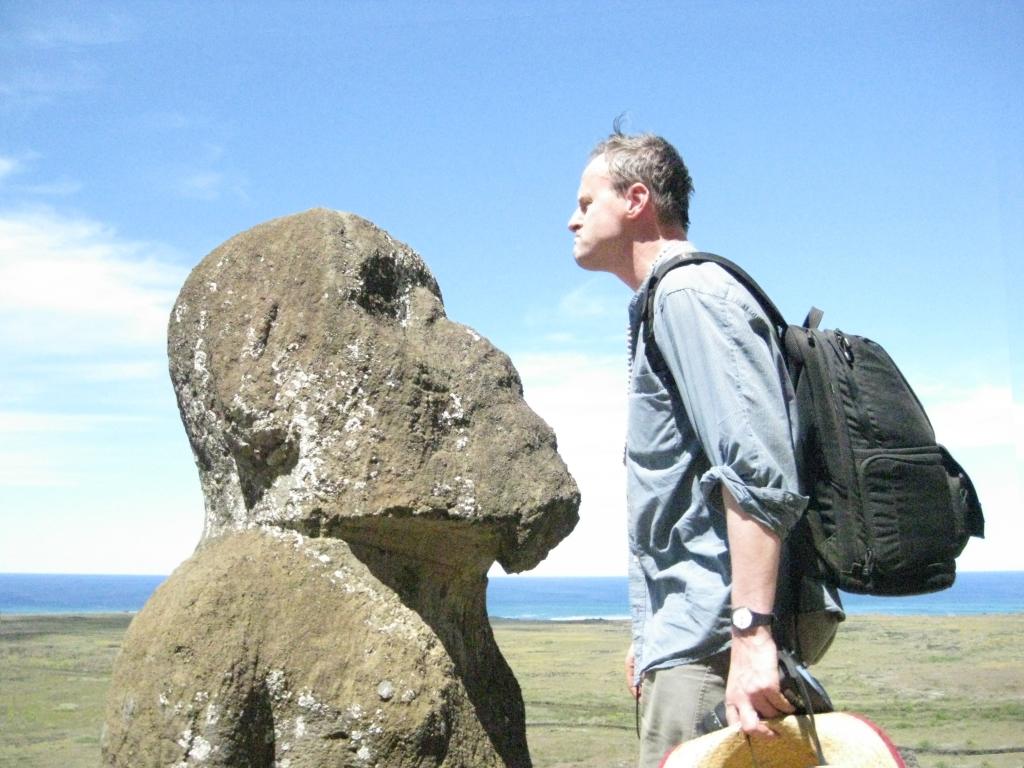
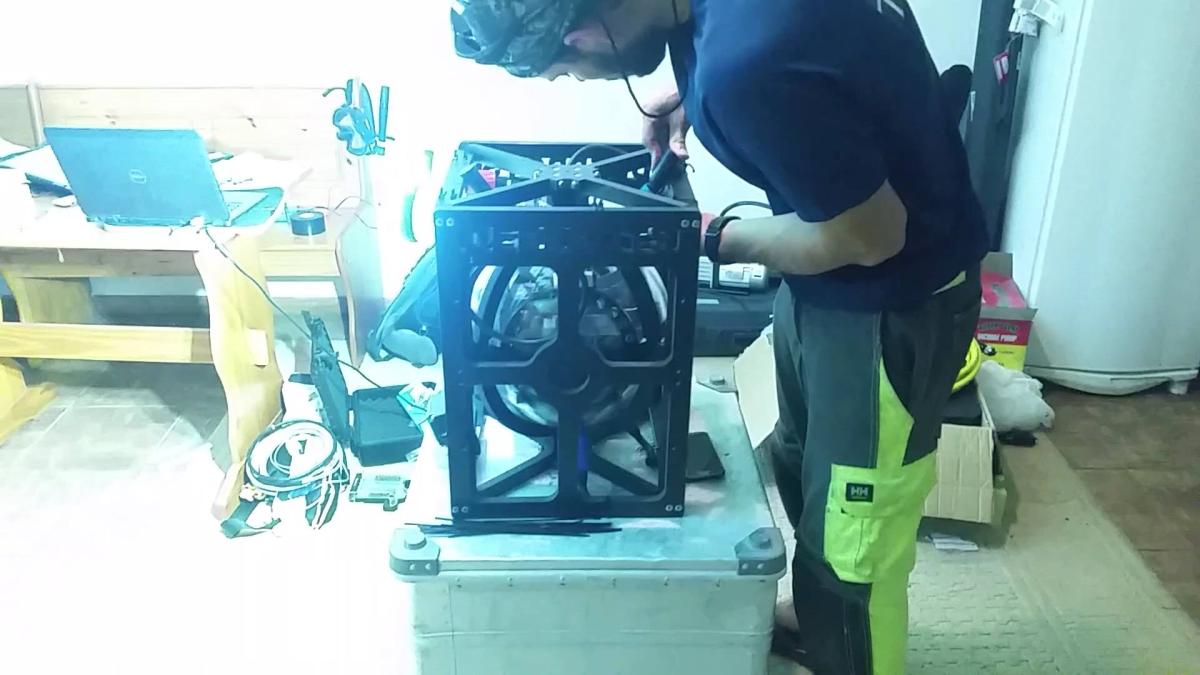
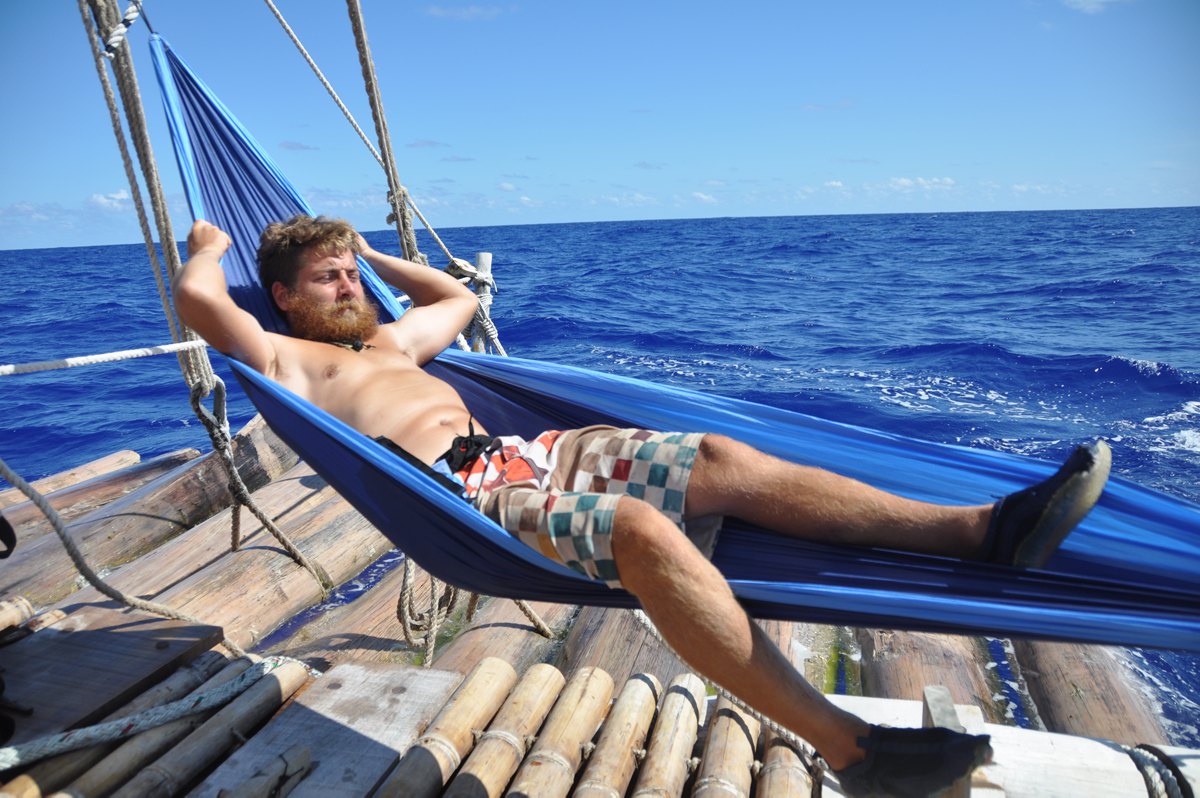
(2016-01-01) The Kon-Tiki2 crew for the next leg, from Easter Island to South America, are busy on Easter Island. In the first picture, they have gathered in Ranu Raraku, around the Tukuturi statue. This particular statue has a close resemblance with one of the crew members. A coincendece? We don't think so. In picture 3 and 4, Erlend Koppergaard, our film photographer, is calibrating his equipment.
Preparing deep-water camera
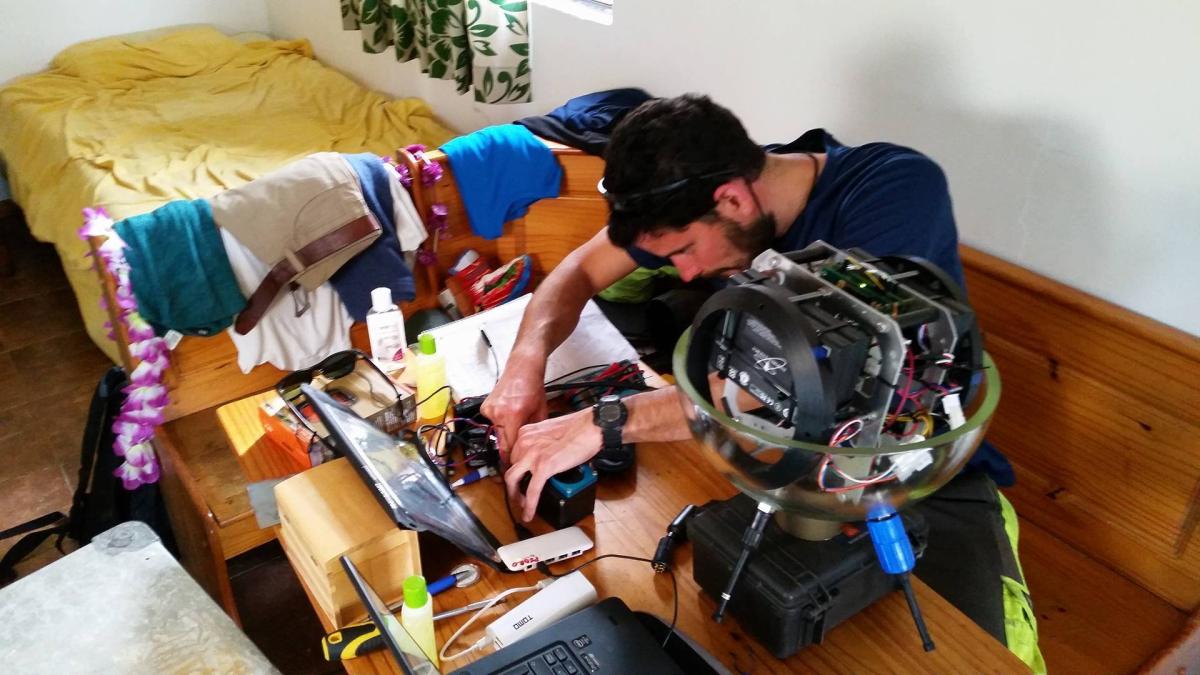
(2016-01-03) Pedro is preparing the deep-water camera. The two halves of the glass sphere, is held together with vaccum. The sphere contains batteries and electronics controlling the lamps and camera, which are placed in separate enclosures outside the sphere.
Preparing departure
(2015-01-05) The Expedition is eager to start the second leg of the journey and head for South America. Some final preparations still need to be made. Kon-Tiki2 Expedition leader Torgeir Higraff writes:
We are getting ready to launch. For the first time in modern
history, ancient style vessels will be sailing from Polynesia to South America. On
Rapa Nui (Easter Island) we have met many friendly islanders and we have made
some repairs on the rafts. We specially want to thank our host Jackeline Rapu
Tuki and her family for helping us with many issues, and the mayor Pedro Pablo Edmunds Paoa
for providing us with fruits and vegetables from the islanders for the return
leg.
In the picture, mayor Pedro Pablo Edmunds Paoa meets with Lisa and Torgeir.
The new Kon-Tiki2 team
(2016-01-06) Torgeir writes:
Finally we got all 14 crew members for the second leg to
Easter Island. The last member to join is Evgenij Orlov who took these
photos. Once again I want to highlight the support we get from the
hundreds of local people we meet every day and the official support
from the mayor, the governor, and the Chilean Armada. We delayed our
departure because of a southerly wind which is still blowing. Tomorrow
we can set sail for The Roaring Forties.
Iorana, Rapa Nui!
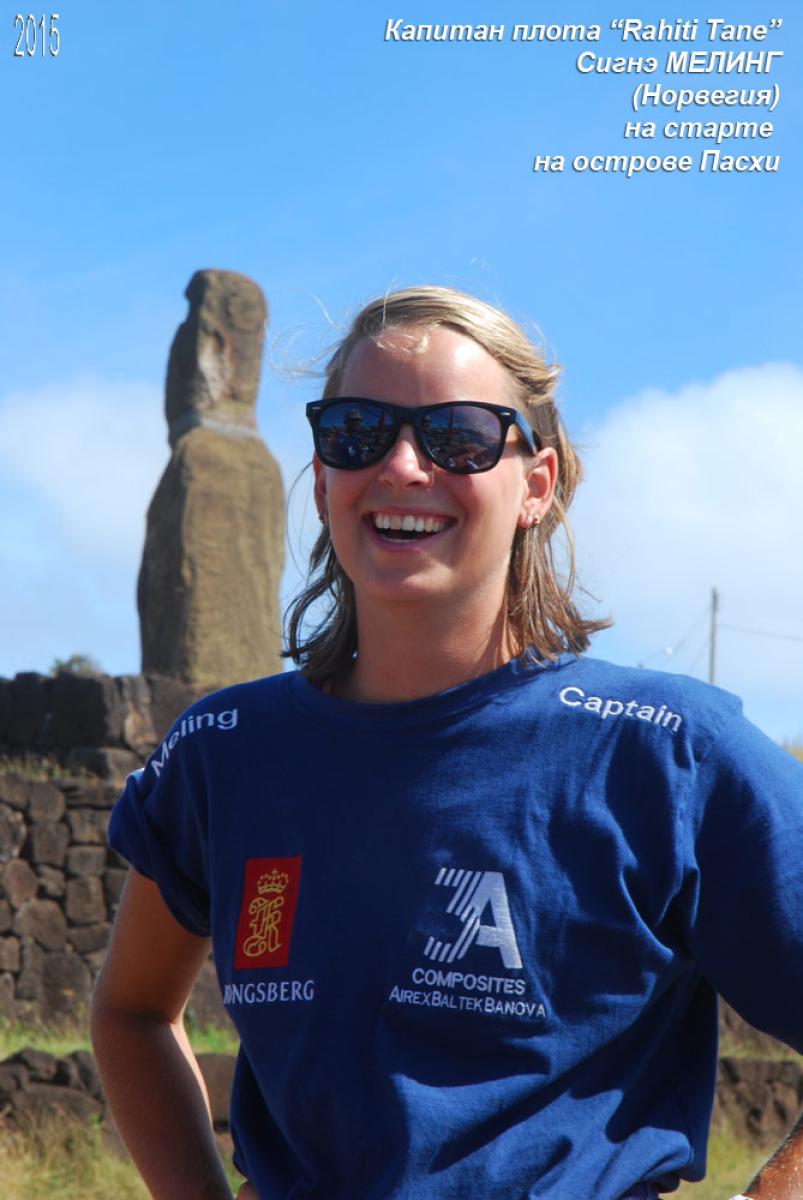
(2016-01-06) Captain Signe Meling reports that both Kon-Tiki2 rafts left their moorings outside Easter Island today. Tupac Yupanqui was towed first, then Rahiti Tane. The Chilean Navy is very professional and helpful. The raft are towed at a speed of 5 knots and the crew hope to return to sail power before dark. You can follow the movement of Rahiti Tane on the map, Tupac Yupanqui's tracker is currently off.
The Expedition would like to thank everyone on Easter Island for being wonderful people in a wonderful place. In particular, Jackeline Rapu Tuki and her family have been fantastic!
The second leg of the Expedition will bring the rafts back to South America. The journey will be challenging as the rafts will take a more southernly route to find favorable winds and currents. The roaring 40's may soon see visitors.
Day 5 on Tupaq
(2016-01-10) Torgeir writes:
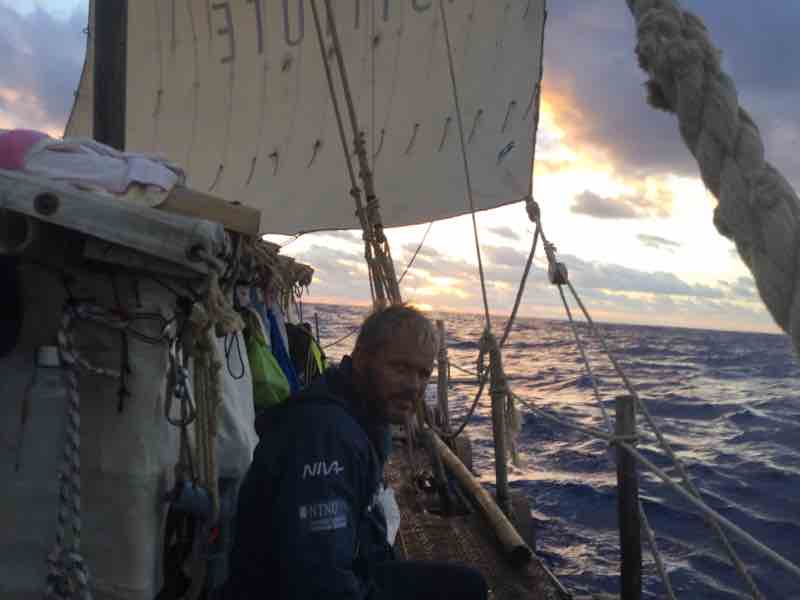
During our three weeks on the island we had several gales. Now, five days at sea, we have had almost no wind and we have sailed only a few miles out from Easter Island. We can still see the volcanoes in the horizon, but now as small shadows under the big clouds. At this speed it will take us several weeks just to get to the Roaring Forties. That is where we are heading now, at the speed of "a couple in love taking a stroll pushing their babywagon in front of them". That's how Jimmy puts it. Jimmy is a 31 year old Swede who spend most of his time fishing. His experiments are good entertainment, especially when he loses his third fish into the ocean. "It is so slippery" he says laughing. I am glad these fish are were small ones he intended to use for bait. When a big dorado gets up on deck I will personally make sure it stays here. The good news is that we still have a "Happy Ship". Team Tupac has fun and does scientific tasks that are much easier to do with no wind. The three-stage sampler from NIVA works well and for the first time we can listen to the sound of 15,000 liters of seawater being pumped through the filters. We are still motivated and prepare ourselves for months at sea.
Meet crew member Lisa!
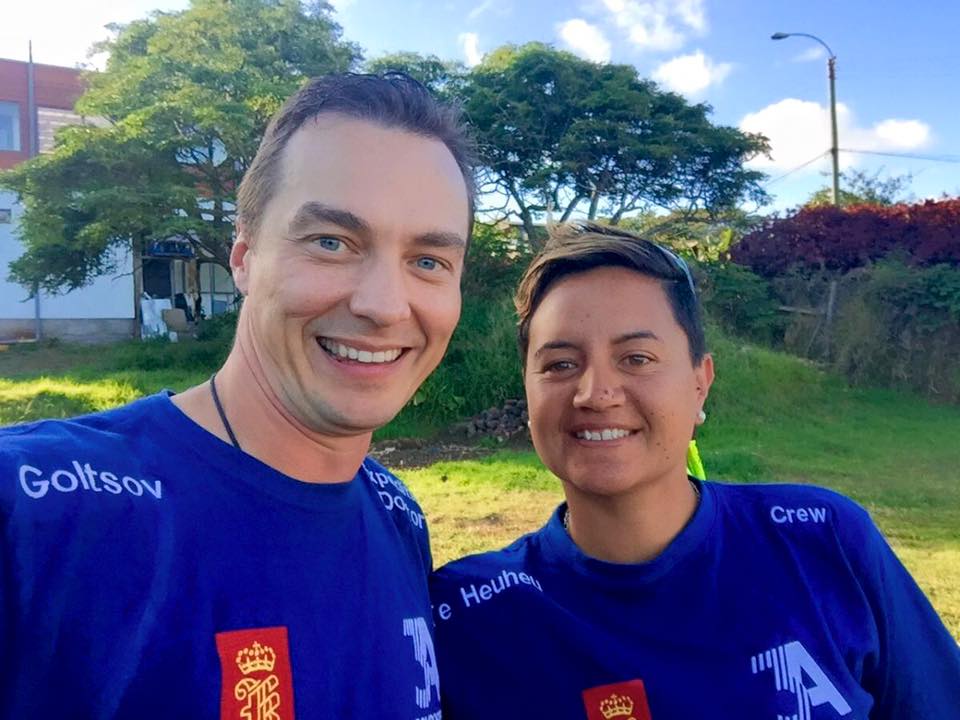
(2016-01-11) Lisa te Heuheu is a part of the Rahiti Tane crew. She is a New Zealand Māori with a passion for the environment, māori knowledge and culture and the development of all people. Together with Liv, she was recently a team member of the Access Water Ganges expedition to India. Now we are happy she's a part of our expedition! Read her blog about this new adventure called Kon-Tiki2.
Day 6
(2016-01-11) Torgeir reports from Tupac:
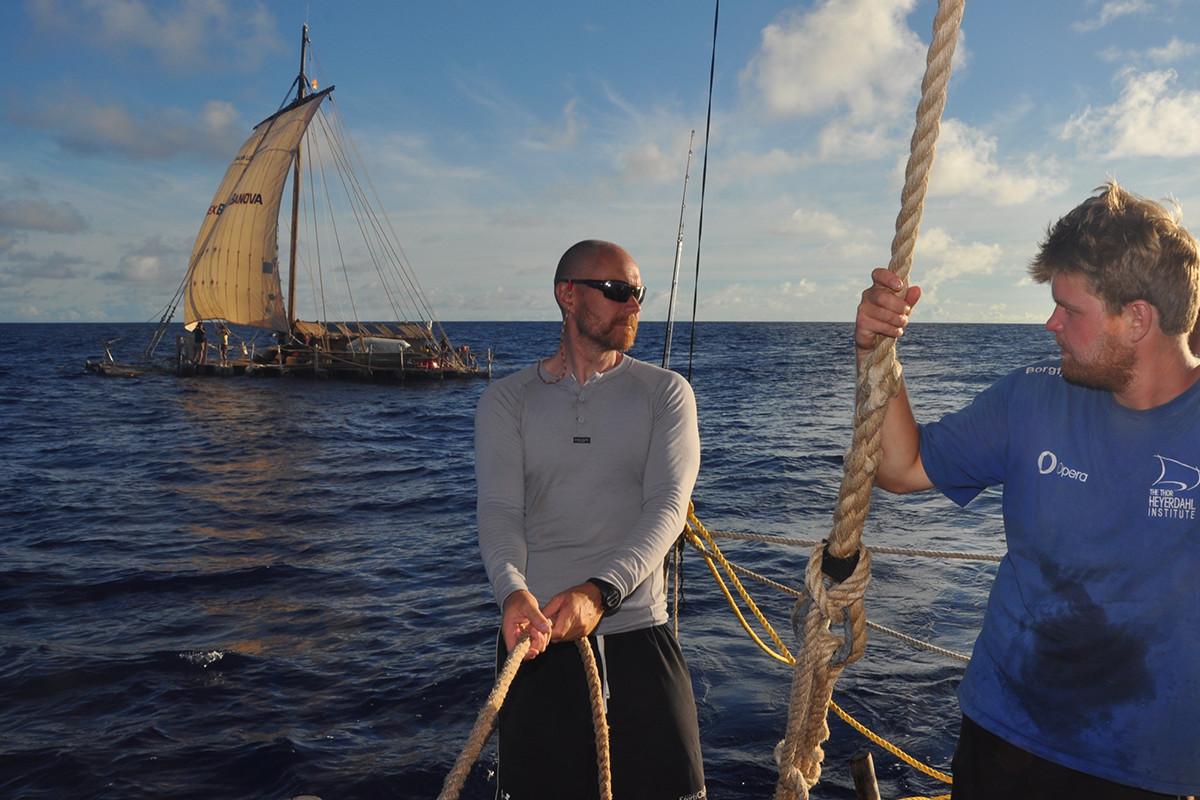
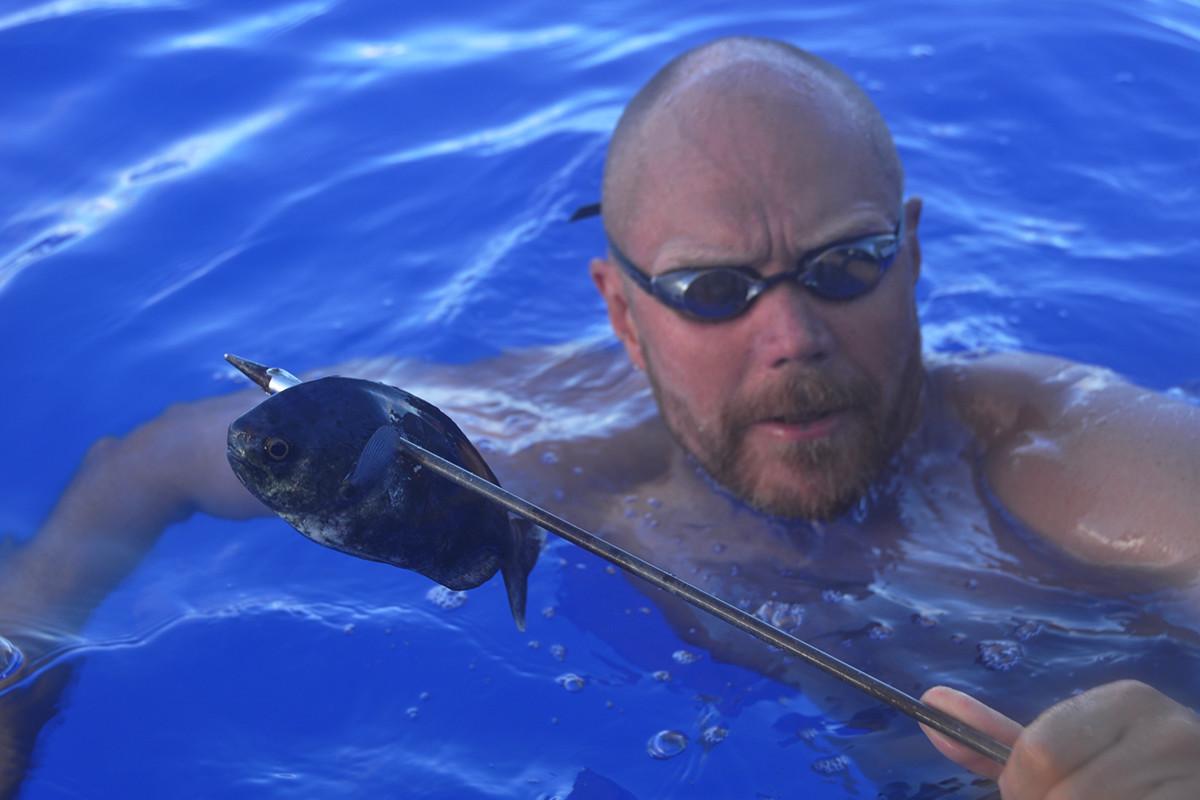
Today was workout day on Tupac. Also, the two rafts met. Pedro, our engineer and oceanographer, came with the photographer Jevgeny to Tupac. Pedro fixed the AIS. Torgeir and Andrey took a swim to Rahiti and met Signe, Liv, Lisa, Sergey and Rasmus there. Meanwhile Erik harpooned a small fish that we use as bait. When the visit was over the wind changed and increased, now from southeast. Great sailing the rest of the day. We try to go east but are pushed a bit north as well.
Håkon adds, from a dry place with a fast internet connection: the wind has since shifted and is coming from south-east, which is the worst possible direction. You can follow the movements on the map on the left side of the home page.
On rafts in our age
(2016-01-12) Torgeir writes:
Many people write me and ask why I build rafts and sail them on the ocean. There are many important answers in the why section of our web page, but I also encourage those who write me to look around and see what the raft means today, in our progressive world of growth-minded states and people. The planet today is like Easter Island in the 17th and 18th century. We kill our habitat slowly and we all know what is going to happen.
The raft is the great escape people use when they are desperate, when they risk their lives to escape from something. And they number thousands, every year. They escape from wars, poverty or politics. On the other side of the ocean they find hope. Thousands of people do not know how to make their own rafts, instead they pay others to get them to the other side.
In ancient times, the rafts were also used to escape wars, poverty, or politics. After a disaster like El Nino, earthquake, vulcano eruptions or draught, rafters were able to find new land and start a new life. Today the rafters only find more politics. The Kon-Tiki2 cannot be compared to crossings in the Mediterranean, but it is a reminder that voyages in search for a better future have taken place at all times and that they go on right now. Lucky are we on these two rafts, with no fear and no bigger worries than when the wind will come. It will come.
First Circumnavigation of Easter Island by Rafts
(2016-01-13) Torgeir writes:
The title is not a joke, but I wish it was. The first week of our historical effort to sail from Easter Island to South America on rafts has been very difficult in many ways. We are now further away from our goal than a week ago. To sail in the "wrong" direction many days in a row is for me like a nightmare. When I read the mail from Gunvor yesterday the situation felt even hopeless. Gunvor, who is a very good sailor and knows how to sail our rafts perfectly, concluded: "with the winds that you have the next week along your route you will never get to South America".
This last night shows some hope. Even with winds coming from our destination, we have managed to sail on 200 degrees south, by constantly raising and lowering the guares (daggerboards). My crewmates and those on Rahiti do a tremendous job. I remain hopeful.
Sergey Goltsov: doctor, blogger, photographer
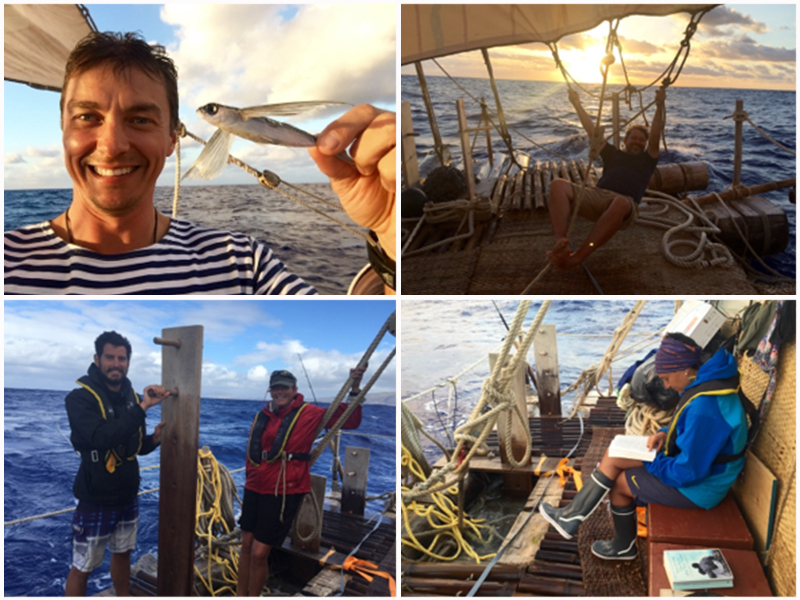
(2016-01-14) Sergey Goltsov is the Expedition doctor on the second leg. Like his prececessor, Boris Romanov, he is Russian and multi-talented. Sergey has blogged extensively about the expedition, both in Russian and in English. Along with the text come images — Sergey is magically able to upload images through the narrow uplink on Rahiti Tane.
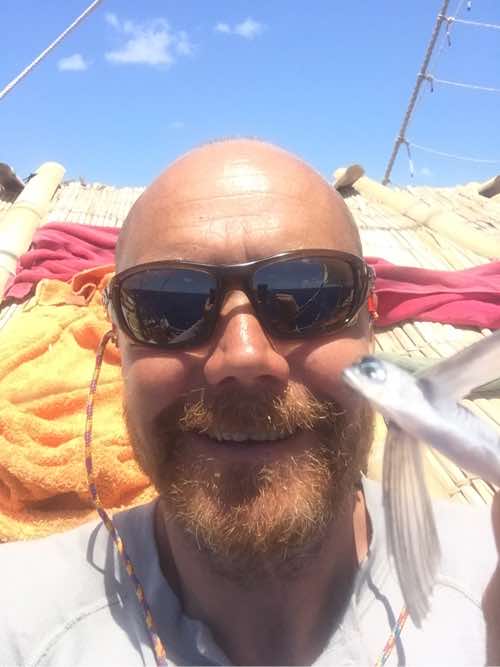
In the pictures above you can see Sergey with a flying fish. Helpful hint: flying fish are edible. In Barbados, flying fish are eaten scaled, boned, and butterflied.
Good food makes happy raft
(2016-01-14) Torgeir writes:
We are still drifting westwards but celebrate that we see the 27 number again: 27 degrees south. The soups we got for Christmas from Asker are very popular, especially when mixed with fresh food from Easter Island. Erlend and Andrey take their job in the kitchen seriously. Making food is also what I enjoy every day. I think my survival instinct tells me to be near the food when I can. If the wind turns tomorrow we should see a new degree on the Jotron AIS every day.
Pacific cuisine on Rahiti Tane: Week 1 at sea
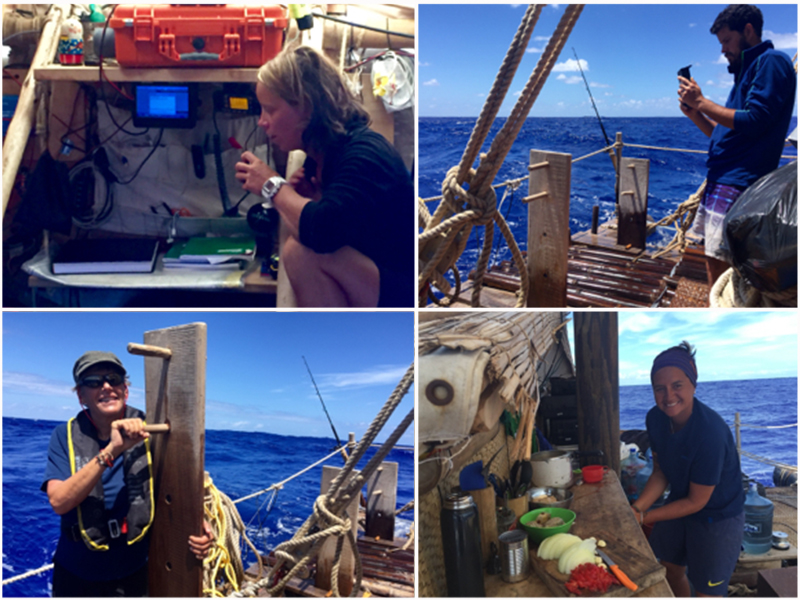
By Lisa and Signe
(2016-01-16) We're back at sea again, with fresh supplies of vegetables, people and energy. It was hard to get hold of large quantities of any vegetable on Rapa Nui (Easter Island) seeing as they grow almost nothing themselves, it's all flown in from mainland Chile. We did get a lot of onion and garlic, some carrots, tomatoes, cucumbers, pineapples and lemons. This is what we've had this first week:
Thursday: Boiled potatoes, onions and fresh salad
Friday: Curry with rice
Saturday: Lentil burgers with rice
Sunday: Chinese vegetables with rice
Monday: Rice with vegetables in a peanut/coconut sauce
Tuesday: Potato soup
Wednesday: Chick peas in tomato-ginger sauce with rice
We've been baking bread every second day, and Tupac have started a bread-baking competition to see which raft can make the best bread. Not sure who the judge will be but we'll sure do our best to win the competition. Lisa is the steward on this leg, and she's doing a tremendous job of keeping track of how much we have of everything and where it is stored. We're probably going to be out here for a very long time so it's important to watch our consumption. One thing that we did get a lot of was chocolate! So, we have increased our chocolate intake: we now eat chocolate on Mondays, Wednesdays and Saturdays as opposed to only Wednesdays and Saturdays on the first leg. First impressions are that Chilean chocolate is very good! So far we've been very happy about the food. Our Russian photographer often exclaims "delicious! Tastes like home!". Contrary to our hard efforts we have not caught any fish yet, even though there was one on the hook a few days ago but it simply took the bait and swam off. Will continue to work hard on this issue. We're now starting week two, and the food planning is well underway.
Why are we sailing westwards?
by Signe
(2016-01-15) We are sailing westwards. South America is to the east. Have we turned our compasses the wrong way around? No, we are sailing west on purpose. Our main goal now is to sail south. We need to get to around 40 degrees south before we can head straight for South America, and with the winds and current we have been getting this past week we have been faced with the choice of sailing either northeast or west/southwest. Choosing the latter gives us the course which will take us the least to the north. The smaller of two evils, on other words.
The problem is the wind. In this area the statistics say that we should have east, north east and northerly winds. We've been experiencing south, south/southeast and southeast. A high pressure system is to the southwest of us, giving us these winds. In the southern hemisphere the winds around a high pressure system blow anticlockwise, and we seem to be at "2 o'clock" in this system. All we need is for it to move east, so that we'll be at "10 o'clock" giving us wind from northeast and east. It just doesn't seem to want to move.
In a normal year this pressure system would be placed southeast of Rapa Nui, but this is clearly not a normal year. In the end, we just have to be patient. The northerly winds will come eventually. And hey, no-one ever said this was going to be easy, right? Spirits are still high, the sun is shining and the sea temperature is a comfortable 23 degrees. No complaints there.
Raft rendevouz
(2016-01-17) The two twin rafts meet again. And, the uplink connection is working! In the first picture, Pedro – our Mexican engineer on Rahiti Tane – is greeted by mast climber Andrey from Russia and Tupac Yupanqui. Erik, our resident lifeguard, can be seen in picture 2 with Ola. After another ten days without fish, Erik uses his skills as a diver to find bait for Jimmy, our fishing expert. In 4, Jimmy has the right logo in his cap, but it remains to be seen what he will catch? In 5, Lisa is making something yummy (they still have fresh vegetables!) while Liv is standing next to a mountain of scientific equipment. In 6, Pedro is showing his true colors, while Torgeir has installed a fitness studio with a better chance to stay dry in 6. In 8, Roberto is seen maintaining the solar power system. He writes, in Spanish:
Luego de 10 dias de navegacion, estamos practicamente en la misma latitud que la Isla de Pascua y unas 200 millas mas al oeste. Fue necesario rodear la Isla por el norte y tomar rumbo hacia el oeste en donde hay mas posibilades de encontrar los vientos que nos permitan ir hacia el sur hasta alcazar la latitud 40 S, conocida como "the roaring forties", donde predominan fuerte vientos con direccion al continente. El gobierno de las balsas es cada vez mas preciso y predecible. El mar, de un azul intenso, todavia no nos regala un buen pascado para refrescar nuestro menu, al que ya se le estan agotando los alimentos frescos. La poblacion de cangrejos ha aumentado a unos cuatro que se dejan ver mas una minuscula criatura que debe ser 100% kontikense. Paciencia y buen humor, este ultimo no ha declinado y esperamos mejores vientos.
In his text, Robert expains the winds and the currents, and the onboard raft population. Stay tuned for pictorial evidence.
Kon-Tiki2 logs still floating well
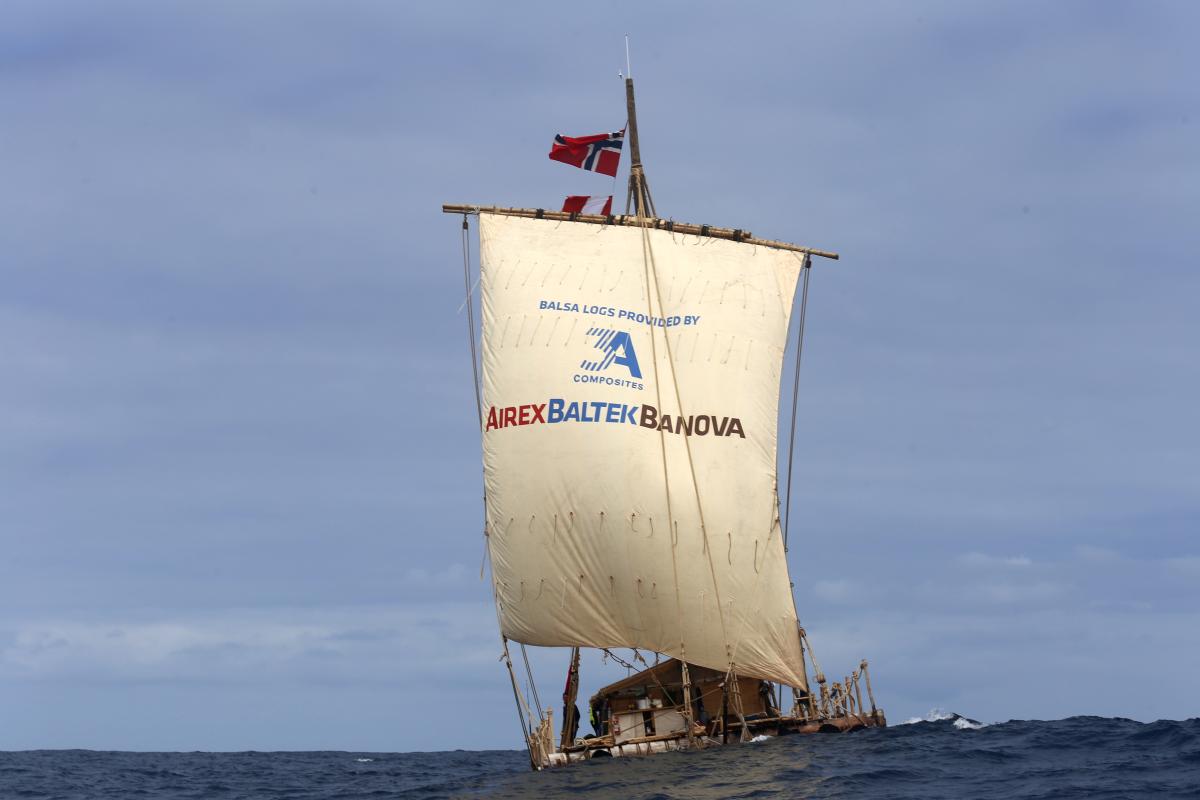
(2016-01-18) Torgeir writes: The wind has been coming from the wrong direction, but the rafts are still good sailing vessels. Rahiti Tane has been our leading star for several nights now, with her light in the mast showing us the best course to sail. A year ago, I was in Ecuador with actor and TV-presenter Les Stroud (Survivorman) to find logs for our two rafts. Our general sponsor AirexBaltekBanova and their engineers provided us with 44 logs which they transported to our construction site at SIMA in Peru. After three months at sea we are still floating well enough to perform good sailing. Check the video on how balsalogs are important in modern society. In the pictures above, Tupac Yupanqui and Rahiti Tane can be seen in water, waves and an epic sunset.
Crew goes bananas
(2016-01-19) Rasmus writes:
When I first came to Easter Island I hadn't given much thought about whether there would be banana trees on the island or not. But when I first saw one, I realised that an old dream was about to come true. The dream of cutting a whole banana stem from a tree, bring it on board and sail away. A quite modest dream, one could say, but those dreams are usually the best as they might actually come true.
Without my knowledge, I happened to share this dream with both Jimmy and Signe who showed great enthusiasm when our hosts at Easter Island lent us a knife, and pointed out some banana stems that we could reap. I might have imagined a slightly more elegant cutting, preferably with a cutlass. But after a bit of work with our arms, heads and the knife somewhere among the banana leaves we managed to bring out lots of bananas. Without blood shed.
The banana stems were brought on board the rafts and mounted in the ceilings of the huts. There it hangs, like the balsa raft equivalent of a cut-glass chandelier. Some people would argue that there are impractical aspects of having such a thing hanging 1.5 metres above the ground in the middle of a crowded area. I guess they would be right, as I have lost count of the many times I've banged my head into the brown and yellow fruits. But hey, isn't it a cheap price to pay for living a dream?
CTD launched from Rahiti Tane
(2016-01-29) The crew on Rahiti Tane (RT) performed great team work today. They deployed an instrument to measure the physical characteristics of the water column, also known as a CTD, down to 500m. The first deep launch from this raft required communication and efforts from at least 5 of the crew members. Arming the instrument, spooling the line, holding tension on the capstan, handling the loose line and steering the raft away from the line were demanding tasks required for the operation to be succesfully completed. Liv, Lisa, captain Meling and Pedro succesfully sent and retrieved the instrument in the course of a sunset. It is noteworthy that even Evgenij, our filmmaker on board who never stops recording, set the camera down to join and ease the team's stress.
The team tested the deep launch capacity of RT. The bamboo boom that holds a pulley on the port (windward) side, resisted the tension and protected the raft. Hundreds of kevlar lines were tied to together to make the deep line on the first part of the Kon-Tiki2 expedition. Each knot represented a threat to this operation in the line under high tension. The deployment was done under course, moving at approximately 2 kn, and the deep line affected the vessel's control. Line spooling was timed, as the line is not marked for length: 30min and 2 persons to send the CTD down, 4 members and one hour to retrieve the 10kg payload. the newly installed setup holds together and adds a new capacity to RT.
The gathered data shows a smoothly decreasing temperature gradient from 24 at the surface to 6 degrees Celcius at maximum depth, the location of oxygen maximum and minimum, and a peak of fluorescence at depth. The Research Vessel Rahiti Tane is equipped with sophisticated scientific instruments from NIVA and NTNU, it has an organized and capable crew on board and will continue in the path to America with its scientific program.
Lemoncake
(2016-01-21-cake) Andrey writes: Today I've made a lemon cake by the special recipe of my mom. All of
crewmembers of Tupac appreciate my cooking. For me it was not only
tasty cake, but something more. Kind of remaining of my home and
family, because this cake is obligatory attribute of holiday table in
our house. It is very important for me, because I haven't been at home
for 3 mounth! And also it is very big pleasure, when the crew really
likes the dessert that you made. Now we are trying to figure out where
we can take more lemons. Maybe someone can send us a bag or two?
Happy Birthday, Paula!
(2016-01-21) A very special happy birthday cake has been made in honor of Paula turning 9 years old. Paula is in Norway, while Paula's father is onboard the Tupac Yupanqui. In these pictures, the crew proudly shows off the delicacy. While the pictures are priceless gifts, Paula is unlikely to have a taste of her birthday cake — by now, the cake has probably been consumed by the sugar-craving crew :-)
Maintanance day on Tupac
By Andrey
(2016-01-22) Today we decided to do some maintenance on the raft in order to prepare
for whatever awaits us over the next weeks. Most of the work was
completed during our Easter Island stopover, but things do break as we
move on. Moreover, we are getting settled and start seeing our space
from a new perspective. Gas tanks, boxes and scientific equipment
containers keep migrating around the raft in search of the very best
spot. Additionally, there is some planned maintenance to be done, since
we've already spent two weeks at sea. This added up to a whole lot of
work. The course and the wind have been rather stable today so we could
pretty much focus on repairs and such.
We started with the cabin floor. During our island layover we have
reinforced the floor taking into account some of the issues we faced
during the first leg of our journey. The problem is that the beam sea
would sometimes cause upward splashes through floor cracks inside the
cabin. Being merely unpleasant for crew members (especially at
nighttime, as it means drying sleeping bags the morning after), such a
shower is a disaster for naviagtion and video equipment! Our
enhancements did work, but the waves are still there, so we had to
repair a fragment of the floor near the command bridge. Then we focused
on the rear deck, which suffered most. The waves keep hitting bamboo
decking that Heikki, Heidi, Boris and I invested so much time and
effort in. Some bamboo planks have split and splintered, some ropes
have torn. Not looking good at all. We rescued what could be rescued
and tried to prevent further bamboo desintegration. If things get any
worse we will have to use a part of front deck planks for repair. The
front deck is feeling much better. Additionally, we have washed our
solar power units and handled the waste, including empty water bottles.
To reward ourselves for a pretty productive day, we lounged in the
newly installed front deck hammock and celebrated with some delicious
spaghetti, sauce and mushrooms.
Two weeks at sea, and having a great journey!
30 degrees south!
(2016-01-22) Signe, the captain on Rahiti Tane, writes:
After a long period of winds from south-east, the pressure system we are in has finally moved east, giving us the northerly winds we have so far only been dreaming of. Early this morning we passed 30 degrees southerly latitude! Finally! Along with the big smiles that are now plastered on everyones faces this will be celebrated with Lisa's banana loaf later on today. We now have 600 miles to go to until we reach 40 degrees south, our next big milestone. Hopefully the winds will be favourable and turn westerly before we reach that far so we can start working our way back towards South America. A happy day for raft sailors in the Pacific!
The picture shows the screen of the Jotron AIS transceiver which also doubles as a GPS, now declaring 30 degrees south!
Week 2 at sea
By Signe
(2016-01-23) On Rahiti Tane the cooking is shared mostly between Lisa, Pedro and Signe. Liv is the breakfast cook, serving oatmeal every morning. Our favourite is when she mixes in some leftover rice, giving it a nice texture. Pedro serves mexican classics and Lisa and Signe mostly just start by chopping onions and use their imagination for the rest. The menu of the week:
Monday: Moros con cristianos (rice and beans mexican style)
Tuesday: Curry with rice
Wednesday: Potatoes with mushroom stew
We bake bread every second day, and it's getting better and better. We are sure to win the breadbaking competition started by Torgeir on Tupac!
As the third week starts we are in high spirits, we have passed 30 degrees south, we have more books to read and more vegetables to eat. All is good.
We have finally managed to finish the bananas, even our monkey mascot Balsa is sick of bananas. These final three will become banana loaf later today.
Speed record
By Liv
(2016-01-23) Tonight Rahiti Tane made a speed record. We reached more than 4 knots for a short while. Yesterday we celebrated reaching 30 degrees South with banana chips. It's noon now and we have passed 31 degrees South. In the last two hours, our average speed was 2.6 knots per hour. One minute is a nautical mile (1852 meters), so the word "speed" might be not be the right word. If the Pacific Ocean had been a frozen sea, it is not hard to imagine and compare the blue waves here with the white snowdrifts or sastrugis in Antarctica. There we would be able to ski and pull a 100kg sled behind at the same pace Tupaq is doing now... The spirits onboard Tupac are high. We are looking forward to Saturday night dinner, and are all happy to move Southwards to 38-40 degrees South to catch Western winds and currents.
A rough night
By Signe
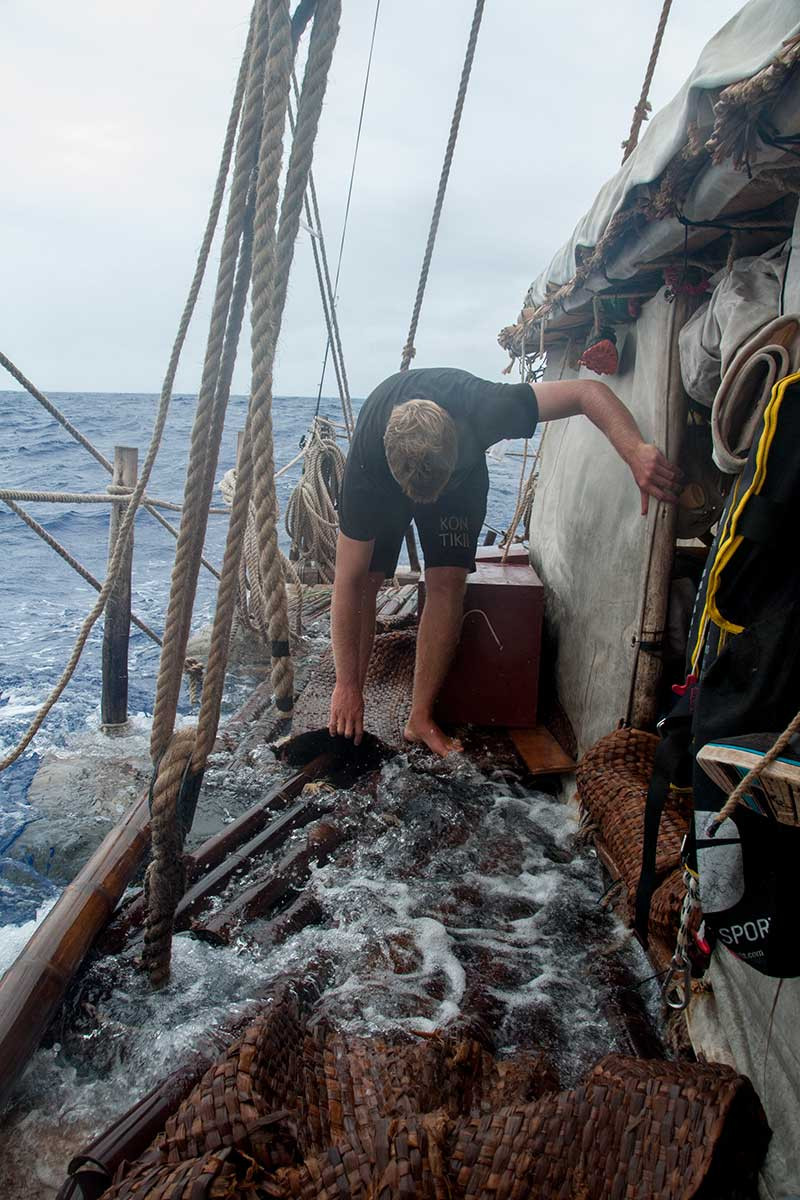
(2016-01-24) It's been a rough night, but surprisingly we slept soundly. There was quite a bit of splashing both inside and outside as the waves came crashing down over poor Rahiti Tane. Waking up this morning the raft looked like a disaster area. 30 five-year-olds in a birthday party could not have made a bigger mess. Many of the bamboo decks were broken, fortunately they had been salvaged by Rasmus and Lisa during the night. Our wooden storage boxes with food and equipment that usually line the cabin walls had also threatened to jump overboard but had been saved and brought to the front of the raft. Pedro and I went to work after breakfast, working our way forward from the aft. Each piece of deck had to be put back in its place and tied down properly. This involved getting wet as the waves broke over us while we were under deck tying knots. A few hours later the job was almost done and we were so wet and cold that we had to take a break. The water still holds 22 degrees so I suppose we shouldn't complain. Fortunately, nothing was lost over board during the night and the raft is still sound. So in total, no harm done. We are now better prepared for whatever awaits us in the Roaring Forties. The good thing is, we sailed 64.5 nautical miles in the 24 hours from Saturday to Sunday. This is not a record as it's 5 miles short of our record from the first leg, but it's certainly the roughest sailing we've had since leaving Peru. Good to see how well the raft handles the weather – we haven't touched a guara board in days.
No swimming
(2016-01-24) Erik writes: We have to admit, there was no swimming yesterday. Our diving board, which is normally 50 cm (almost two feet) above sea level, was mostly under water. It's lovely to be at sea in big waves, but hard to sleep with all the sounds and the wet water.
In Erik's first picture above, you can see the diving board on Tupac Yupanqui. The second picture shows one of the local residents: a small crab has hitched a ride on the raft.
The latest craze
By Rasmus
(2016-01-25) Two of the things I like best in life are sailing and sleeping. (I don't want to be a boaster, but trustworthy people actually keep on telling me that I show quite some talent when it comes to the latter). It is usually a good combination as you seldom sleep as good as after a night watch.
Yesterday however, we had wind speeds of about 11 m/s (5-6 beaufort) and the waves were growing bigger. High waves are not a problem per se, it depends on the wave length. As long as a wave has the time to pass before the next one arrives, the raft is just gently lifted and tilted. However, when there is a short wave coming, it breaks over the aft and if you are unlucky, some water is pressed through any hole in the floor of the hut and splashed into your face.
This was the case last night, and while I was lying in my bed, trying to be unconcerned about the occasional involuntary face washes, I came up with a possible solution. Luseplatting! (Update: "baggywrinkle" in English) It is an arrangement made out of small pieces of rope tied to a rope and it ends up looking like a elongated toilet brush; or Mark Zuckerberg's dog, I've been told. Usually it is used to protect things such as sails or gaffs from unnecessary chafing, but I thought it could do the trick as sealing compound as well.
Highly motivated, Lisa and I managed to produce about 5 m of luseplatting during the night watch, and we ended up with two fluffy things that almost looked like pets. Despite their cute appearance and look of appeal, we quickly stowed them away in a hole in the deck along the wall of the hut, where the sea previously had found its way in. It was a great success, and my two hobbies were suddenly not in conflict any more. Liv has now produced her first luseplatting, and I believe that it might soon be the latest craze aboard Rahiti Tane.
Mast & Masters
By Andrey
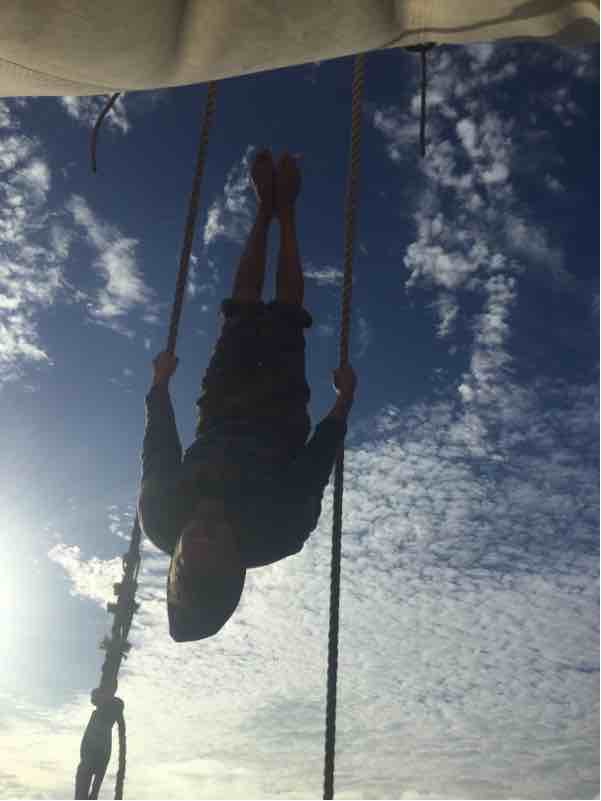
(2016-01-26) Today I worked on the mast. A wind meter broke and now, after
swinging on the ropes and fighting with the drill and the screws for
about forty minutes, we know the wind speed and direction once again.
Turned out that a new battery was all that was needed. It is a little
disappointing that work could have been done with less effort, but the
result is what counts. I hope you will appreciate a few photos taken
from the highest point in the radius of several nautical miles!
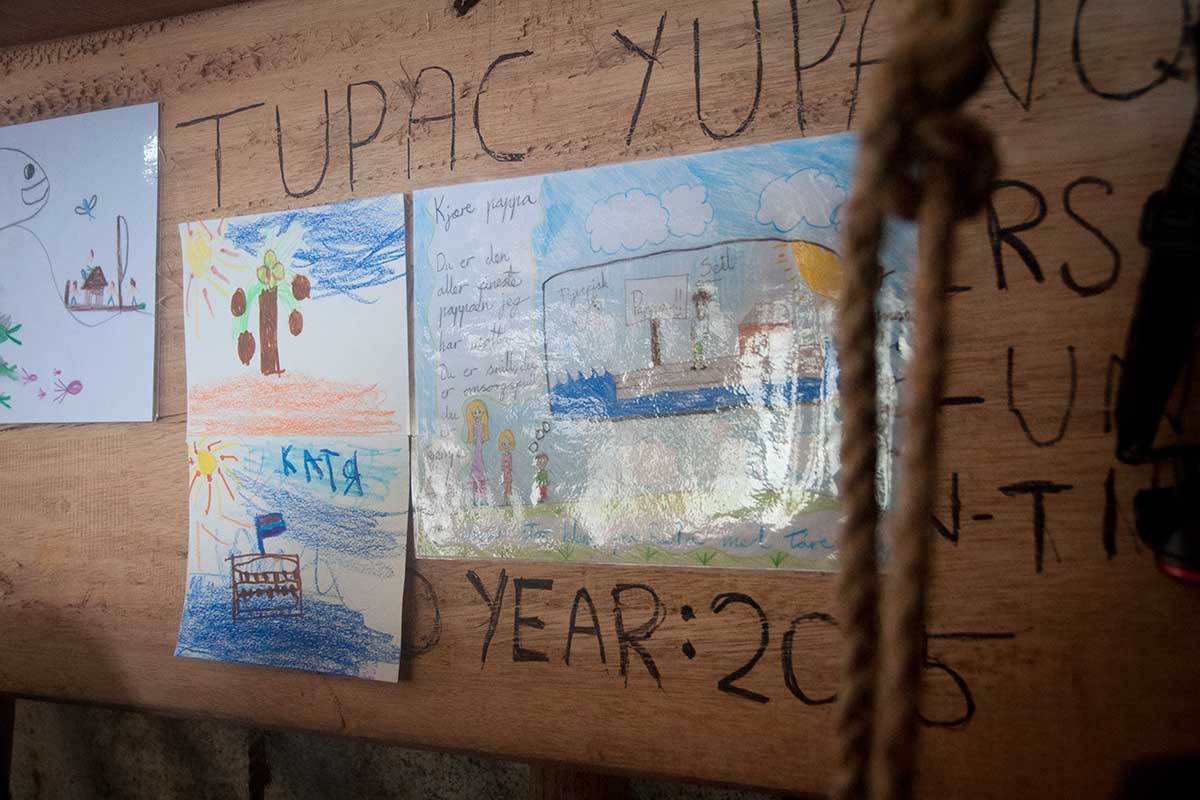
Also, we decided to improve ambience on Tupac. We probably
got a little tired from the rubber boots swinging under the ceiling and
from the perpetually damp towels. In a word, we felt like we needed a
sprinkling of art around us. Now one of the cabin walls is serving as a
gallery of children's drawings. It feels great and very touching to see
a bunch of bearded guys hanging up the drawings painstakingly colored
with bright markers and pencils. All the pictures are very meaningful
and, most importantly, sincere. They make us think of home. The
subjects are simple. But look at these rafts, tropical trees, fish and
huge whales! That's exactly what they look like in children's
imagination. Thanks to Paula, Sverre, Kate, and Pete for raising our
spirits! These pictures are now much dearer to us than works of the
most famous masters.
Bamboo deck crushed
(2016-01-26) These pictures from Tupaq Yupanqui show damage on the bamboo deck. Crushing waves have caused the deck to splinter in places, as described by Signe. The decking lies on top of the balsa logs, which are unharmed.
Pacific Cuisine on Rahiti Tane Week 3 at Sea
By Lisa
(2016-01-28) Another week and the food crew has recruited 2 more chefs to it roster. Pedro has shown some talent and has been making Mexican specialities for the crew of Rahiti Tane, full of spice, heat and flavour, Pedro's creations are a welcome addition to the Rahiti Tane menu. Rasmus also has some food inspiration and started out by making a zesty sprouted lentil salad to go with our fresh bread at lunch.
We have worked our way though a lot of our fresh fruit and veges and said good bye to the final bananas on Friday. As a treat I made 2 Banana Loaves for Thursday and Friday. It flooded me with memories of New Zealand, we have a cake and tea culture and I could imagine sitting in my grandmothers kitchen eating cake, drinking tea and chatting about random events at home. The smiles that the loaf put on people's faces, it felt like total luxury to be eating such a treasure.
Our fresh vege list is potatoes, onions and lemons. We are being creative and inspiring as we can when it comes to the use of these ingredients and I am continually impressed about how well we eat here on Rahiti Tane. Here is a snapshot of our dinners of the last week:
Thursday - Papas con Chorizo
Friday - Rice and Beans in Peanut Sauce
Saturday - Spaghetti Bolognese
Sunday - Spicy Aloo Stew
Monday - Quinoa Balls with Rice and Sprouted Lentils
Tuesday - Mexican Lentil Soup with Fries
Wednesday - NZ Baked Beans with Smashed Potatoes
As we head into weather that is wet and damp, we have started introducing more snacks and even had an evening of Hot Chocolate and story telling. One thing we have done well on our raft, is to make sure that we have food events that we can look forward to. Chocolate on Mondays, Wednesdays and Saturdays, are a treat the crew never let me forget, but also when we hit a milestone like 30 degrees latitude we had a whole lot of snacks and popcorn to celebrate. We are looking forward to a few more events on the horizon to break out some new cuisine and tantalise our taste buds!
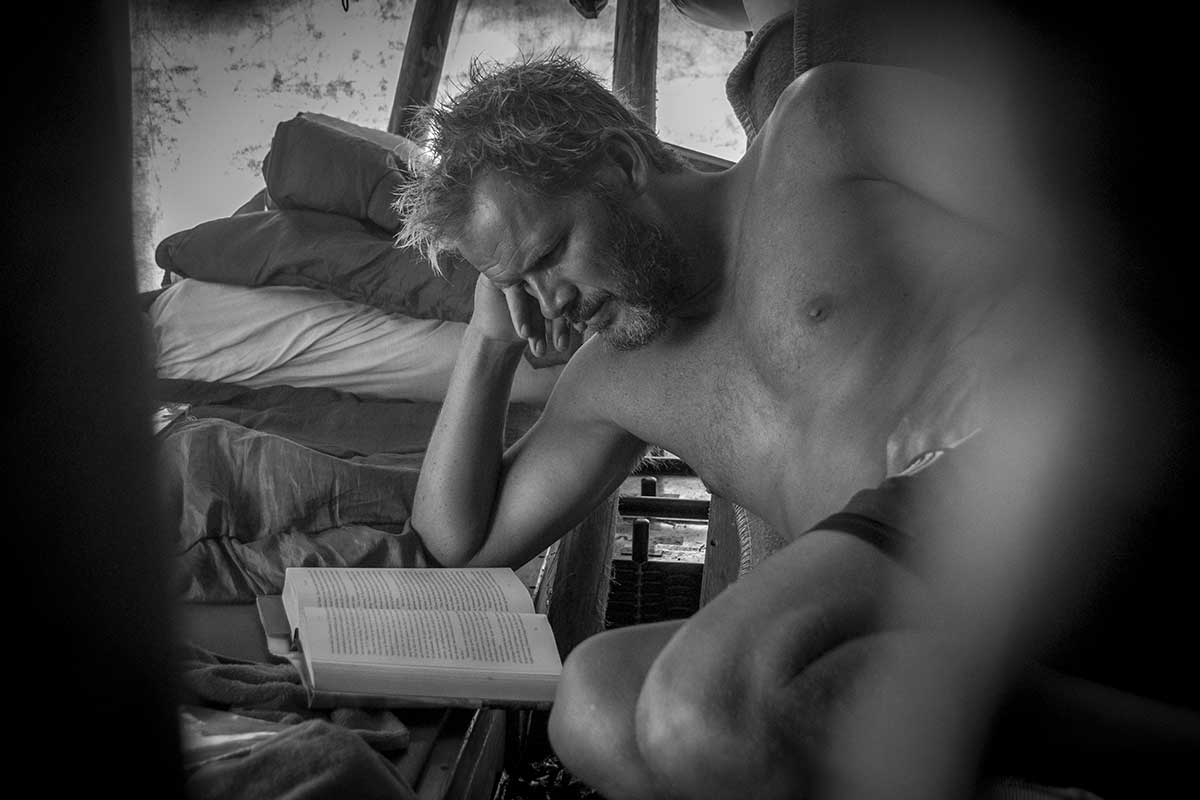
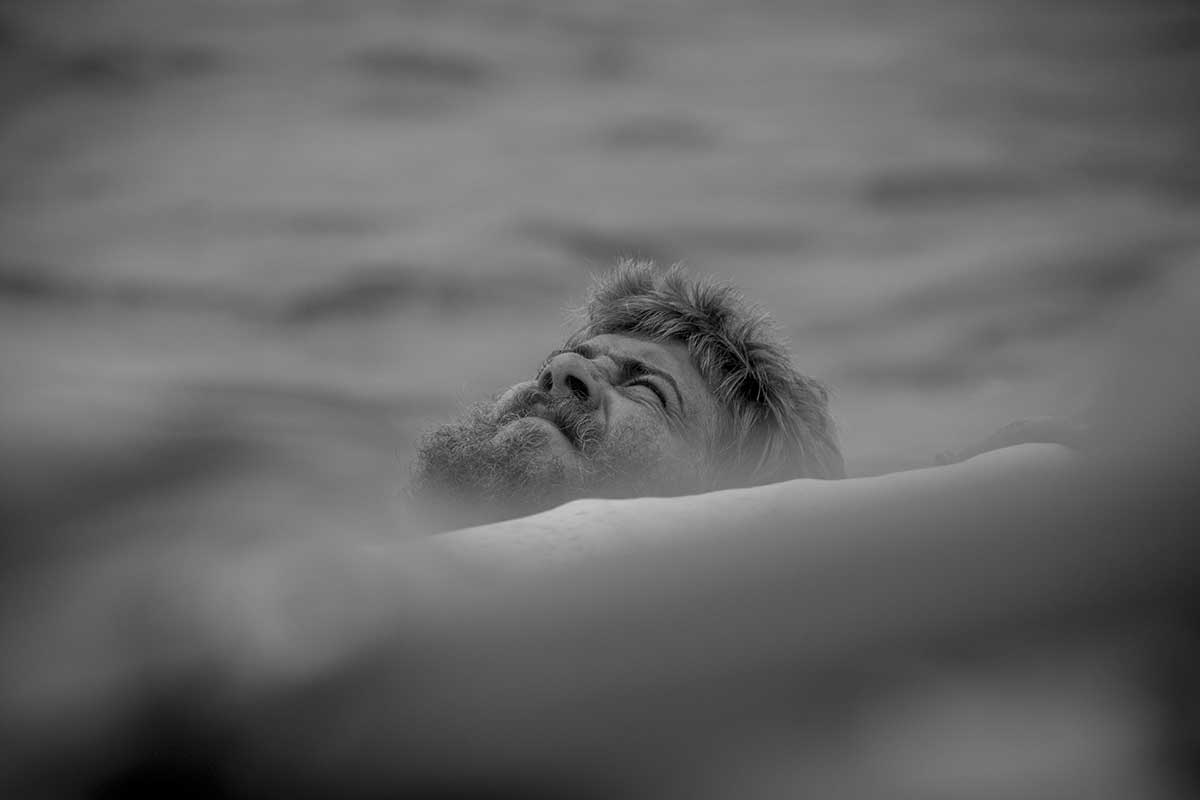
Crew in black & white
(2016-01-28) Erlend Koppergård has taken these portraits of the crew on Tupaq Yupanqui.
Tactics
(2016-01-28) Erik writes:
What is the correct way? After some good wind, we decided to take down the sail and just drift. The wind is now east/south but it's supposed to go back to northern later today. The picture of Torgeir shows how we are trying to keep a good mood by doing silly things.
Signe writes:
Sailing from 30 to 40 degrees south is a bit like playing red light green light. The area is dominated by a large high pressure system and every few days a small low pressures passes by, from west to east. This means that we have two or three days of good northwesterly wind until it all of a sudden weakens and turns to southwest, then southeast. After about 12 hours it comes back to northwest. Having vessels that sail relatively slow and can't beat very close to the wind our tactics so far have been to lower the sail whenever we're no longer able to sail towards the south, and wait. The idea is that we will not drift as far north as we would have sailed north with this wind. As soon as the wind turn back in our favour we hoist the sail and sail as fast and far as we can before the next round of southerly winds. Both rafts lowered their sail last night, and hopefully the wind will turn during the day today. Meanwhile we patiently wait.
The second picture shows Lisa playing the guitar.
2450 meters!
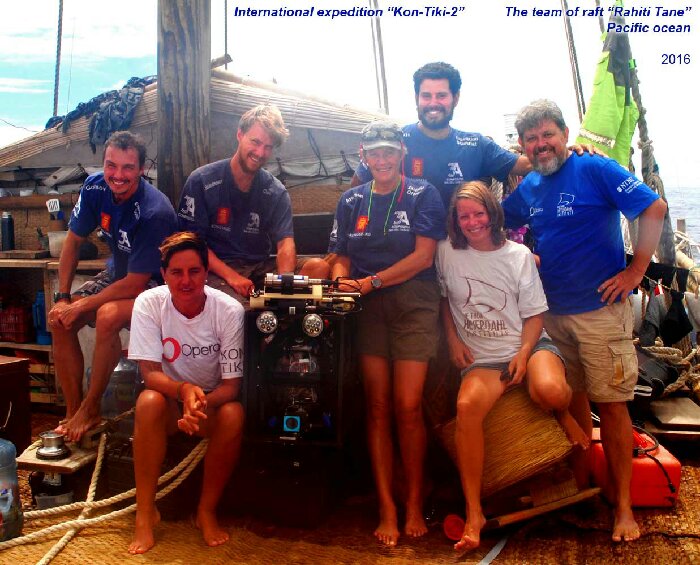
By Pedro(2016-01-29) Today the crew on R/V Rahiti Tane sent the Sperre Deepbot camera and the CTD to 2450 meters below the raft. Winds were unsuitable for sailing, and the sail was therefore lowered. The instruments, the kevlar line and its bobbin, the electrical winch and the crew got themselves ready immediately afterwards. The operation began at 0100hrs in the universal time UTC, or one hour before sunset. It took 5 hours to spool, first out and then in, almost 4000m of kevlar line. The downcast, technically easier and less energy demanding, took 1.5hrs and the effort of 3 people. Retrieving the instrument demanded full concentration of everybody onboard. They dealt with knots in the line, stuck pulleys, tangled lose line and the tension of a load that included the 10kg bot, 3kg CTD and 10kg rocks as weights. Effective communication, periodical task rotation and properly working instruments and installation resulted in a succesful operation.
The temperature in abyssal depths drops to 2 degrees in the Celcius scale. Three and a half hours of footage were recorded during the cast by the spherical glass-housed Deepbot. Equipped with two intense led strobes, the deepbot brought to the surface visual evidence of plankton, marine snow and possibly macrofauna, which can be situated with its depth and water physical properties: oxygen, fluorescence, and salinity. A shiny sea surface around the raft, illuminated by the strobes in the middle of an overcast dark night, was a rewarding landscape for the crew indicating the near conclusion of the operation. Both instruments are ready for the next dive. The following morning allowed the overexcercised crew to rest through a pleasant morning, and a harmonius sunrise with a delightfully calm sea.
The picture is a courtesy by our photographer Orlov. The crew gathers around the instruments to celebrate an exciting and demanding activity on board.
[Håkon adds, from a dry place on land: congratulations to Pedro and the Rahiti crew! You have achieved something truly remarkable in the history of oceanography. You beat our previous record of 2046 metres, and you did so with a huge payload, in the dark! The knots on the rope are unfortunate artefacts stemming from the kevlar spaghetti, but I'm happy that the triple fishermen we tied are holding up. Remember, there's a video projector on Tupaq Yapanqi which can project the deep-water footage on the mainsail!]