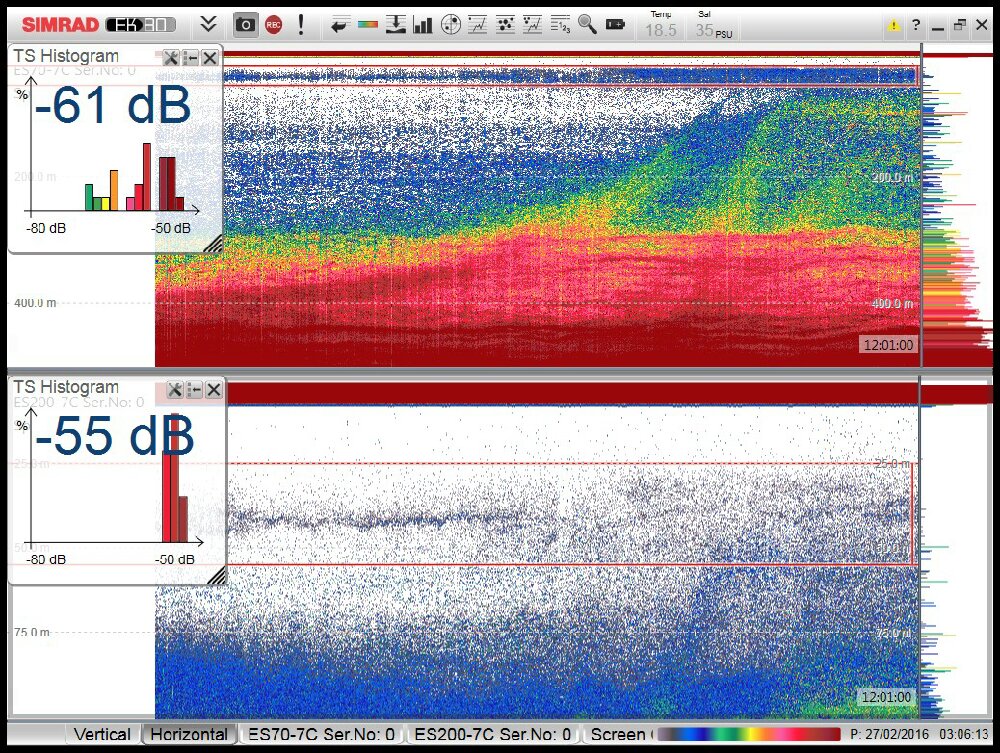
(2016-03-01) In a daily routine, plankton and fish go up and down in the sea looking for better conditions. These include seeking solar light for photosynthesis at shallower depths, food availability at another depth, or perhaps less light to hide away from predators that can see and eat them. The Tupac Yupanqui raft (TY) is equipped with state-of-the-art equipment to study this phenomena. Underneath ther raft, between two logs, two echosounders from Kongsberg are mounted to study what is known as dial vertical migration (DVM) in the waters where it cruises. A simple battery setup permits this raft to collect acoustic information new in the field of marine acoustic ecology.
Instead of the traditional "ping" of the sonar of submarines from the 70s, the sonars for ecological research on board TY transmit a siren-like sound into the water and can detect plankton up to a few millimeters long at 500m depth. This new technology is broadband, frequecy-modulated (FM) and provides better resolution than traditional "ping", echosounders. Over the last few days, the Tupacs have analyzed the migration of species from deeper to shallower waters and vice versa.
With broad band signals, acoustic fingerprints can be recorded from each individual. It is possible to identify species by the echo they produce, this is, by analizing "how do they echo" the signal that TY transmits. This, together with the activities performed on the sister vessel Rahiti Tane, help the scientists build a more complete frame of the pelagic ecosystem in the middle of the south east Pacific. Later on, these echosounders will describe biotic diversity in the Humboldt current, near the American continent.
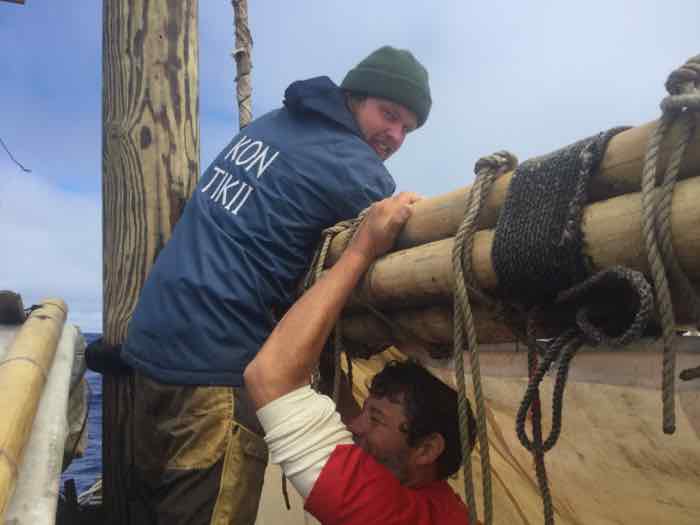
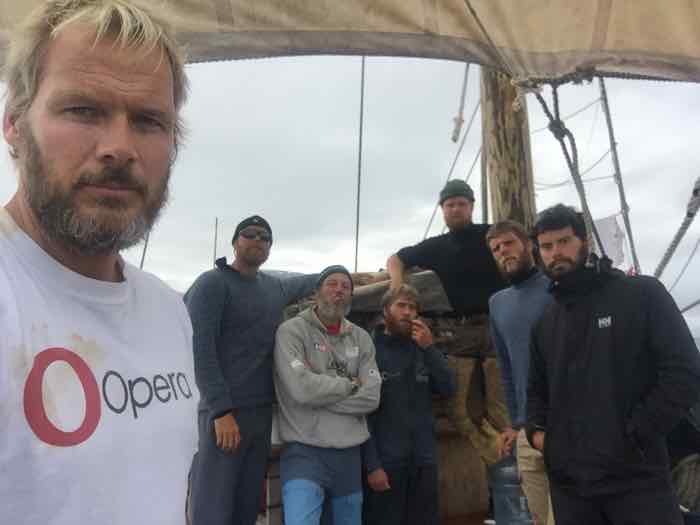
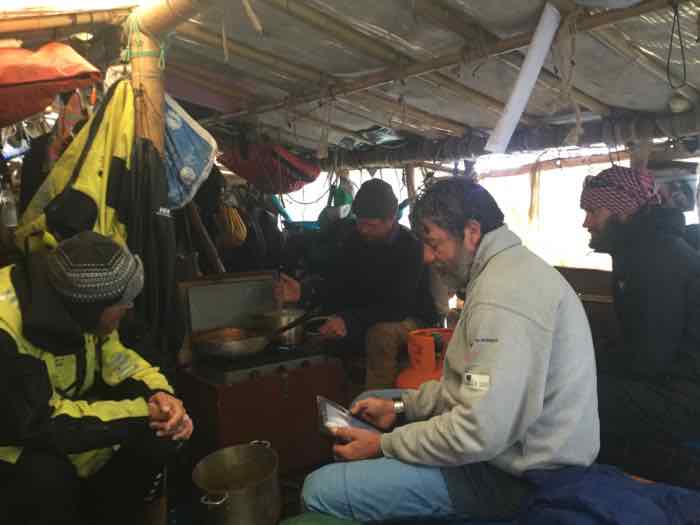
[In the first picture, the by-now bearded author can be seen with Tupac's sail. Picture 2-4 show echosounds while at the SIMA shipyard in Peru. Picture 4 is a screenshot of the software calibrating the echsounders, while the last picture shows an ascent of plankton during the night at different intervals. The green plumes are sound scatterers moving from 500m and upwards over time.]
The two faces of the roaring 40s
(2016-03-02) The rafts have seen strong wind recently, witth a near gale from north-west. They held high speed, covering 28 nautical miles in 8 hours, giving an average of 3.5 knots. Today, however, they saw another side of the roaring forties. Maybe we should call them the purring forties.
(2016-03-03) Team Tupac is drifting westwards in a strong breeze from east. The raft does 1.5 knots without sail. Yesterday a celebration of 98 degrees west. Today back on 99. The picture shows the bearded crew leaning on the yard, which normally holds the sail up.
Is Liv Bored?
Liv has started to get emails from friends and family with the questions: Are you bored? How do you cope with the inactivity? What do you do? What do you miss? As a landlubber, how do you cope out there? Read her answer, and find out what she misses most!
(2016-03-03) I said to my crew fellows: A good thing about drifting backwards is that we can celebrate 99 degrees again today and 98 degrees west one more time later! Always look on the bright side of life!
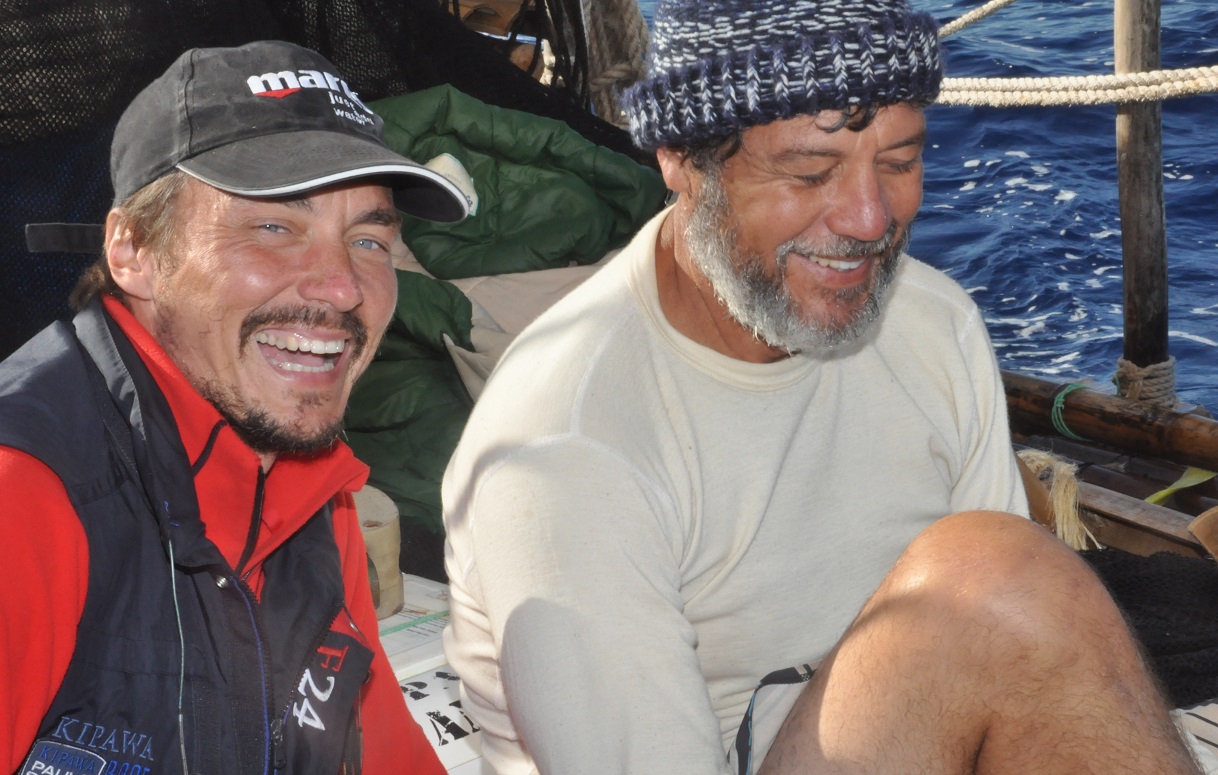
In the picture, Captain Ola Borgfjord (left) and Torgeir Higraff enjoy some carefully packaged popcorn.
Bearded men
(2016-03-04) Roberto has, like all men onboard the rafts, grown a beard. In this blog post he discusses the benefits and the drawbacks of having a beard on the open ocean.
When I am thinking or mulling over some issues, I enjoy stroking my full beard. It is pleasant to gently push the hairs with the back of my hand and feel a bit of a tickle when the tip of the hairs touch the skin of my chin.
(2016-03-04) It's day 3 of drifting backwards, now also with rain as opposed to the sunshine from the past two days. Hopefully this change signifies that the wind will also change soon! To pass the time, we fish, read, eat and sleep.
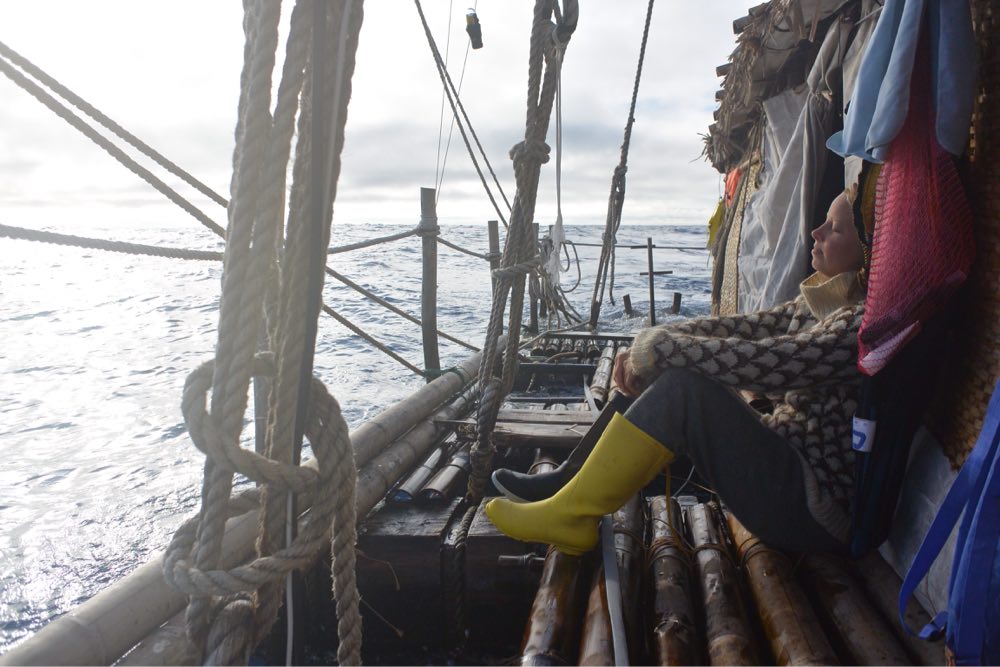
In picture 1, Rahiti's monkey mascot Balsa prefers to stay inside with his colouring book. In picture 2, Lisa is fishing. Picture 3 shows Liv in her reading cave.
(2016-03-05) I have great fun watching my crew-mate Roberto Sala catch fish. He laughs and yells like a child who for the first time feel the power of a fighting fish in the rod. Ten years ago he was just as happy when he finally cautght a fish on Tangaroa. On that voyage, the crew caught fish every day, all crew members except Roberto – although he was fishing more often than the rest of us. "How is it going? Got something?", we used to ask him. His usual answer was "No fish!!". So he was nicknamed No-Fish-Sala. So far on Tupac, the hairy and bearded former naval officer has caught two fish. Only Andrey and myself are stuck with zero. Both of us have sailed more than hundred days on this raft.
(2016-03-05) Onboard Rahiti, we are very happy that our captain Signe has her old school friend Rasmus onboard. They learned the old techniques of sailing traditional open wooden boats at Fosen Folkehøgskole in Norway. Rasmus even built his own "færing", 2-man row- and sailboat, and sailed it back home to Sweden.
When the wind and the weather gets rough, a rope or a brace is breaking, they know what to do and repair it with skills and knots in few minutes. Ola, the captain on Tupac has also his background from the same school, his father was the boatbuilding teacher for eighteen years. Onboard with him are also the expedition leader Torgeir and Roberto that have both sailed a raft before with the Tangaroa expedition in 2006. Former students of the same school built the rafts in Peru. So if you are intetested learning these skills and more; check in on www.fosen.fhs.no
The shows Captain Signe and Rasmus in good teamwork on the aft deck.
(2016-03-06) Tupac is seiling again, after three days of drifting westwards. Our destination is South America, more precisely Valparaiso in Chile. I was there in October last year to gain support for the Expedition. I did so in meetings with the admiralty of the Armada of Chile. They are now monitoring our progress with their search and rescue operation. I also took part in the Our Ocean conference with thousands of others, many whom were concerned about micro-plastic and other threats to our present and future ocean. The Stormberg clothing manufacturer, also a sponsor, is asking the washing machine industry why all the micro-plastics from clothes end up in our oceans. On the photos you can see the blue jackets from Stormberg chosen by the Kon-Tiki2 crew. It is made fronm recycled fabrics. You can also see how we harvest energy from the environment; with solar panels as our energy source we run full-scale oceanographic research on two rafts, covering 6000nm over five months. Every day we collect samples from the sea that NIVA later will analyze for micro-plastics.
(2016-03-07-signe) There's nothing quite like being woken up by Liv handing me a cup of coffee in bed - and seeing that the wind is filling the sail and we're heading in the right direction again. Happiness! The weather forecast says we have three or four days of good winds ahead of us so I'm looking forward to more such mornings.
(2016-03-07) There are moments in life that will never return. Points in time when you look to the horizon, concentrating to remember. And you know that in ten years, twenty years, you will think back to these minutes and recall what happened there and then. One such moment took place on our floating logs today, after 60 days at sea, on our way to South America 2000 nautical miles away. Why? Because we now know that everything depends on us. And each member of the crew is equally important. One for all. Estimations of our remaining food and water show that the journey will be difficult. But today, just now, all onboard gave their earnest confirmation that they will fight to win, hungry or thirsty, to reach our common goal.
March 8th: Happy Women's Day!
(2016-03-08) The International Women's Day is celebrated throughout the world, even in the South-east Pacific. Both rafts of the Kon-Tiki2 Expedition have issued statements. Andrey writes:
Today is the 8th of March and the crew of Tupac wants to send our wishes for women nearby! Dear Signe, Liv and Lisa! We miss you all and love you! We wish you dry clothes, sleeping bags and good winds! For Liv and Lisa we also wish some fresh fish. Have a great day!
Liv writes:
On behalf of the women on the Kon-tiki2 expedition we wish all female followers a great March 8th! The three of us feel very privileged to be on this adventure. Before this expedition, Lisa and I came back from a two-month expedition on the river Ganges in India. We are all aware of the millions of women in India and all over the world need our support to get education and a better life. Our day? Sergej got four fish this morning! The three of us also got a big plate of Russian chocholade each from Jevgenej!
The picture shows the three women on the Rahiti Tane raft, from right to left: Liv, Signe, and Lisa.
(2016-03-09)
Dear Dr. Hook (a.k.a. Geir Sivertsen, Kon-Tiki2's fishing expert). I apologize for this photo, and for the hunting technique that Erik presents on the photo. But the crew on Tupac has left most standards of sport fishing and we are now hunters and gatherers on the biggest oceanic desert in the world. Please forgive us!
(2016-03-09) I have read almost all our books, knitted and used up almost all my yarn, listened to all my music... what now?
Facing the prospect of another 4 (5? 6?) weeks at sea, I started fiddling with a rubik's cube that was lying around about a week ago. I know how to do a 3*3, but this is a 4*4 and that is a whole other story. I've managed the solve the top layer, but it stops there. To save myself from going nutty trying to solve it, and my fellow crewmates from going nutty watching me try and fail, with the frustration that invariably follows - can somebody please send me some instructions?
[Signe's email address is captain.rahiti@myiridium.net. Only very small attachments get through the satellite connections]
Collecting water and memories
(2016-03-09) On Tupac the creative thinking is on its best under pressure. The team noticed that rain water runs down the sail onto the three ropes like in aquaducts. During his nightwatch, Andrey collected several liters of water by attaching a casserole underneath the ropes. On the photo Torgeir collects another cup from the invention. It tastes fresh with a hint of sisal and cotton, Torgeir reports.
The big happening this morning was a giant molamola, trying to race Tupac for a few minutes with its huge fin waving from side to side, the tip just above the surface. The raft kept 3 knots and won the competition, and the molamola gave up before Erik jumped into the water. The massive white body in the sea must have weighed almost a ton!
Dr.Hook on good food
(2016-03-10) Dr Hook, also known as Geir Sivertzen, writes back to Torgeir:
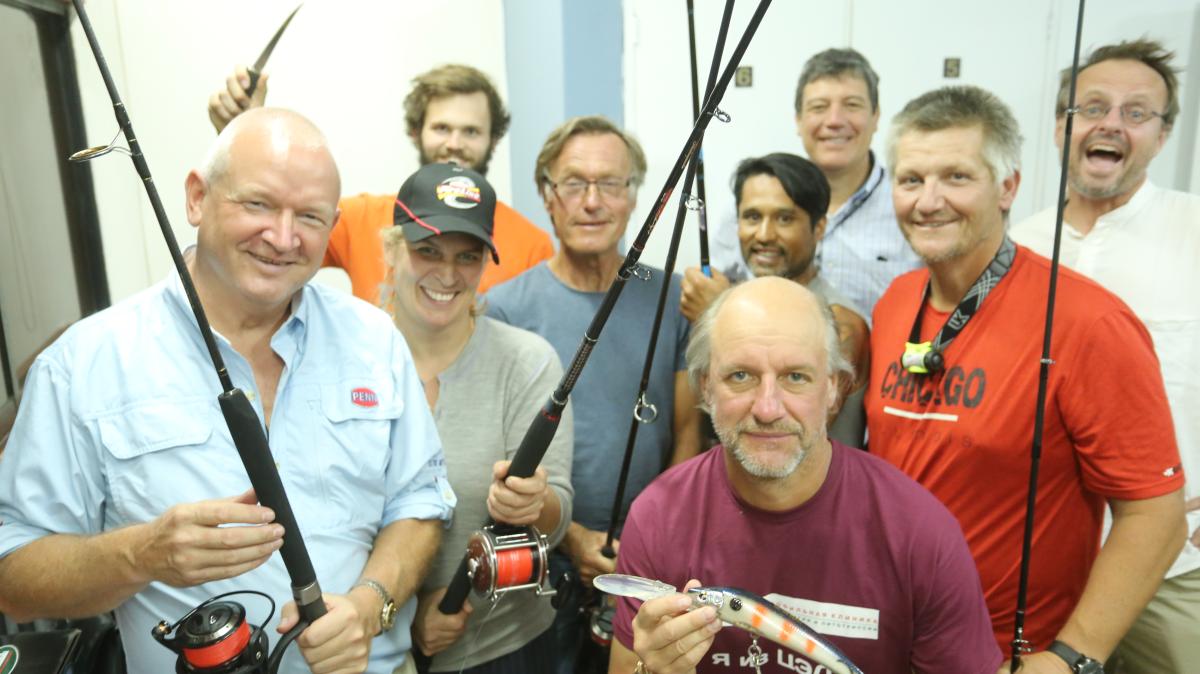
I am a hunter, harvesting the nature. I love to eat meat or fish that I have brought home from the nature, and spearfishing used to be one of my favorite activities when I was an active scuba diver. Sportfishing is great, and I very much appreciate the nobel art of flyfishing and I may also release fish when the situation is right for that. BUT I also love to fill up my freezer with fish I have caught. I really appreciate to see that you finally are catching quite well from the KonTiki rafts, with the fishing equipment I provided from PENN/ABU/Berkley and introduced to you in Peru. Keep up the good activities. Catch the fish with your spears, on the gaff, trolling and casting for fish from the rafts. Get the excitement, the photos and videos, the good food and NEVER let there be a single moment without having two lines with hooks in the water from the rafts. You will catch more fish, and I look forward to see the results on photos and video.
The first picture shows Dr Hook with hopeful students at the Escuela Naval in Lima in October 2015. The second picture is an underwater photograph of fish being caught from the raft, using equipment provided by Dr.Hook.
Albacore for dinner on Tupac
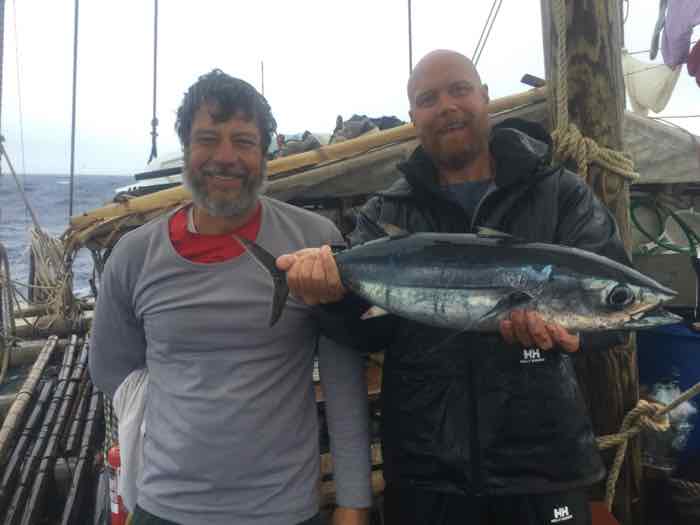
(2016-03-10) Dr Hook's words of encouragement (see below) must have caused good fortune for Tupac Yapanqui: a record 10-kilo, some say 15-kilo, Albacore was caught by Erik today. For every fish they catch, they can keep on fighting against the wind for more hours, towards South America.
In other news, a gale from south-east (the wrong direction, that is) hit the raft and caused havoc on the deck of Tupac. The kitchen has now been moved indoors for protection. On the map, you can see that the rafts are being pushed northwards by these winds.
Sleepless night
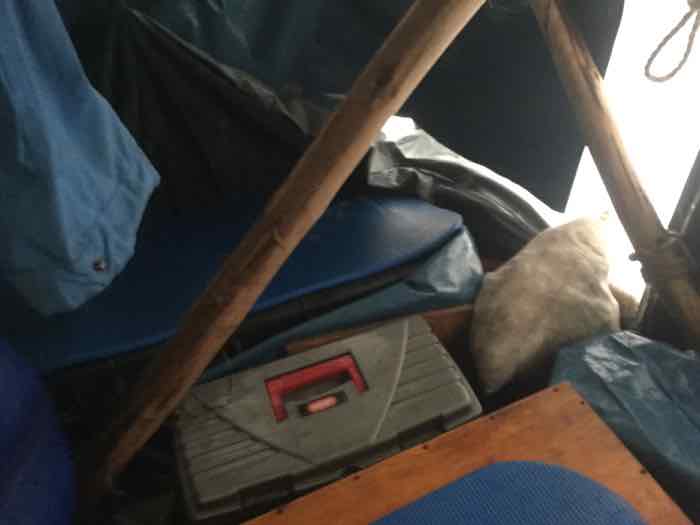
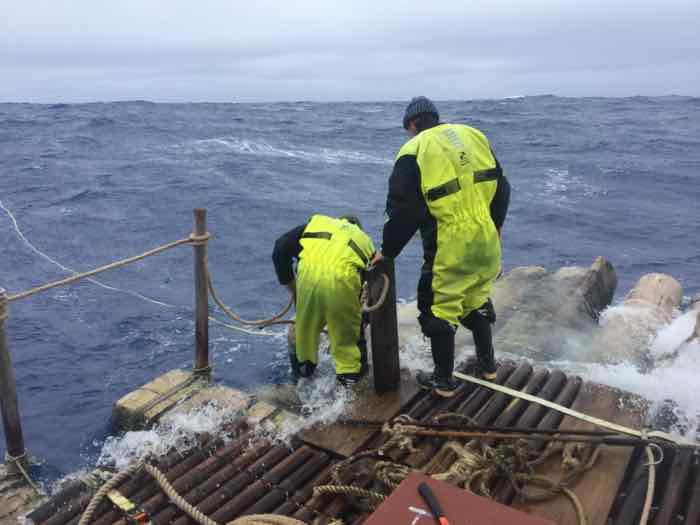
(2016-03-11) The crew on the Kon-Tiki2 rafts had a sleepless night when struck by a 8-10 meter high waves in gale conditions. Some damage has been reported and repairs will commence when the wind slows down as predicted by weather forecasts. In the first picture, the crew on Tupac are out on deck. The magnetic compass can be seen on top of the emergency raft. In the second picture, Roberto lights the gas burner by shorting a 12 volt electrical connection; there are no working lighters left. The third pictures shows damage to the walls of the cabin. In picture 4 and 5, captain Ola can be seen in his makeshift hammock bed, above the kitchen which has been moved inside, temporarily.
The floating garden of Rahiti
(2016-03-12) The rafts have sailed into biologically active waters since leaving Easter Island. In the first picture, Liv "The Barber" Arnesen is mowing the lawn in the aft of the Rahiti Tane, preventing the crew from sliding around on the slippery sea weed. In the second picture, barnacles and seaweed fight for precious territory.
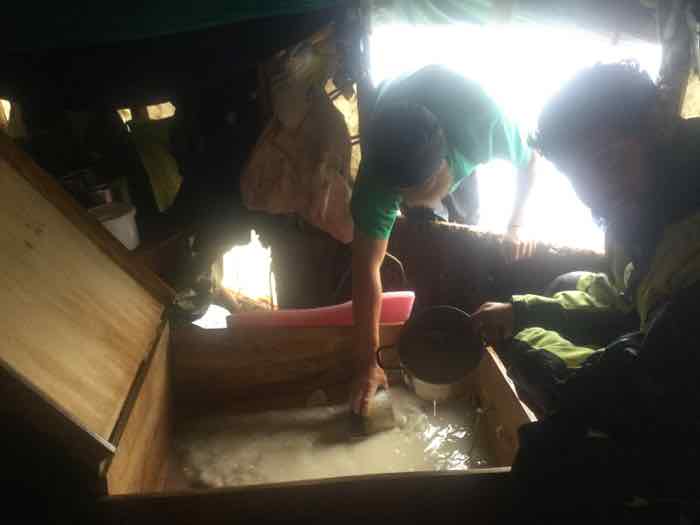
(2016-03-12) Today we have a lot of bread. Torgeir found a plastic bag full of breadmix in a box on deck. That sounds like great news, but the box was also filled with seawater. So the brave bakers on Tupac had to make bread of all the breadmix. Not a huge catastrophe for hungry men. In the first picture, Torgeir is seen with freshly baked – but also the last – bread from Baker Hansen. In the second picture, Pedro enjoys the bread. He will bring some to the Rahiti Tane raft, when he transfers later today.
Repairs & Recovery
(2016-03-13) The crew of Tupac has been repairing damage caused by a gale some days ago. Huge waves broke on the deck and ripped the walls of the cabin. In the first picture, Ola is repairing the railing. In picture 3, soaked breadmix is recovered and later turned into delicious bread.
(2016-03-14) As Torgeir was forced to finished Tupac's last package of flour yesterday, as it had gone wet in the gale, the crew of Tupac do not have bread to eat anymore. On Rahiti we are of course concerned by their situation, but as we are all thoroughly conversant with french history, we also know the remedy. "Let them eat cakes then." Inspired by Marie Antoinette, Erlend and Rasmus on board Rahiti spent the night watch between 00:00 and 04:00 baking buns for the flour and oven less people of the fellow raft. Erlend will bring the buns over tomorrow when he will, knock on balsa, finally end his more than four week long confinement onboard Rahiti and return to his home raft. The forecast looks good for tomorrow, so hopefully he will be able to make it.
As you can see in the pictures, the oven onboard Rahiti is also starting to show worrying signs of malfunction. Lighting it was quite some work, and the glass front of the hatch has to bee kept in place with duct tape. I guess you know what they say about things that cant be repaired with duct tape: "If you can't duck it, ..." Well, we seem to be able to keep the oven for yet another day or two.
One-huge-fish-Andrey
(2016-03-15) Andrey sailed 111 days before he got his first fish. And that wasn't a small one – it was our biggest catch so far! Andrey has never caught a fish from the sea before. No wonder he was yelling more than both Erik and Roberto when he realized that the fish was secured on deck. In the second picture, Torgeir can be seen with 7 kilos of fish filets.
Kon-Tiki2 Expedition ends
(2016-03-17) The Kon-Tiki2 Expedition has decided to end the expedition after 114 days and 4500 nautical miles in the South-East Pacific. The goal of the expedition has been to show that balsa rafts can sail from South America to Easter Island, and back. The Expedition reached Easter Island after 43 days at sea, but the return voyage has proven more difficult due to atypical winds.
We have shown that balsa rafts can sail to Easter Island. This is a first, in modern times. We have also made good progress on the return journey, but this is an El Nino year and the weather patterns we have encountered have been atypical. We realize that reaching South America will take too long and we prefer to evacuate to ensure safety for all, says Expedition leader Torgeir Higraff.
The Expedition consists of two balsa rafts that left Lima in Peru on Nov 7th, 2015, and arrived on Easter Island just before Christmas. On Jan 6th, 2016, the rafts started the demanding return voyage.
In a normal year, we would have reached South America by now. Instead, we are still 900 nautical miles from land and the weather forecasts are not promising. The crew is at good health and spirit, and there is no emergency situation. These rafts have proven to be exceptional vessels at sea. They have impressed us by their seaworthiness in all sorts of weather, over enormous and remote waters. Needless to say, it is sad to end the expedition without reaching South America., says Higraff.
The Kon-Tiki2 Expedition has done important scientific research on climate change, marine life, plastics, and pollution in the Pacific.
The rafts are rigged as floating research vessels through a unique collaboration between NIVA, NTNU, Kongsberg Maritime, Norwegian Meteorological Institute, Nortek, Sperre, Opera, and the American research organizations NASA and NOAA, says Cecilie Mauritzen, Chief Scientist of the Expedition. We have gathered large sets of data on climate change and pollution. From a scientific point of view, it has been particularly interesting that the expedition took place in one of the strongest El Nino years recorded, even if El Nino now contributes to the termination of the expedition. As research partners, we look forward to receiving and analyzing these data sets, says Mauritzen.
The Expedition has been supported by the Thor Heyerdahl Institute and the Ministry of Foreign Affairs. The expedition is adjourned in close collaboration the Chilean Navy. They have assisted us in a highly professional manner. The Norwegian Embassy has also communicated closely with the Expedition, says Ambassador Hege Araldsen at the Norwegian Embassy in Santiago, Chile.
For further information, contact Håkon Wium Lie, h@kontiki2.com or phone +47 90192217
Preparing for rescue operation
(2016-03-17) The crew on Tupac Yapanqui reports that a plane from the Chilean Armada passes above raft as they prepare to disembark. On Rahiti, Pedro is talking on VHF with a possible rescue ship, the Hokuetsu Ushaka enroute to Chile. In the first photo you can see one of many repair operations on Tupac. In picture 2 and 3, Erik is in his diving gear rescuing the echo sounders from underneath the raft. Picure 4 shows the lowered mast, and picture 5 shows the Tupac crew inside what has been their home for the last 10 weeks. In the final picture, taken a few hours later, the Hokuetsu Ushaka has arrived. Thus, the raft will be abandoned, but we will continue reporting on the well-being of the crew. Stay tuned.
All onboard, even Balsa
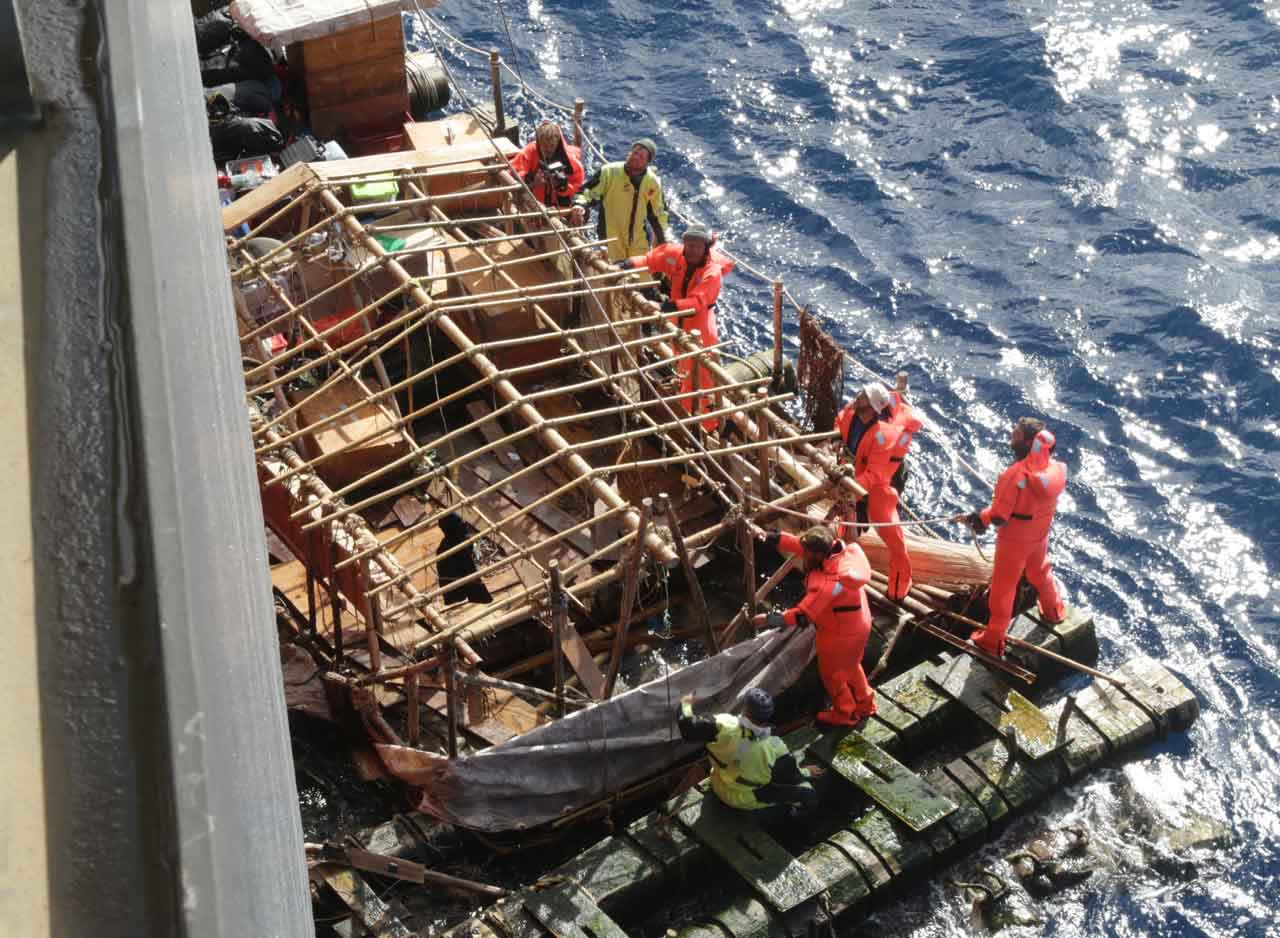
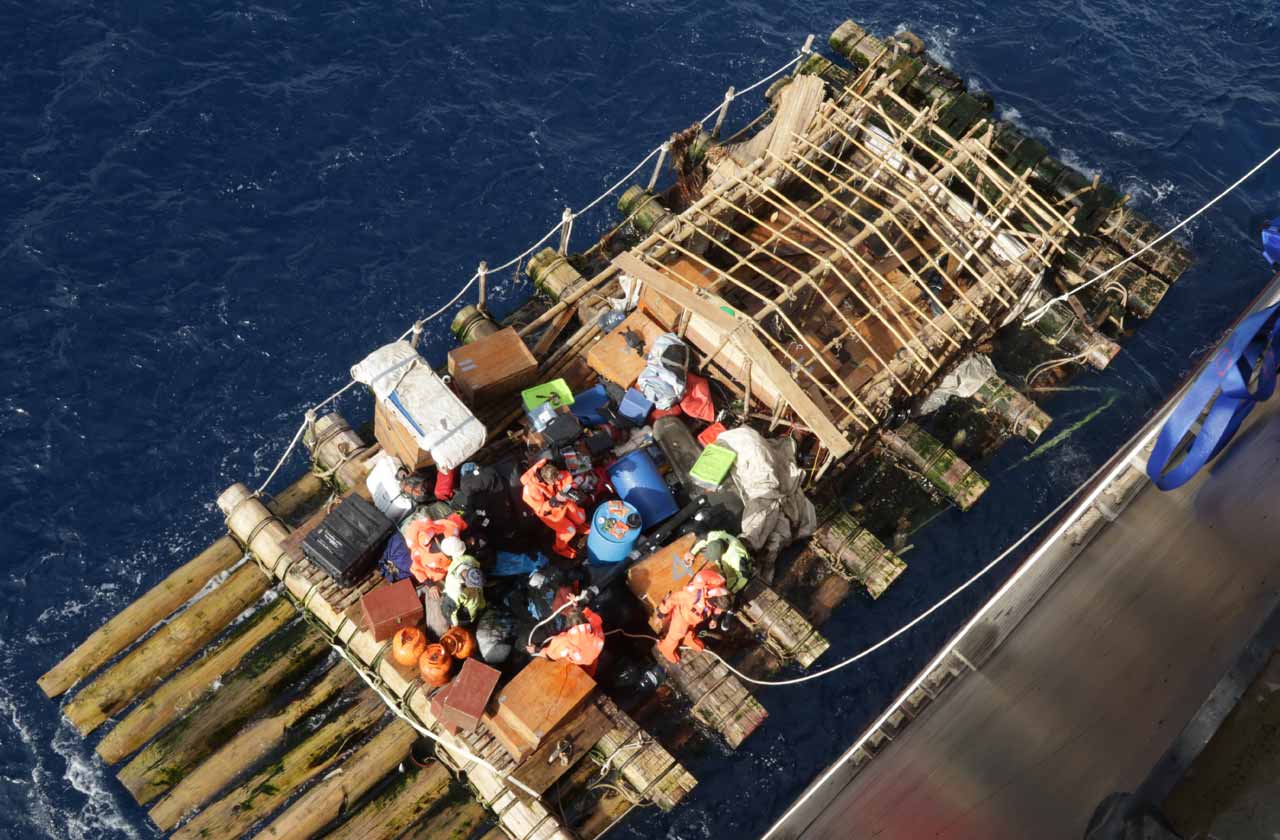
(2016-03-18) All Kon-Tiki2 crew members are now safely onboard the Hokuetsu Ushaka freight ship. This includes Balsa, our monkey mascot, as seen with Expedition leader Torgeir Higraff and Captain Signe Meling in the last picture. The expedition requested assistance after 114 days and 4500 nautical miles in the South-East Pacific. The balsa rafts were dismantled in a controlled fashion to not be a danger to other vessels. People and equipment were transferred from the raft to the freight ship, and Captain Ola Borgfjord can be seen with cases of equipment in the sceond picture. We are thankful to the captain and crew of the Hokuetsu Ushaka for welcoming us. Also, we thank the Chilean Navy for coordinating the operation in a highly professional manner.
(2016-03-19) When our call for assistance was sent out, the Maritime Rescue Coordination Center contacted the closest ship that could come to help. As we were in an area with little ship traffic we were mentally prepared that we could have to wait for several days. However we were lucky that the woodchip cargo vessel Hokuetsu Ushaka under the command of captain Sun Gug Yun was only twenty hours away from Rahiti Tane, on their way from Japan to Calbuco in Chile. After successfully saving the crew of Rahiti Tane, Hokuetsu Ushaka continued south a few hours in order to reach Tupac Yupanqui.
Captain Ola and captain Signe, both needless to say concerned over the situation, were deeply impressed by how perfectly the captain maneuvered the 49 000 tonne and 210 meter long ship so close to the raft that the crew could throw mooring lines down to the rafts. This ship is as long as a skyscraper is high and has only one propeller - maneuvering is not easy. The huge hull of Hokuetsu Ushaka served to dampen the waves as the assisted raft was tied longside. A rope ladder was lowered down along the ship side and the raft crew, each secured with a harness, climbed up the 16 meter high ship side. Equipment was hoisted up in another rope that was manned by the dedicated crew that worked hard to save as much as possible.
All procedures were followed and it was a very successful rescue operation - twice! We would like to commend the captain and crew for the professional and friendly way in which we have been received onboard the ship.
(2016-03-19) The 14 crew members of the Kon-Tiki2 rafts are now safe and healthy on board the cargo vessel Hokietsu Ushaka after a successful rescue operation Thursday. We decided to ask The Chilean Armada for assistance and to end the scientific expedition Kon-Tiki2 after 115 days of sailing and 4½ months at sea. The two rafts – Tupac Yupanqui and Rahiti Tane – were made of 11 balsa logs and 10 crossbeams held together by 2000 meters of natural fiber ropes – like the ancient South American rafts. Tens of thousands of waves, up to six meter heght, hit the rafts in an extreme El Niño year. This constant stress for 16 weeks weakened the ropes. Some of the 150 or so knots were replaced in tough working conditions, but we could not replace all of them. In particular, the rigging was a major safety concern. To avoid accidents (e.g., a mast collapse in a storm) we decided to perform a controlled disembarking during daylight in good weather.
We are very happy with the help from the Armada. In October last year, a month before the launch of the rafts, I met representatives of the Aramade in their headquarters in Valparaiso. On Easter Isladn, the Armada assisted us in mooring the rafts, and during the voyage we have had weekly contact with the Armada.
Kon-Tiki2 is a unique collaboration. Logs from Ecuador provided by the AirexBaltekBanova comany were turned into rafts in Peru at the shipyard of the The Peruvian Navy, then sailed to Easter Island, and finally rescued by The Chilean Armada in an attempt to reach South America.
(2016-03-19) After two days on the cargo ship, the Kon-Tiki crew and the scientific equipment from Tupac are now with the crew of 43 people on the coast guard ship Pilot Pardo. We have been rescued twice this week and I think my fellow Kon-Tiki2 crew members share my opinion that both rescue operations were perfectly executed. My gratitude goes firstly to Captain Yun Sun Gug from South Korea who made us feel as home in Hokietsu Ushaka. He was rescued himself in the Indian Ocean 41 years ago when his ship sank early in his career. I know what it is like, I understand how you feel, the veteran told us in a moving speech yesterday. In those days we did not have communication like now, we only had morse. My wife and daughter suffered a lot for 20 days before they got to know that I was okey. In comparison we talk with our family with our tablets, thanks to our Opera Software sponsorship. I will never forget Yun and his crew.
In Pilot Pardo we had chicken for lunch and were served wine. Now we rest in good beds and enjoy Chilean professional rescue standards. These men really know what they are doing. It took only a few minutes to bring us into the RIB boat and from this we were lifted up in the air and to the stairs that lead us onboard the 80 meter long ship. Talcahuano is their home port, some 450km south of Santiago. We'll be there Monday at 10am.
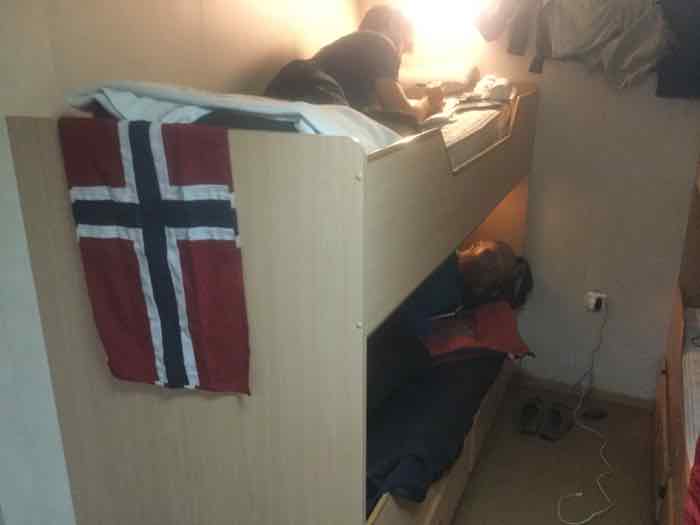
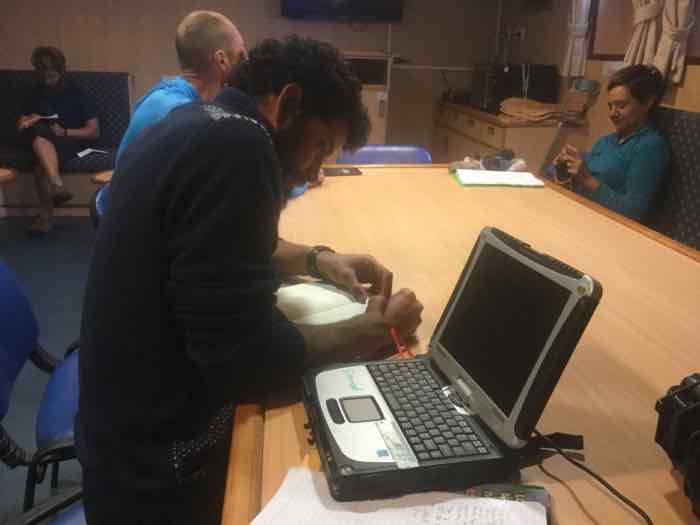
[In the pictures, you can see Captain Yun Sun Gug with Torgeir; a picture from the transfer to Pilot Pardo; the rescued Norwegian flag onboard Pilot Pardo along with recognizable crew members Lisa, Andrey and Pedro. Finally, Torgeir with the officers on Pilot Pardo]
Maori power!
(2016-03-20) Lisa, one of the Kon-Tiki2 crew members, was injured when being evacuated from the Rahiti Tane raft. Read Liv's description of what happened and how Lisa continued the climb to the deck of Hokuetsu Ushaka.
(2016-03-21) The Chilean Navy ship "Piloto Pardo" today entered the port of Talcahuano, near Conception, in Chile. All Kon-Tiki2 crew members are on board. While still at sea, but with cellphone connectivity, Expedition leader Torgeir Higraff expressed heartfelt sadness for not arriving by raft, as he has been planning for years. However, he also expressed gratitude for everyone being safe thanks to the Chilean Navy and the Hokietsu Ushaka freight ship. In the hours to come, the crew will transfer to a local hotel and have debriefing sessions. And probably a good meal, prepared on land, for the first time in 74 days.
Home to a hero's welcome
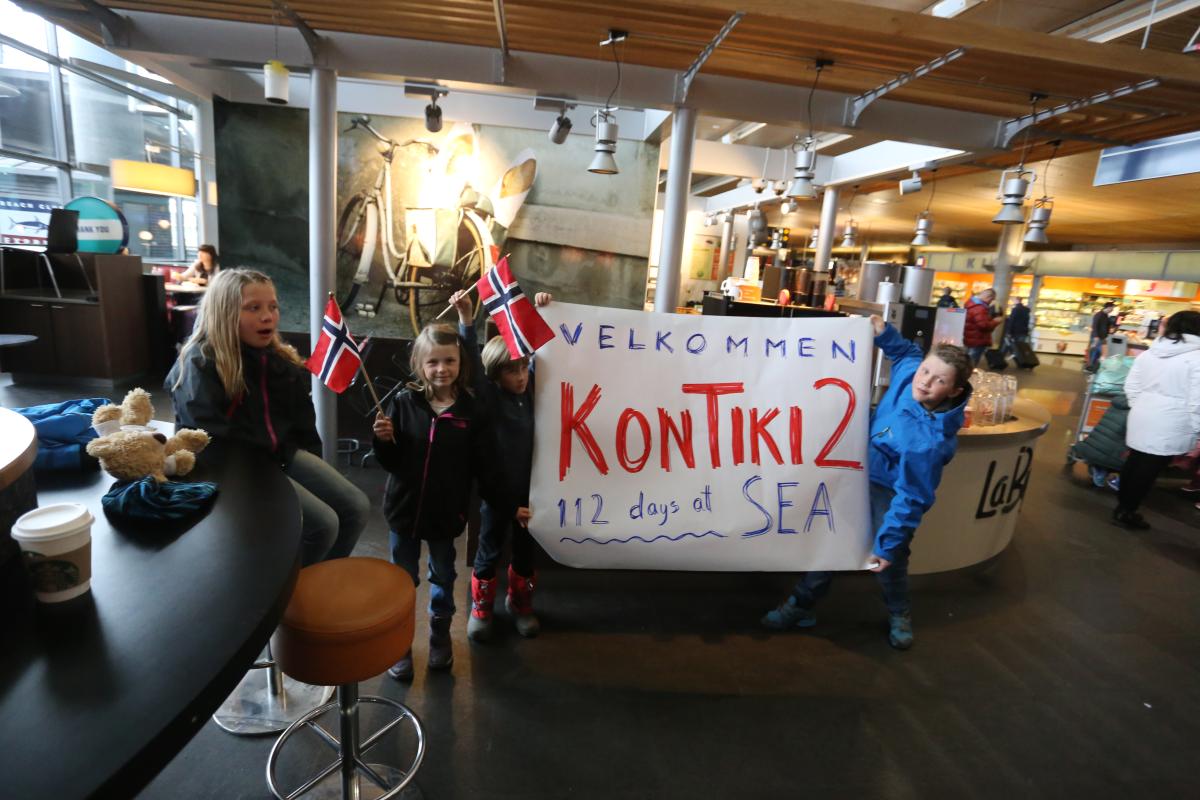
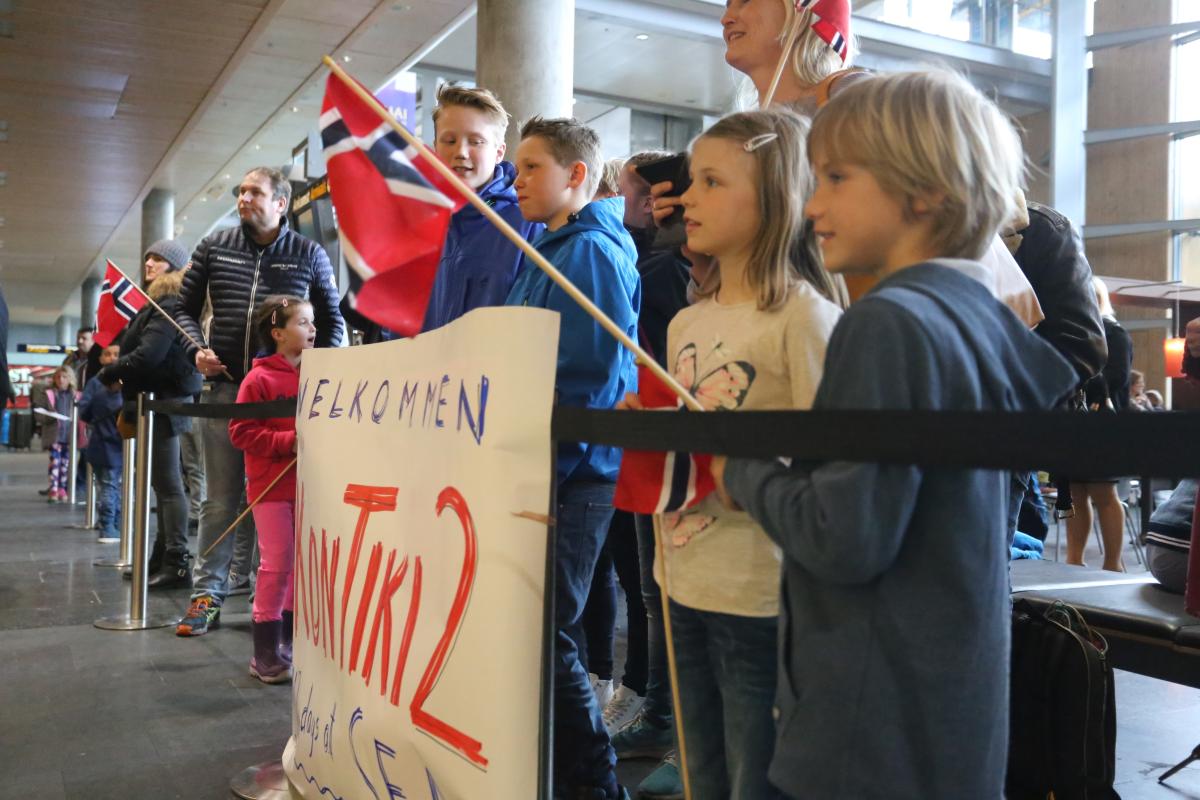
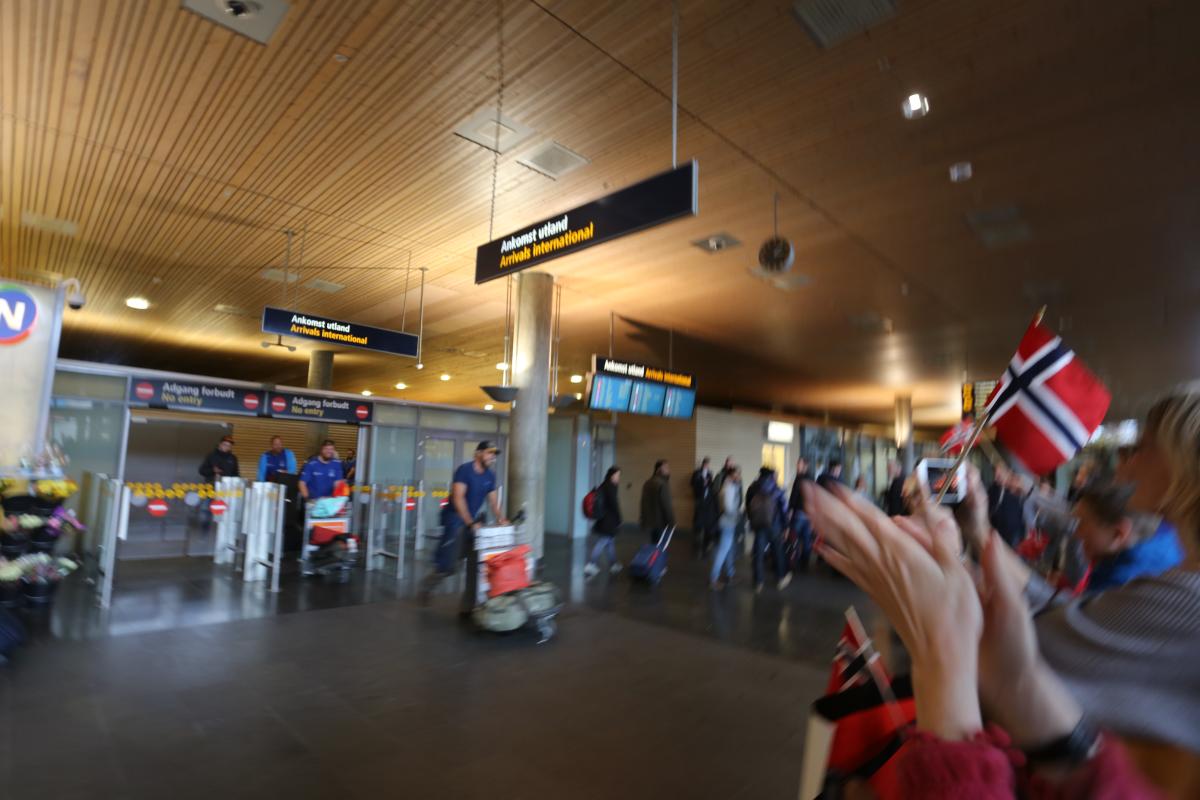
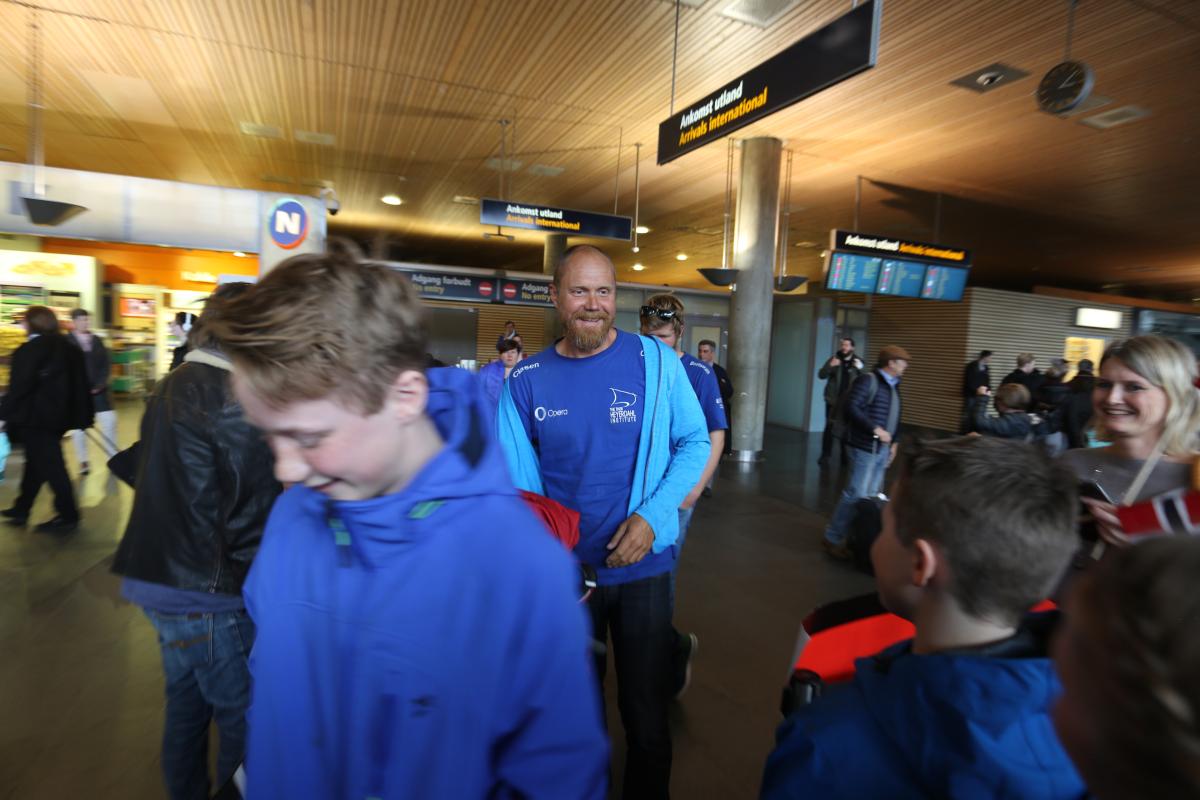
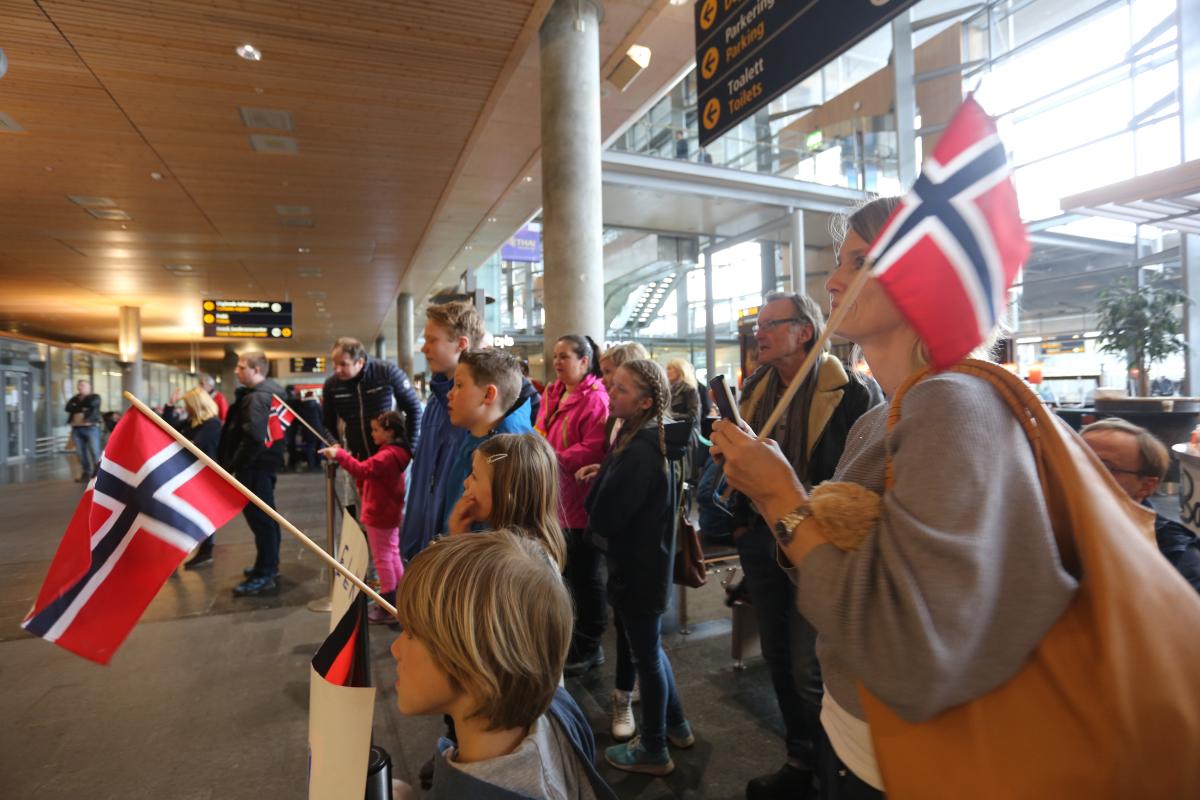
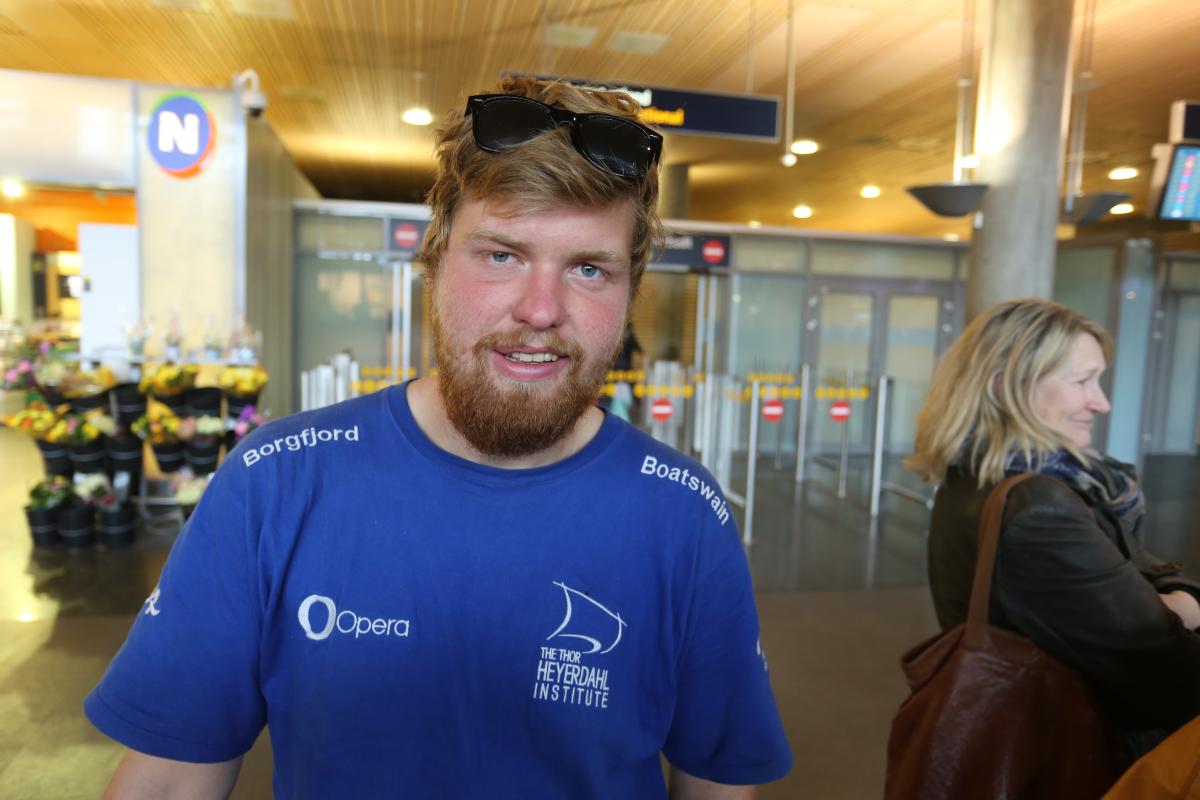
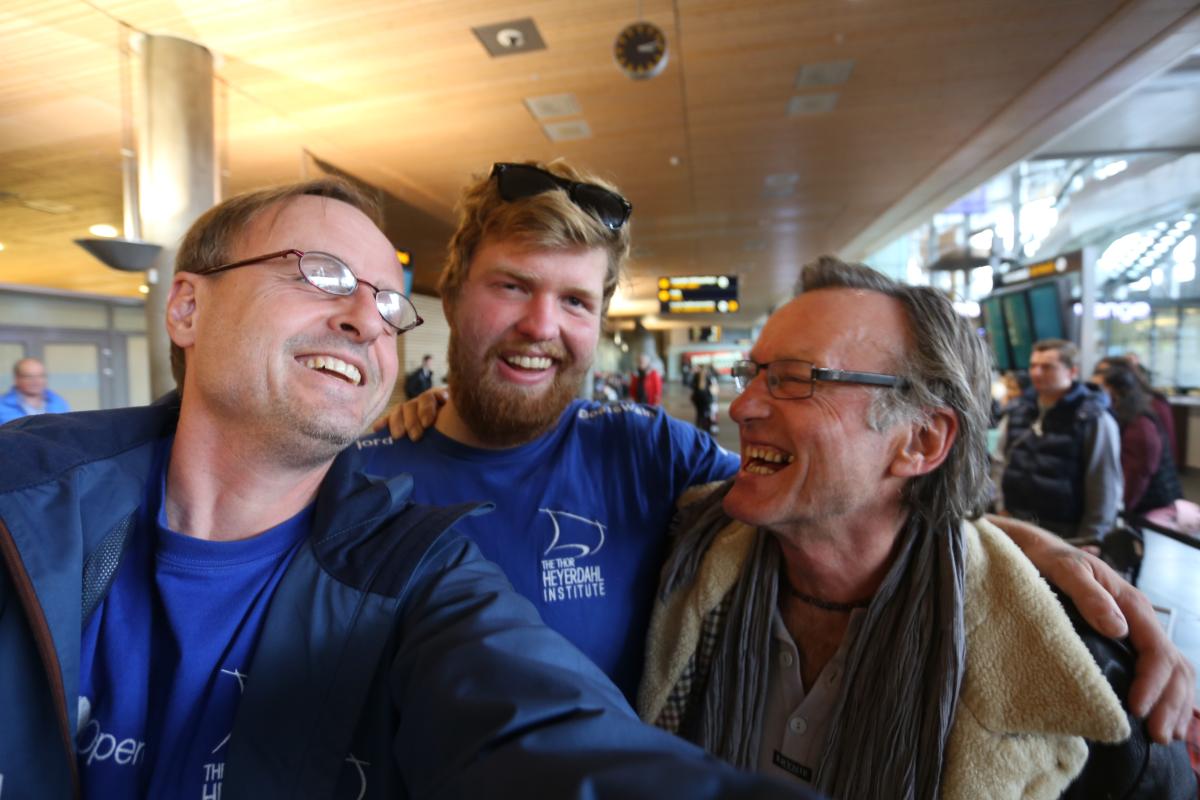
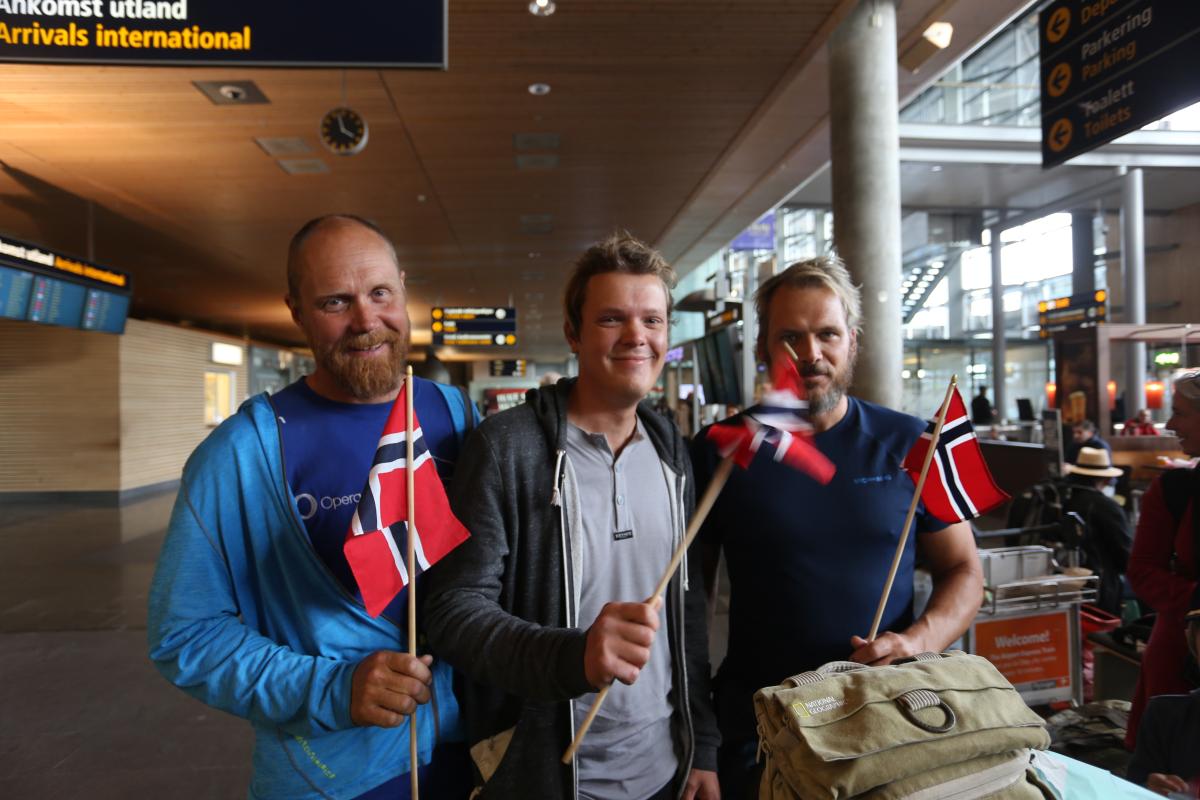
(2016-03-25) Several Kon-Tiki2 crew members, including Expedition leader Torgeir Higraff, landed in Oslo today, to a hero's welcome. Family and friends had gathered at the airport to greet the crew. In Norwegian tradition, flags were used to cheer the returning sailors, who were happy to be home after an extraordinary journey. In these pictures you can see Ola, Erik, Erlend in addition to Torgeir. Also, Håkon and Øyvin, crew members from the first leg, were present, and can be spotted.
Andrey, the Russian crew member on Tupac, did not arrive in Oslo, but he has written some closing remarks, well worth reading.