By Jimmy
(2016-02-01-fish) You can call me Ishmael. That's how Herman Melville starts his classic novel Moby Dick. The situation on board Tupac had started to resemble that of captain Ahab's ship. Except he was going crazy over one particular Whale. We, or at least I, were going crazy over any fish. Twenty five days of nothing but the occasional squid or unidentified deep sea fish. All we had seen of the big pelagics was a lone Dorado playing along the raft. Uninterested in our more and more desperate attempts at catching it. At the final stages of desperation I resorted to using Serrano ham as bait. No result.
Then, today, amidst the biggest waves and the strongest winds of the second leg. It appeared again. A quiet small female Dorado, playing in the waves along the raft. Almost surfing. It's beautiful emerald body shining beneath the surface. The Penn rod was ready to be used. But as soon as I had it in my hand ready to pursue, the Dorado was gone. Cursed! I assumed a position overlooking the windward side of our raft. Sun from behind me to be able to see my prey. After about twenty minutes a much bigger bull dorado appeared as a silhouette in one of the waves. When the waves are high enough you can actually se the fish inside the towering wave. Like an aquarium. I made a cast maybe ten meters in front of the bull. He darted forward and took the bait. Like out of reflex. I tried to set the hook but the bait came flying at me. The Dorado disappeared. I threw again and again. But he seemed Uninterested. Or maybe he had felt the hook and didn't like it. Who would?
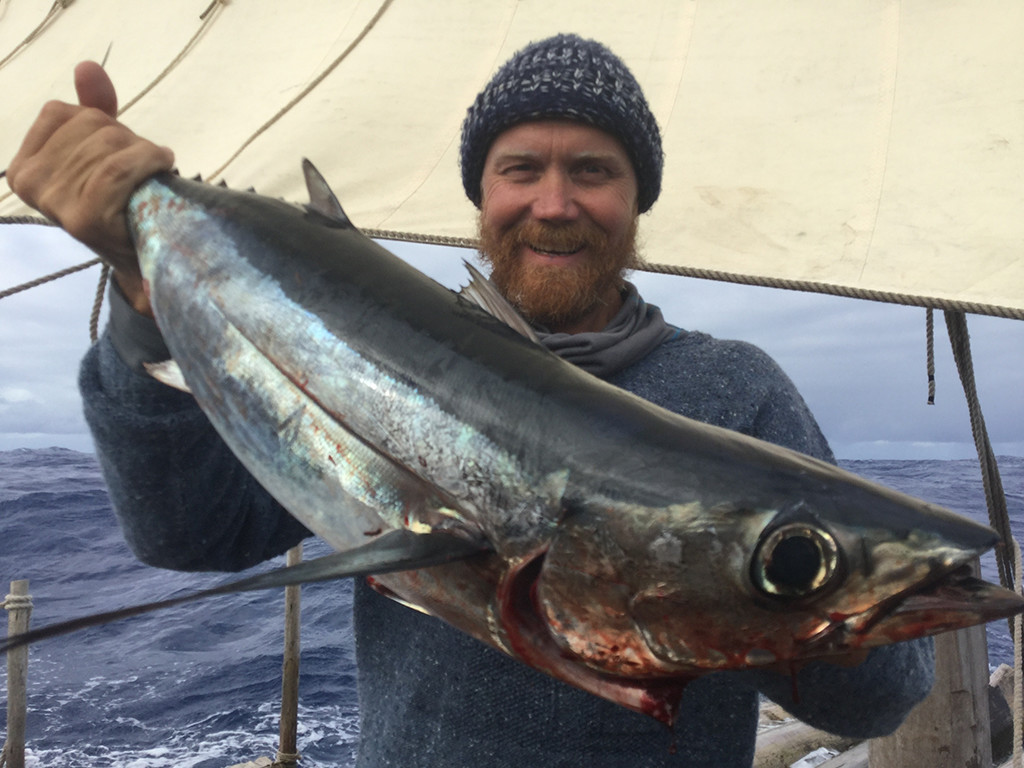
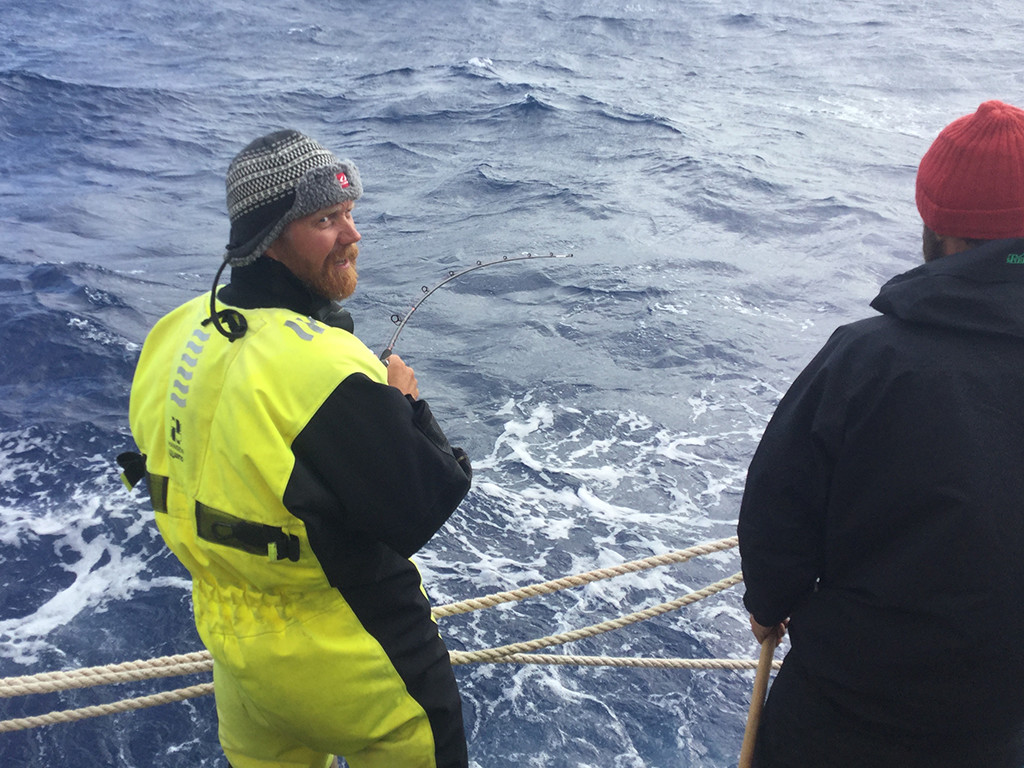
I changed tactics and used a small fish with a Mustad circle hook. Letting it skip just at the surface. Minutes turned to hours. When suddenly the bull came thrashing trough the waves towards my bait. But for some reason the bull shone away. Lurking some ten meters away. I tried to cast the bait closer. He pursued trying to take it. I free lined to let him take it easier. He took it. With the circle hook you should not set the hook. Just tighten the line. I let him almost swallow the bait before I did that. I could feel his weight. But he didn't seem to react. Just swam lazily away. I put on some pressure, he answered with a forceful rush of fifty meters ending in a spectacular jump. He took line as if it was nothing. When he had taken some three hundred meters I managed to get him to start swimming along the raft rather than from it. A big win since he had already taken all the fireline. Just some monofilament line to protect the spool left. He continued to jump. Wasting a lot of his energy. I gained little, but so did he. After a while he decided to go deep. I lost what little line I had and was forced to apply all pressure needed to stop him. He caved before the equipment or I did.
The most critical moment was still to come. The landing. Thanks to the steely nerves of the Tupac crew we managed to gaff him and put a towel around his head with ease. Dorados suddenly stop flapping about when you do that. Odd. The drama took maybe twenty minutes. The fish being rather big, just as the waves and the wind today. As we fishermen say when we caught one: tails up!
(2016-02-02) The Pacific winds and waves are playing with us. Friday night we had strong winds and our top speed was 6.5 knots! When the wind turned southernly Saturday around noon, we took down the sails. We are now drifting slowly northwards and the weather forecast is not promising. The strong wind creates waves up to 5 meters. When they hit the deck, the bamboo and the mats fracture. Every day we make repairs but the waves continue to damage our deck – often with great success.
Last week was a week with low pressure and rainshowers. Everything got humid. Saturday the sun came back and we dried out sleeping bags and clothes. We have a dream to reach the fourties on February, 10th, which is Captain Signe's birthday. To do so, we need maximum luck with the winds. No matter our position, we are looking forward to the birthday party!
The last two days I've been reading Steven Callahan and John Caldwell's books. Callahan survived 76 days on a lifeboat after his boat sank. He survived thanks to his practical skills and mental strength. Caldwell, who had no sailing experience, bought a sailboat in Panama after the last world war to get to his wife in Australia. On his way he practised and learned to sail and navigate. His mast broke in a storm and he drifted for months. He managed to catch a few fish and birds, but also cooked his military boots, his belt, ate lipstick and drank motor oil to survive. Recommended books for sailors and armchair sailors.
35 degrees south!
(2016-02-03) Rahiti Tane today passed 35° south on its way to the roaring 40s where the Kon-Tiki2 Expedition hopes to find westernly winds that will bring the rafts towards South America. The other raft, Tupac Yupanqui, is also expected to pass the invisible line sometimes today. Both rafts have satellite-based trackers which report the position every 30 minutes. Therefore, you can follow the rafts' movements on the maps linked from this page.
Are there effects of El Niño?
(2016-02-03-el-nino)
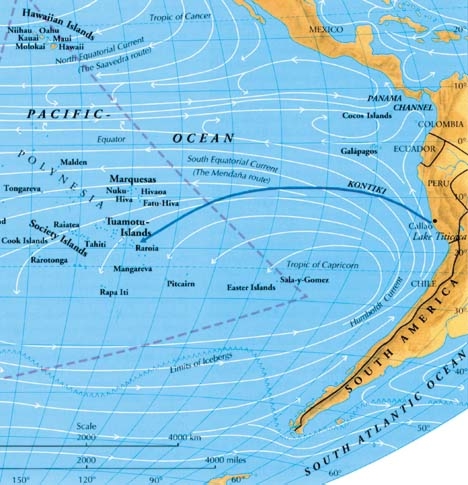
First, consider a simplified chart of currents in the region of Easter Island in picture one. This chart shows
the prevailing winds currents, which is the route taken by Kon-Tiki i n 1947. Around Easter island, at 30°S, the prevailing winds and currents are towards southeast.
Kon-Tiki2 departed Easter Island on 7 January and first sailed towards southeast. The rafts need to sail southwards in order to reach the eastwards winds and currents around 40°S. However, an abrupt reversal occurred on 11 January that took the rafts towards northwest instead. For some days, they sailed on a meandering path until they turned southward on 17 January. What happened between the 7th to the 10th of January?
The second picture from the climate.gov website shows that a
westerly wind burst associated with El Niño occurred between
the 5th and 9th of January and the wind was blowing in a
west-southwesterly direction in the region that the raft was located
at that time. This appears to be consistent with the track of Kon Tiki
2 in that period (see map in Kontiki2.com) and suggests that El Niño
did influence the path of Kon Tiki 2 as it left Easter, but that this
effect was brief.
(2016-02-04) Low winds can bring the morale down because they extend our time to reach land. However, they also give the crew on Rahiti a scientific scenario. Plankton, species that are transported by the ocean currents, is everywhere on our path. The Pacific might look empty, but a careful eye will soon find out that the blue hides secrets. We try to unveil some of them.
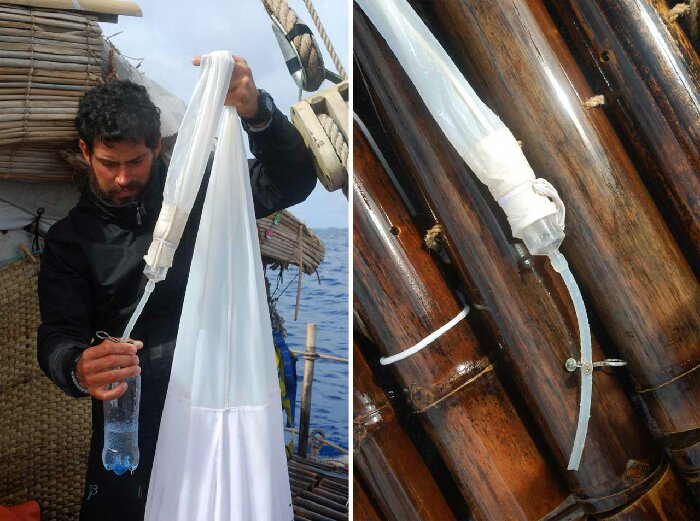
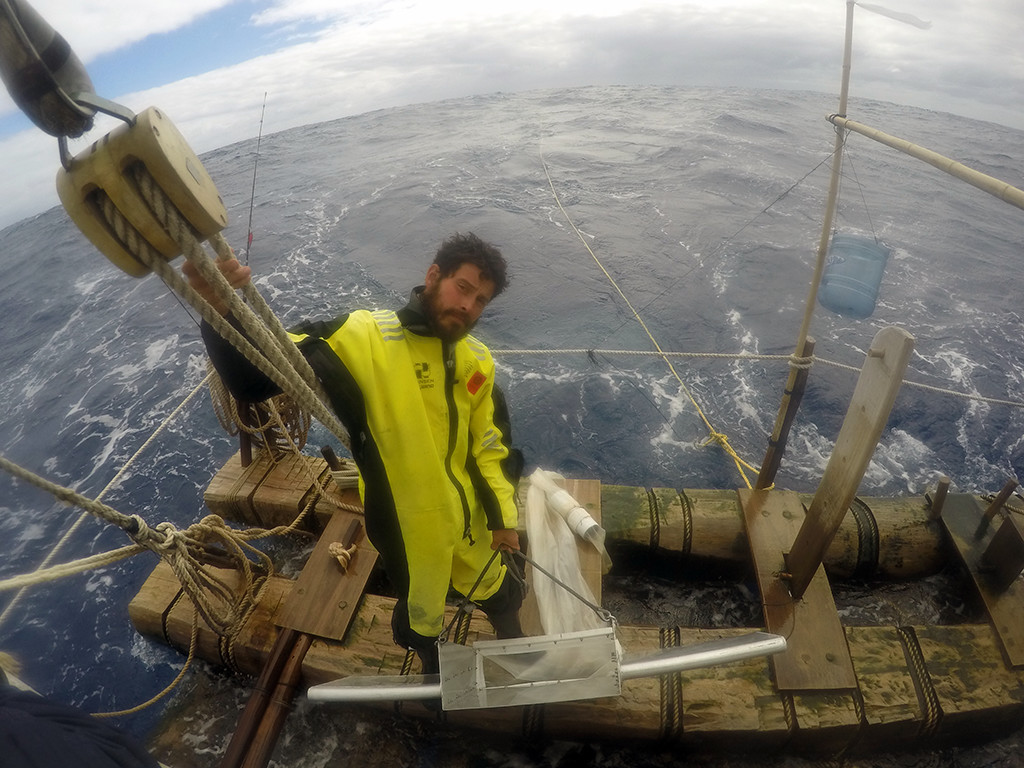
During a regular night watch the observer can get attracted to bioluminiscent organisms in the sea. These are animals and plants that generate light when perturbed by the raft. One of our activities is to collect them. We are equipped with a net that has a very small grid. When the wind is weak, we don't move very fast. This is the ideal condition to deploy the net so that it doesn't brake from pulling too much. Also the specimens inside do not get crushed by a strong pulling raft. After an hour of patience we can collect the surface plankton sample. In a lab, we will be able to analyze them under the microscope.
We also filter out of the water the organisms that are capable of using the sun to generate their own food, the phytoplankton. They give us an idea of how much oxygen is produced and how much the pelagic ecosystem can produce; they are the basis of the food web. Finally, we extract DNA out of the water. The sea is a soup of cells and bacteria. They represent a library of genes available in the ocean. It is there in the blue, but we can't see it with our eyes. While Tupaq extracts macrofauna, dorados, to eat them, we extract microflora and fauna from the sea to study them.
In the first picture, you can see a greenish circle in the filter. This is condensed evidence that we are surrounded and outnumbered in the middle of the Pacific. The net is one of the tools provided by NIVA to help us better understand our environment. The photographic material is a courtesy of Evgenij Orlov.
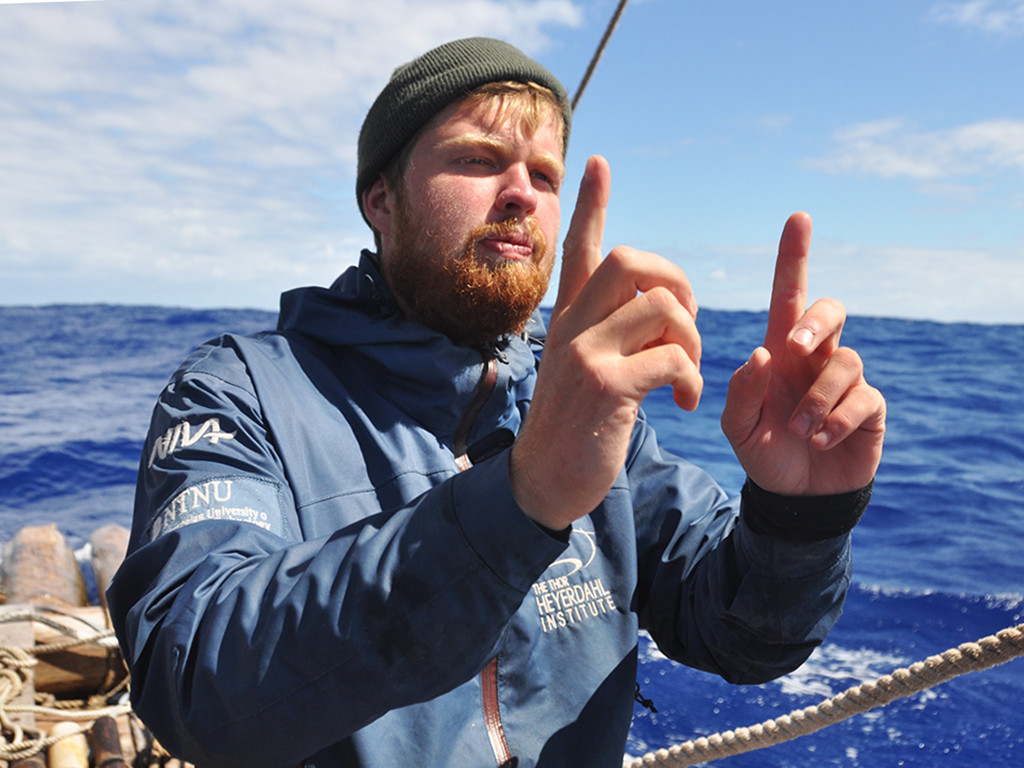
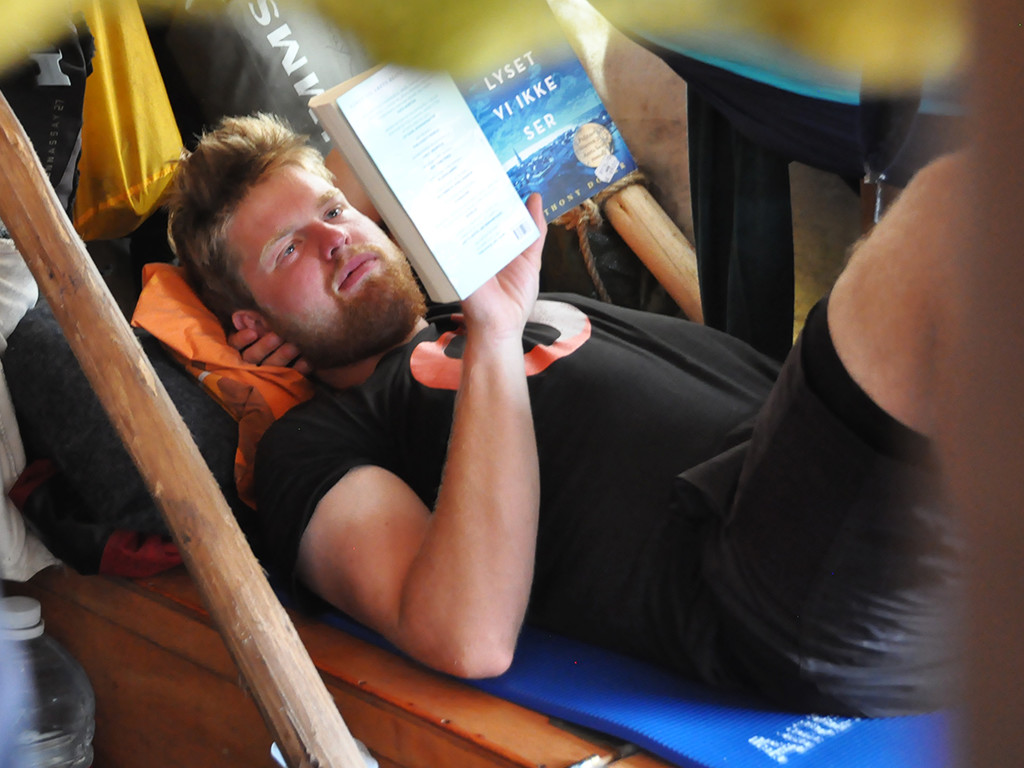
(2016-02-04) A fine batch of Erlend's photographs made it through the satellites today. In these pictures, the brave men on Tupac Yupanqui are shown in their everyday activities. Ola can be seen in the first five pictures. At the end, the Jotron AIS receiver marks the position when then pictures were taken.
(2016-02-05) While Jimmy aboard Tupac, inspired by Herman Melvilles classic novel Moby Dick, is going Captain Ahab on the fishes around their raft, the crew aboard Rahiti has a more relaxed attitude towards fishing. Besides the scientific sampling led by Pedro, and his attempts with the fishing rod, we have tried to outsource the fisheries to the ocean it self.
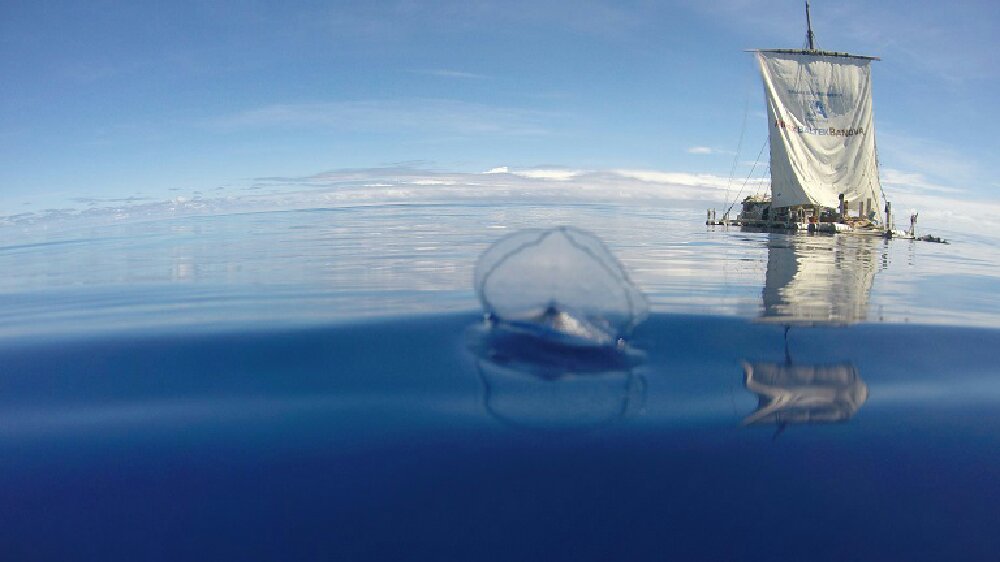
Sometimes it does not pay off in a culinary way though, as when a Portuguese man of war (a type of jellyfish) yesterday got stuck in the wakes between the logs in the aft. The waves threw it back and forth tearing the tentacles of the poor thing. When it was disarmed a little wave served it to us by lifting it up on the decks. An excellent opportunity for taking pictures of this fascinating creature that occasionally has passed us by the last few weeks. Pedro, eventually picked it up with a pincer for a closer examination and now the little predator is lying in state inside a plastic bottle on our deck.
From a nutritional point of view, we had better luck last night when a 25 cm squid took a hike aboard the raft. Liv caught it and thought it could be used as bait later on. Well, for the lazy fisherman it is also a possibility to eat the bait yourself. Pedro took the opportunity to show off his Jamie Oliver skills, by slicing up and frying the squid in oil. We added some garlic and had soy sauce as a salivating dip. O, the taste was almost divine! Would have been a waste to feed it to the dorados.
By the way, the animal life is increasing in abundance around the raft as we go south, to more productive waters. Besides the already mentioned dorados, of which we saw one jumping after fly fish yesterday, sea birds are becoming increasingly common. And today we also saw an albatross. It would be fun to see whales again though. In that case, let's hope that Jimmy does not get too inspired by captain Ahab and grabs the nearest harpoon.
A Russian doctor is a doctor and so much more
By Anna Turchaninova and Nadya Artemieva
(2016-02-06) Soviet doctor Yuri Senkevich was a part of Thor Heyerdahl's Ra (1969),
Ra-2 (1970) and Tigris (1977-1978) expeditions. Through his
professionalism along with amazing interpersonal and presentation
skills, Yuri has not just promoted Soviet-Norwegian friendship and the
whole Thor Heyerdahl story. Being a military doctor in those darker
times, he was also a person with a truly global mindset. As a TV
journalist and host of the extremely popular «Travelers' club» (a TV
show aired for over 30 years on Central Television), he would open the
world without borders to Soviet people.
As a tribute to Yuri Senkevich, Torgeir Higraff, the leader of Kon-Tiki
2 mission, has invited two Russian doctors — Boris Romanov and Sergey
Goltsov — to participate in his project. Boris Romanov sailed aboard
Rahiti Tan from South America to Rapa Nui, and Sergey Goltsov took his
place on the raft for the second leg of the expedition. Both have
proved to fit well in Senkevich's shoes. Qualified doctors with
extensive experience in athletic and extreme medicine, they are also
investing substantial time and effort in making the expedition more
visible to the public.
Sergey Goltsov is a storytelling gem. His daily reports (that keep
coming in spite of poor connection and other technical difficulties)
are full of vivid metaphors and poetic imagery to convey the power of
the Ocean and emotional diversity of the team. 'Just another regular
day on the raft' becomes a real adventure for lucky Russian readers!
Boris Romanov is a truly charismatic presenter. Upon his return from
Rapa Nui to Moscow, he was interviewed several times and has recently
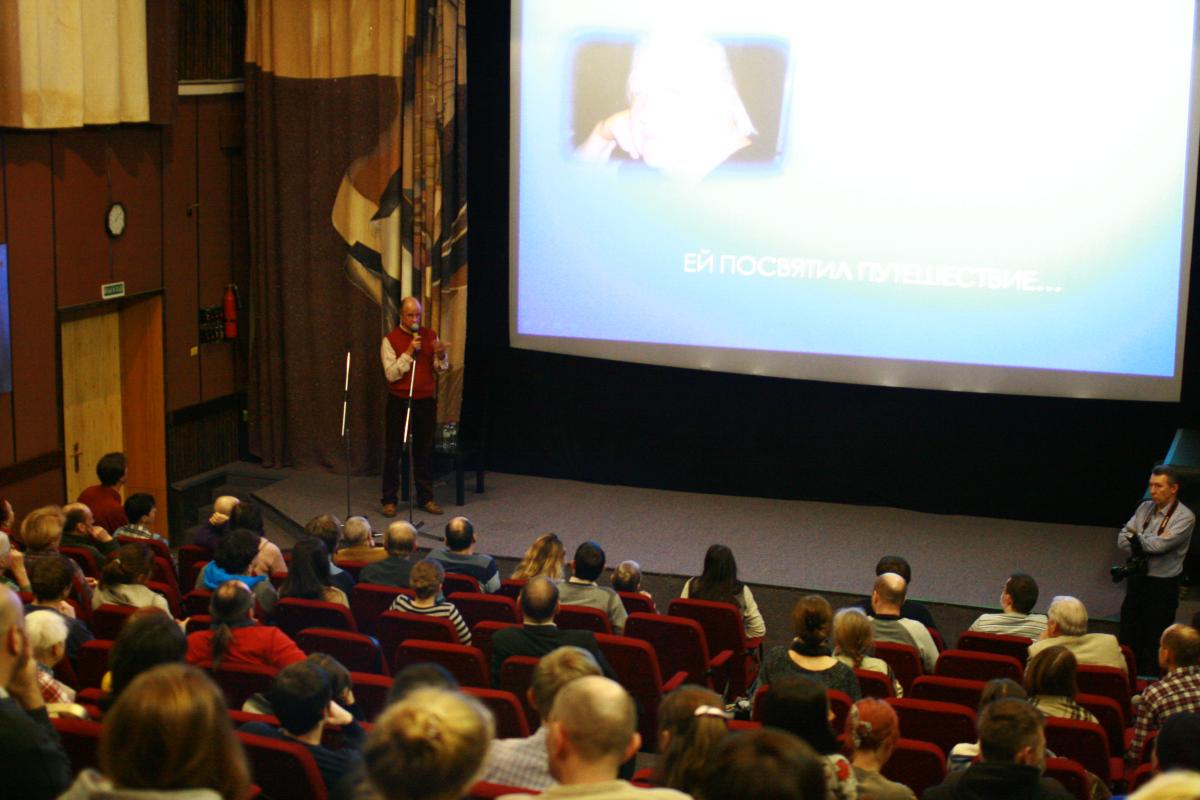
hosted a mind-blowing public presentation at the State Darwin Museum.
Boris showed some pictures of Kon-Tiki 2 and told stories — abundant
with detail and medical humor. «I decided to rather be a bad sailor
than a good doctor, and it worked. We didn't have many health
emergencies, I suck at tying knots, the fish is afraid of me, so I
mostly did the dishes and assisted the heroic women of Rahiti Tane in
handling night watches and navigation». Boris has compared managing the
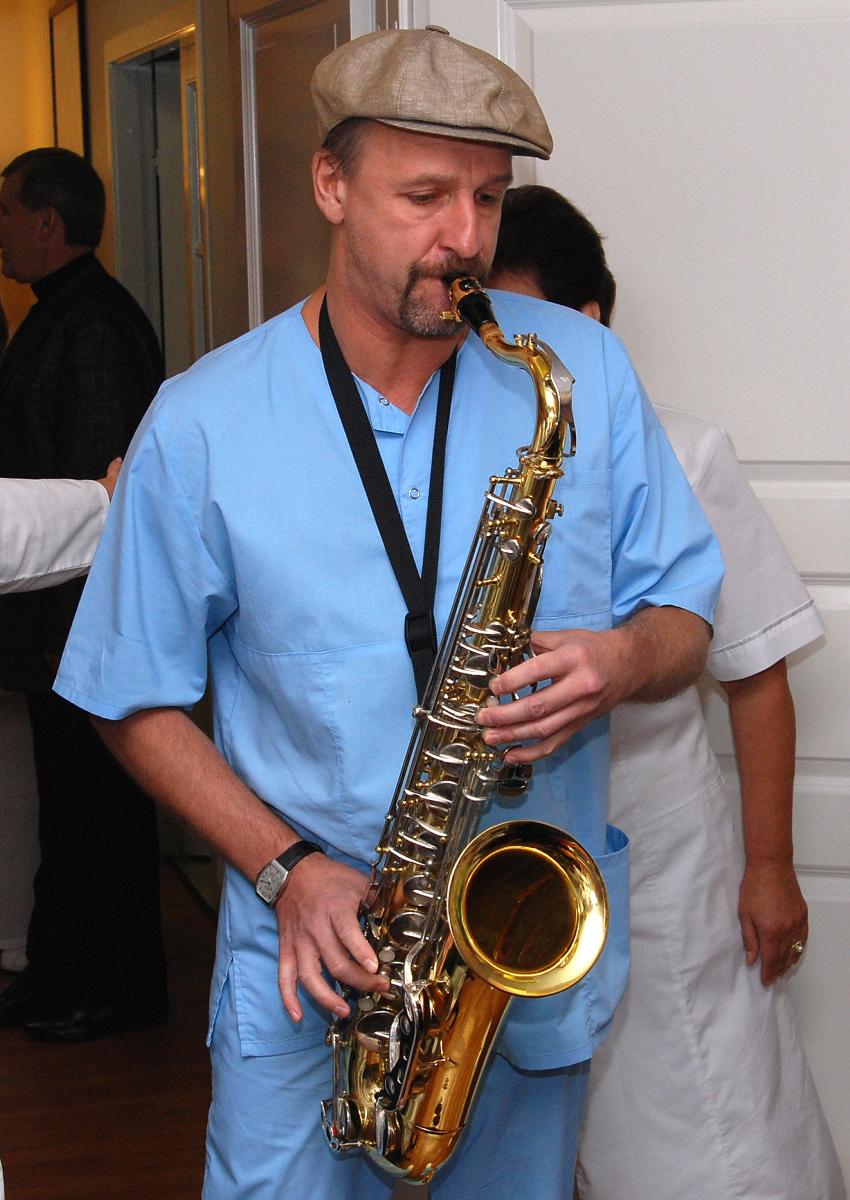
guara boards with playing a trombone, but he himself is a saxophone
person and prefers a different approach to raft sailing. He says one
should let the raft sail with the wind and the current, then adjust the
course substantially, and keep sailing with minimal interference.
Exhausted with constant humidity and having lost 12 kilos of weight,
Boris already dreams of going back. He is convinced that Kon-Tiki 2
will accomplish its mission and reach South America, even if it happens
later than expected. We stay tuned for Sergey Goltsov's reports!
[The pictures above were taken during Boris' speech in the State Darwin Museum in Moscow last week. Except the first, that is: Boris played the saxophone before the Kon-Tiki2 expedition]
(2016-02-06) As the crew on Tupac Yupanqui were about to mark the first month
at sea, wind speed suddenly rose from 20 to 40 knots which is strong
gale. The front deck was washed by a huge wave that almost took our
kitchen to the sea. Inside the cabin, a wooden box with cups, forks,
knives and spoons was lost. Also, the wave pushed its way into the
bookshelf and our precious collection of nautical books from Flyt Forlag ended up on deck.
Ola started the rescue operation by ordering two reefs in the sail.
There was no damage to rig nor sail. Erik and Torgeir has their
personal spoons and cups. The rest of the guys need to find more
creative ways of eating soup. Dinner today at Tupac is Real Turmat.
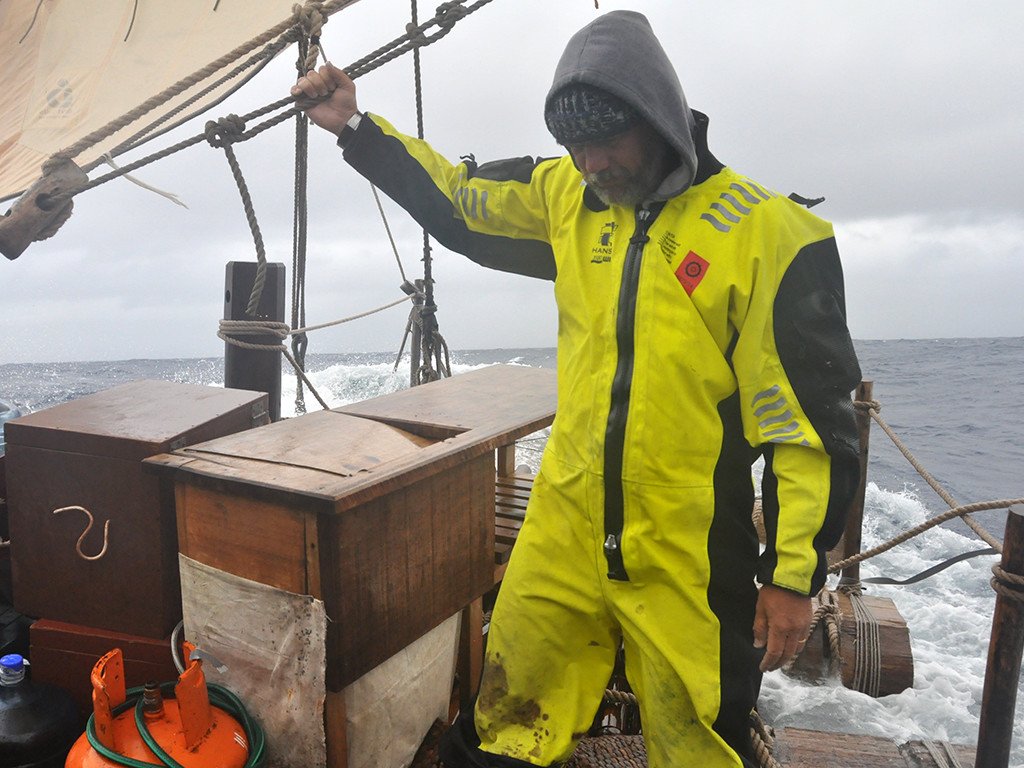
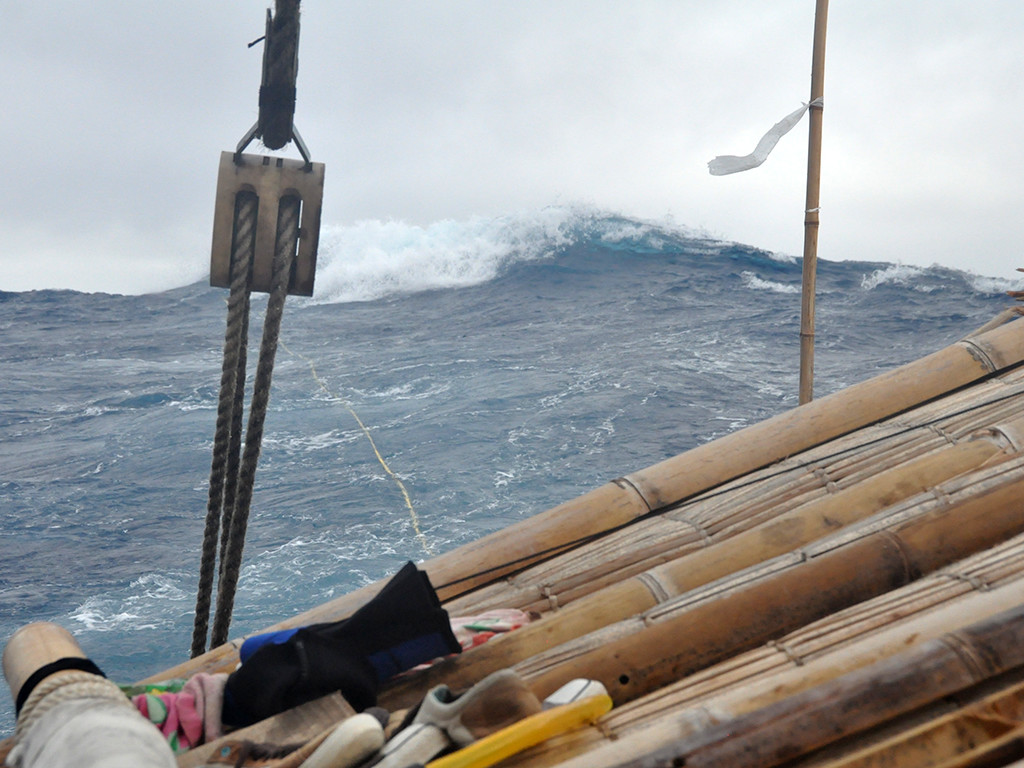
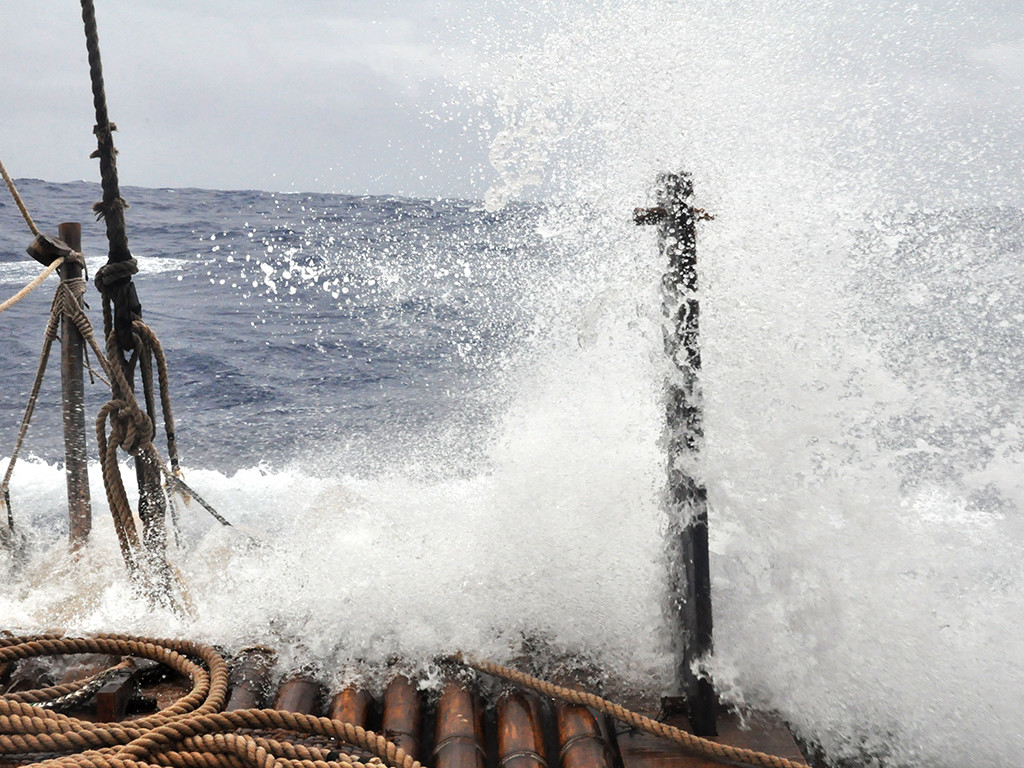
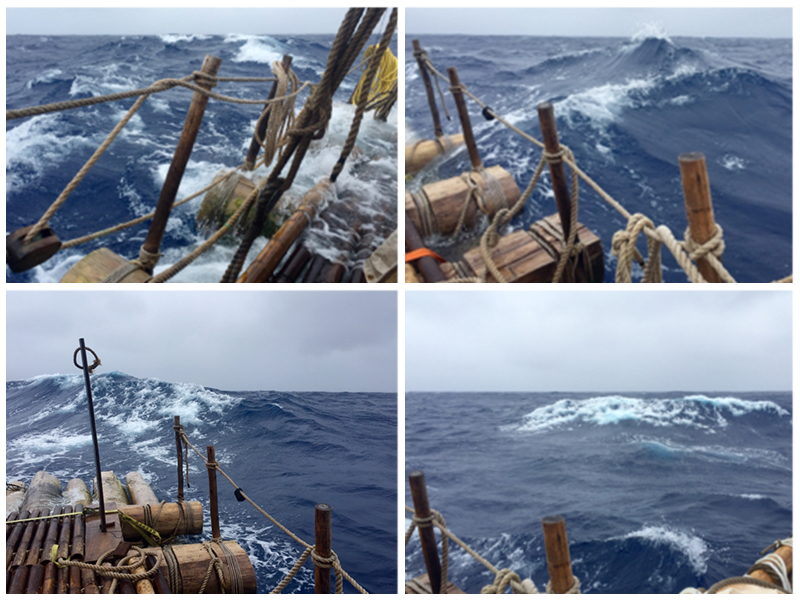
In the first picture, Roberto is seen with the dismantled kitchen on deck. Picture 2 and 3 show a dynamic sea around the Tupac Yupanqui raft.
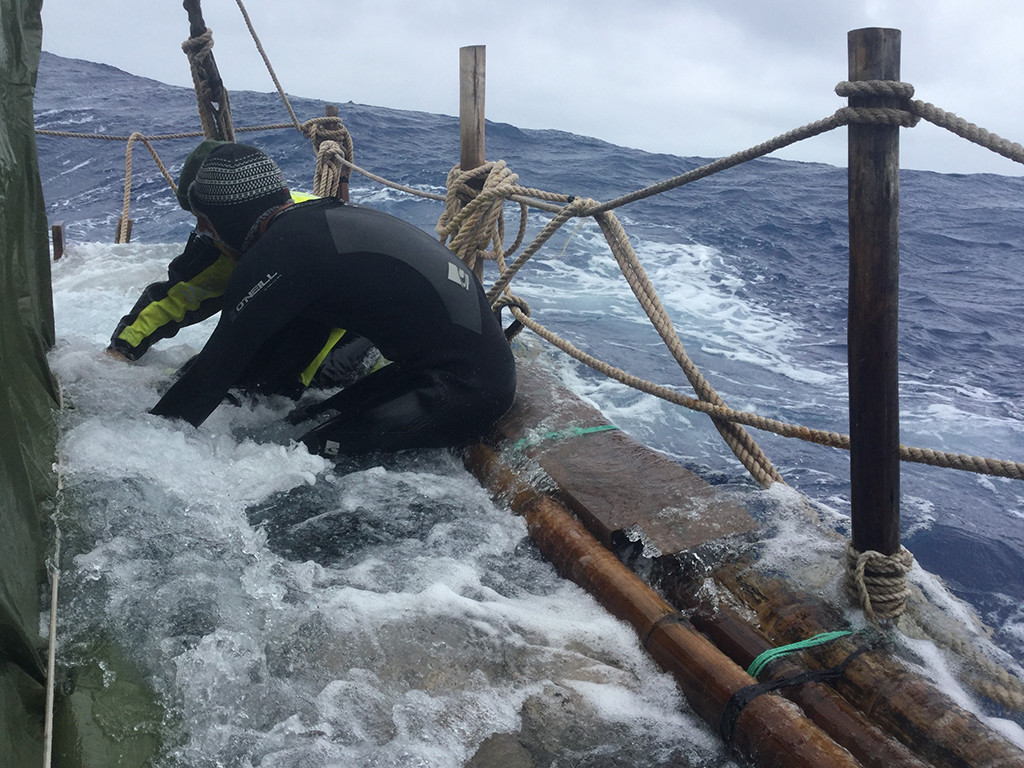
(2016-02-08) Thursday, Friday and Saturday were three wild days in the Southern Pacific. A gale hit us, peaking Friday evening with winds up to 40 knots. The seas grew with every hour, amounting to somewhere around 5-6 meters. Friday afternoon we took two reefs in the sail, and just as we had finiahed a gigantic wave hit us from behind. This wave lifted everything, moved it, and set it back down.
The worst damage was on our port side, where equipment weighing around 400 kg was lifted. The decks under the equipment fell down between the logs, and so the water plywood box with water bottles, deepsea robot and more fell down between the logs as well. The wave also created a large hole in the deck under the galley, and broke several other decks.
The wave was not a polite and shy visitor, it forced its way into the cabin as well. Several bed boxes fell down between the logs as a result of this, giving people a very crooked and unstable bed for the night. The fact that all our sleeping bags and clothes also got wet didn't make the situation any better, and it was a cold and dreary night.
Early Sunday morning the wind both eased and turned SE, and so we took the sail down. Sunday was spent repairing, a slow process in the complete chaos. After a long day of work the raft started looking like a raft again, and it's now possible to walk on deck again rather than jump from box to box between the debris. Today, Monday the work continues, repairing the decks under the galley and outside the cabin door, where there is now only a large hole.
Damage aside, we sailed far during the gale. In the 24 hours between midnight Friday and midnight Saturday we sailed 81.2 nautical miles! We made it to 37° 39' south! Now we face a new challenge: the forecast says we'll have close to no wind for the next five days. At least that gives us time to repair and get ready for the next round.
(1) Torgeir On his nightwatch, thinking about another five weeks on the raft.
(2) Erlend, film photographer. The director of the documentary about Kon-Tiki2.
(3) Wet on front deck.
(4) Andrey don't see the point in shaving.
(5) Erik does not want to get cold during his watch.
(6) The albatross keeps visiting Tupac.
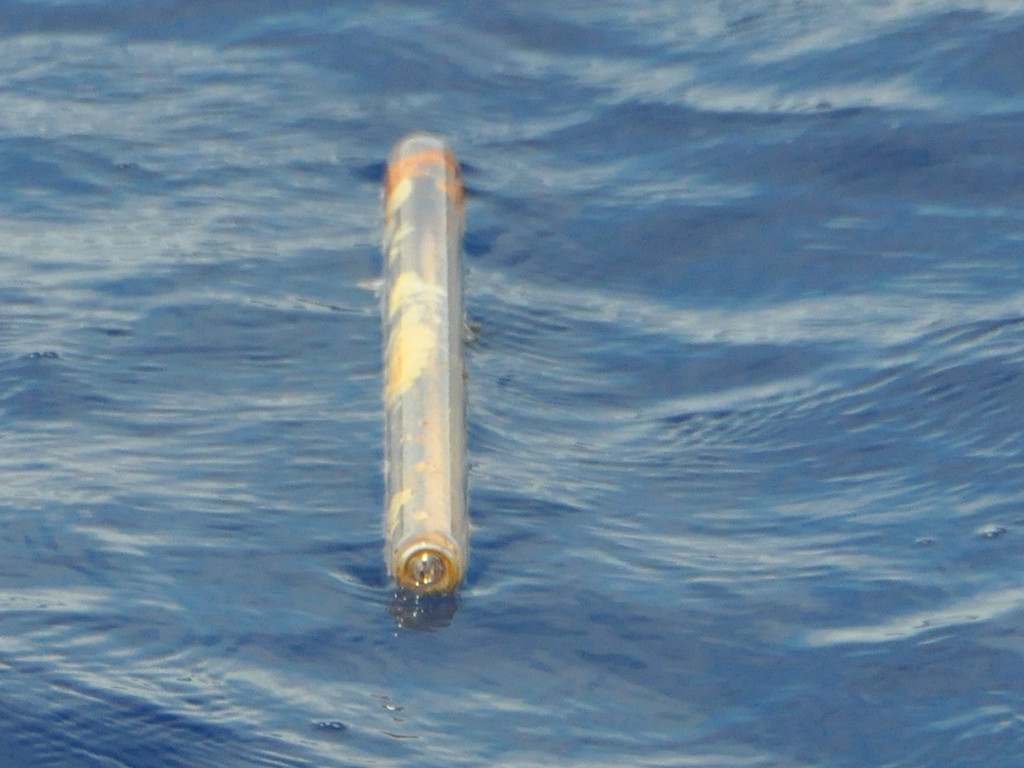
(7) Garbage floating in the sea, seen from the raft every day. This one is a light bulb.
(2016-02-10) As the medical doctor of the expedition, Sergey Goltsov always keeps an eye on the crew of Rahiti Tane, treating all small wounds (hopefully we won't get any big ones) and trying to limit the risks that anyone gets hurt. Putting a lot of effort in his duties, it hence seems logical that Sergey was the one that spotted the big grey shark that swam by the raft this afternoon. Nobody was in the water for the moment, so it was a happy rather than alarmed shouting of "Shark! Shark!" that was heard over the raft.
We all ran to the edge of the raft to have a closer look. Although I was safely standing on the deck, looking down on the big fish (around 2,5 meter long) when it swam by the raft less than a meter away, I felt both in awe and some chills along my back bone. Regardless of being on the upside of the water surface, my brain had no problems what so ever to imagine how it would feel to meet that razor-toothed hunter in the water. The perfectly shaped body, agile and fast, with the sharp and deadly end coming towards me. I imagined me, trying to get out of the water in a clumsy fashion, waving with all the limbs and pieces that might pose as an interesting bait for the predator from the deep seas. I wonder if I will dare to see a generic pirate movie ever again.
At least dr Goltsov does not have to worry about treating me for lost limbs due to shark attacks. From now on I will benefit from the rafts many options to wash ones self, in the safe space between the cross section balsa logs, protected by the long ship balsa logs that run below. Just another benefit of sailing a vessel that is half way submerged.
(2016-02-12) Captain's birthday, my friends, is a big day. Any vessel, and especially a balsa raft, stuck in the calm in mid-Pacific in the 37th degree and 02 minutes of the south latitude and 111th degree and 08 minutes of the west longitude looks different due to the festive mood on this day.
The morning begins with coffee made in a coffee pot, surprises and presents to her who sleeps least of all, gets tired most of all, every moment understanding, like any other captain, that she will be the first who will see a rock that might come out of the fog and the last who will leave the raft in case (Heaven forbid!) it is destroyed.
Lunch with freshly-baked bread and Norwegian cheese which has been in store for this day smoothly slides into dinner and swimming among crowds of birthday guests surrounding the raft – here we can see jellyfish of all shades, alone and in groups, crabs aiming at getting closer to the festive table and climbing right on our legs, spies from submarines (in fact this is our filmmaker Evgeny), small shoals of fish bustling in and out between the logs and groups of big dorados which create a festive atmosphere with their rainbow colors...
The presents are being taken out of the dark corners, not expensive, but very nice and unique because they weren't bought in advance but became presents here on the raft. Rasmus is putting a chocolate cake made by himself into the oven. The music pouring out from small acoustic speakers is turned down a bit and before supper we've prepared a real performance played by all the crewmates. Now let's get started to a guitar accompaniment...
Doctor Goltsov:
Hello, hello, my names Joe Monroe.
And I'm calling from Indiana.
Can I speak to Diana, please?
Am I speaking to my Diana?
Liv replies:
Oh, no, no, no! I'm not Diana.
I think you have got
The wrong number, my friend,
You've dialed the Rahiti Tane.
Rasmus, once again:
Hello, hello, my names Joe Monroe.
And I'm calling from Indiana.
Can I speak to Diana, please?
Am I speaking to my Diana?
Lisa, keeping on playing the guitar, in a whining voice:
Oh, no, no, no! I'm not Diana.
I think you have got
The wrong number, my friend,
You've dialed the Rahiti Tane.
Pedro can't rest:
Hello, hello, my names Joe Monroe.
And I'm calling from Indiana.
Can I speak to Diana, please?
Am I speaking to my Diana?
The filmmaker Evgeny filming all that:
Stop, stop, stop, stop... :)
And all together, in chorus:
Oh, no, no, no! There is no Diana!
You've dialed the birthday party
Of Signe Meiling
Captain of Rahiti Tane!
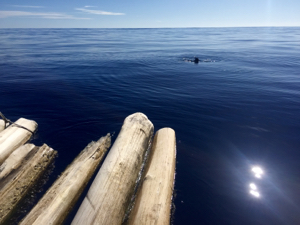
(2016-02-12) During the last days we have had little or no wind, so the sail has been taken down and we have been drifting awaiting better conditions that will allow us to get further south, so that we can continue eastwards. In the middle of all the deck mending we have also been focusing a bit on the life below the decking. Not only the the shark that newly hit the headlines (rumors has it that it most probably was a planktivorous species, one that feeds on plankton instead of raft sailors), but also the 10 dorados or mahimahi, as they are also called, that have been circling the raft the last days. Through the calm sea surface we could see the bodies of the big fishes as they completed yet another lap around us. And when we were tired of watching they would call for our attention by jumping and splashing.
Personally I'm way to impatient to spend more than 3 minutes with a fishing rod, so I'm impressed by Pedro that spent hour after hour trying to catch one. First with little success, but all of a sudden one early morning a hungry dorado actually took the bait! Pedro struggled to get it close enough so that we could grab it with the hook, but unfortunately, the fish got away. The bait was taken two times more but our prey managed to escape both times. Pedro looked frustrated and as the sun rose, it seemed like the dorados got uninterested.
Inspired by the almost successful attempts of Pedro, Sergey grabs a rod. It takes a couple of minutes, the sea surface is dead calm, the sun is slowly climbing the sky. But somewhere beneath the surface a dorado cannot resist the bait any more and Sergey shouts that he has something on the hook. Pedro, that has not lost his hunting instinct, grabs the large hook and quick as a cobra he managed to hook the fish before it swims under the raft. Once its on board, we try to get a towel over the eyes of the dorado, a way to make them calm according to our fishery mentor Jimmy aboard Tupac. We did not really get the towel where we wanted, but eventually we manage to get the fish under control.
It was with great happiness two of the main characters of the drama posed with the third one, that by this time was not able to feel anything at all. "Omega 3 vitamin" Sergey concluded with the 118 cm dorado in his hand and a smile almost as wide upon his face. Even when working as a fisherman, our ship doctor is always concerned about the health of his fellow crew members.
The rest of the crew smiled almost as wide when Pedro served garlic fried fresh dorado for lunch, and I found myself jiggling of joy when Lisa later served fish and chips for dinner. Bones and fins were cooked into a Russian styled bouillon, while Pedro kindly provided the rest of the fish some space in the scientific freezer for later consumption.
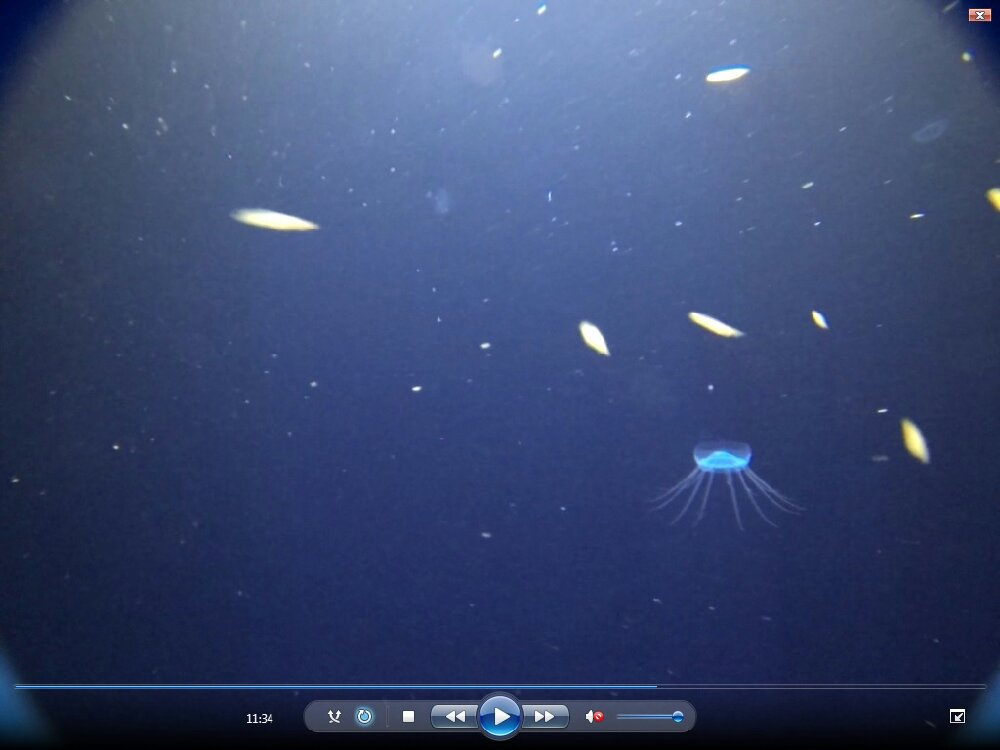
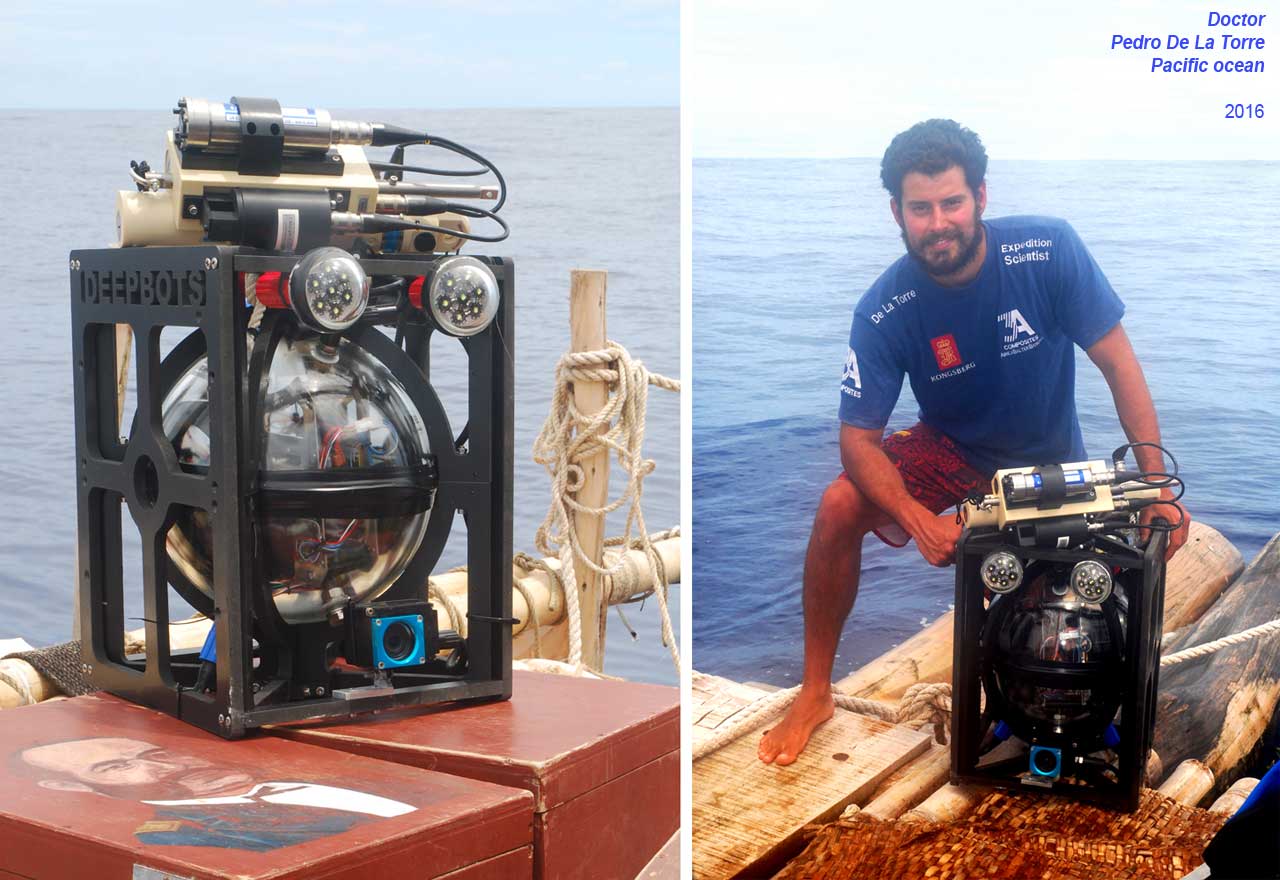
(2016-02-13) The crew on R/V Rahiti Tane (RT) have used Pacific weather to deploy their instruments over board. Footage of abundant nocturnal plankton right under the hull (if the term applies appropriately) of the raft was obtained. Specimen samples from this section of the water column have been collected with the plankton net featured in previous publications. The pictures portray one cnidarian, or medusa, located around 10m deep at 0100h local time. Large dorados are curious but shy to the staging strobes of the Sperre Deepbot and so are squid and other fish whose silhouette can be seen from the surface only. The guts and blood of a recently caught dorado were used as an attraction for large predators, but none showed up. Calm wind conditions allowed the crew for more activities.
In a beaufort 0 sea state, the sea surface mirrors clouds when seen from above or fish and plankton from below the water. Diurunal plankton that are not very afraid of being eaten in plain daylight, are easy to spot. The neuston and pleuston are groups within plankton that drift on or right underneath, respectively, the surface; they sail with the wind. A flat sea allowed the observer to easily spot some species in these groups. The siphonophore man'owar is commonly encountered in the sea, but also on board RT. There are others like that jellyfish portrayed in the picture next to the raft. That day, a navy of hundreds of individuals surrounded the vessel. However, a stationary raft allowed for more.
Five stones attached to a CTD were casted down from the port side of RT. A time lapse of the enduring actvivity was taken from the mast, and one photo is shared. an electric motor is installed in the rafts center. It assists with the retrieval of instruments. One member creates tension on the spool side, starboard, of the motor. Anotjer one loops the excess because the line is retrieved faster than it is rolled into the bobbin. This is specially noticeable when all the line, approx 3.5km, is out and each coil is around the bobbins axel diameter only. One more rotates the bobbin by the sail to store the line. This process improves everytime and the crew becomes more and more experienced in deep casting. 2.8km of water where profiled. The stones came back full of sand and the bathymetric map indicates a depth between 2.7 and 3.1km. A sunset clean to the horizon, with stratocumulus clouds at mid heights, dorados jumping in the background, and a warm fish dinner were the reward for the hard working crew.
(2016-02-14) After several weeks with an empty horizon Tupac showed up a few days ago. Over the last days we've sailed slowly closer to each other and yesterday we managed to meet. On Rahiti we took the wind out of the sail, slowing down and thus allowing Tupac to catch up from behind. Just as they were about 50 meters behind us we let the sail fill and steered a parallel course. Tupac caught onto the yellow safety line trailing behind us, and we could exchange crew. Dr Sergey packed his bag and got into the dinghy with ferryman Pedro and together they pulled themselves along the line to Tupac. There, photographer Erlend was ready and jumped into the dinghy, taking Sergey's place.
So far the maneuver had gone very well. Captain Ola on Tupac steered the raft well past Rahiti and onwards - full control. We were just a tiny bit to slow in realizing that their yellow safety line passed under our raft and got stuck on a guaraboard. During the first leg of Kontiki2 Ola and David devised a challenge. It was to jump into the water in front of the raft, dive down and swim under the raft, coming back up in the wake aft of the raft. The faster the raft sailed the easier it would get. This was a fun game, and we soon needed new challenges. The next was to dive down in the aft, swim forward and grab onto one of the guaraboards under water. Yesterday this went from being a game to being a very useful skill, as the only way to free the safety line was by pulling it off the guaraboards from below. The pressure from the line was so great that it wasn't possible to just lift the guara. Pedro and I jumped into the water with divingmasks and little by little freed the line from guaras and scientific equipment.
The plan is to have Erlend stay with us on Rahiti for a few days before delivering him back to his fellows on Tupac.
(2016-02-16-food) We have had a week of weather that has taken us from the wet, to the cold, to the gale, and back to the sunshine and calm seas. With changeable weather, our effort around cooking changes as in the cold you crave carbs, spice and heat, when the temperature goes up and you feel relaxed and dry so to does the menu change.
We have had a really fun week overall experimenting with cakes and food, but the highlight of the week would have to be that Sergey caught our first fish. A nice sized Dorado (Mahimahi) that fed the troop for a good couple of days. The first meal was fried fish mexican style for lunch, then a Mahimahi Russian Boullion at dinner and ending with a version of NZ Fish and chips, served with a lemon and caper dressing, was all divine and pretty special to be eating such a delicacy out here, fresh and in the open ocean. Being close to Norwegian celebration for Easter Signe made 2 dozen "boller" buns for the crew. They were the best buns I have eaten in a long time, and she baked these whilst trying to repair decking and getting our raft back in shape after the gale.
I tried a Lemon Drizzle Cake recipe from home, which was delicious. Light fluffy cake with a hint of lemon, drizzled with a lemon sugar syrup that seeped through the cake and giving the delicate cake a real zing. Rasmus' Chocolate Mud Cake was Signes cake request on her birthday, with her favourite pasta for dinner, and a spoil from Liv of Norwegian Goat Cheese for lunch. Liv and I were on watch that morning and she had to listen to our beautiful birthday singing as we served her a cappucino and almond cake as a pre-breakfast treat. Our dinners would look good on any table this week and we ate like kings!
Thurs - Falafel, honeybaked potatoes, quinoa and lentils and Lemon Drizzle Cake for dessert
Fri - Indian Daal with White Rice
Sat - Spaghetti Bolognese
Sun - Lentilles aux vin a la Pacifique and "boller" buns
Mon - Coconut Curry with Peruvian Beans on White Rice
Tues - Dorado, NZ fish and chips with Lemon and Caper Dressing and Mahimahi Boullion
Wed - Creamy Garlic and Mushroom Spaghetti and Dr Fredrik Wikström Chocolate Mud Cake for dessert
The one meal that often gets a little short of creativity at the moment is lunch. We make fresh bread every second day, but we lose a bit of inspiration to pair it with a dish. So the effort this week will be focusing on lunch ideas and getting a bit more inspired about what to make at this time of the day.
(2016-02-16) One could expect that a month on board a slowly moving raft in the Pacific, with nothing else to watch but endless rows of waves and and some seabirds, would turn anybody to a "live in the present" carpe diem zen guru with a degree in mindfulness. However, as a sailor, the harsh reality is that you are usually in quite the opposite mindset. No matter how hard you try to enjoy downwind and sun, your brain is often occupied with thinking about repairs, improvements, preparations for gales to come, weather forecasts and ... wait a second, what is that noise? Some kind of chafing? Something moving out of place? And even if you have taken care of some of the weak spots that the ocean found during the last tough weather, you push your imagination to keep one step ahead of the big blue, eliminating weak spots that could become problematic in the future.
The last couple of days have been some of the best since we left for South America. The moderate downwind has been steady for a longer period than ever before, the steering has been almost automatic, Tupac has been well within sight, fish are jumping into our pot, and the sun has been shining while the temperature has remained pleasant. This was not what I thought I could expect when I joined the expedition, but definitely what I hoped for. We have mended all the decks and things would have been perfect, if it was not for that worrying sound from the mast.
I'm afraid that I will have to be a bit technical at this point. Depending on the craft a mast can have many different positions, shapes and characteristics (in most cases they point more or less upwards). The masts of our two balsa rafts are pretty plain however and are supposed to point straight upwards. Yet, having a rigging of natural fiber poses a problem. The ropes are very prone to stretch, and in order to keep the mast in place, we have to tighten the stays and shrouds as soon as they become slack. Stretching stays is not a challenge in its own, but the rigging is designed to put up with strong downwinds. Therefore, we have 4 shrouds and 2 backstays, in total 6 points, that are all keeping the mast from moving forward (while also balancing it sideways). On the other hand, the position of the sail does not allow us to have more than 2 forestays, that prevent the mast from moving backwards. In the long run, this means that every time we tighten the stays and shrouds, this bias will, little by little, lean the mast backwards. The crew of the first leg got aware of the problem, so before we left Easter Island we made sure that the mast was leaning a lot forward. However, we did not know if we would have the possibility to repeat the procedure while at open sea.
The last couple of days, the mast has started to make squeaking sounds, which has been an indicator that it is starting to lean too much backwards. However, the forestays have been tight, not allowing any shortening, while the aft stays and shrouds have become more and more slack. Yet, as explained above, we have felt reluctant to tighten them. As a temporary solution Signe decided to move one of the shrouds a bit forward on port side, but the sail prevented us from doing the same on starboard side, and it was not a permanent solution anyhow. So yesterday, fueled by lentil patty burgers and good weather, we finally decided to take the bull by the horns and see if we could make the mast lean forward. However, to be able to do so we had to give some slack in the shrouds and aft stays, and we also had to lower the sail as the halyard functions as a stay in itself when the sail is hoisted all the way up. Even though the conditions were good, it was a bit scary to give up some of the control over the movements of the mast, and it was moving quite considerably. As Signe and I started to work, Liv was quick to join in. Lisa had to take over Liv's job while she was recovering after I banged my shoulder to her forehead (by mistake, I swear) whilst tying a rolling hitch. She recovered quickly and eventually everybody on board got involved in the stretching of the stays. In the end we managed to get the mast upright and the noises dissipated. It might seem like a small detail, but the knowledge that it was possible made us all really happy. As we got rid of one worrying factor, we took a small step on the way to that "live in the present" paradise. Thats all the worries for now, unless we come up with some new problems ... which I doubt will be very hard!
(2016-02-16) The rafts of the Kon-Tiki2 expedition are on their second leg, from Easter Island to South America. To reach westernly winds and currents, the Expedition has sailed southwards from Easter Island and the rafts are now close to the "roaring 40s" where prevailing winds come from west. However, this being an El Nino year, prevailing winds are not always prevailing. After several days of rapid sailing in the right direction, the winds suddenly turned today and the rafts are drifting backwards in a gale. Big waves now hit the deck and cabin, as can be seen in these pictures from Tupac Yupanqui. The forecast, however, looks good and the Expedition can expect steady westernly winds to return within a day.
(2016-02-18) In a milestone event, the Kon-Tiki2 Expedition crossed into the roaring 40s today. No balsa raft has been this far south in modern times, and the crew is celebrating the event. Weather forecasts for the next week is good with steady winds from the west, just like we hoped and expected. The rafts use these winds to sail towards South America in an epic roundtrip voyage. In the pictures, the Jotron AIS transceiver bears testament to the position of Tupac Yupanqui, and her crew is seen celebrating.
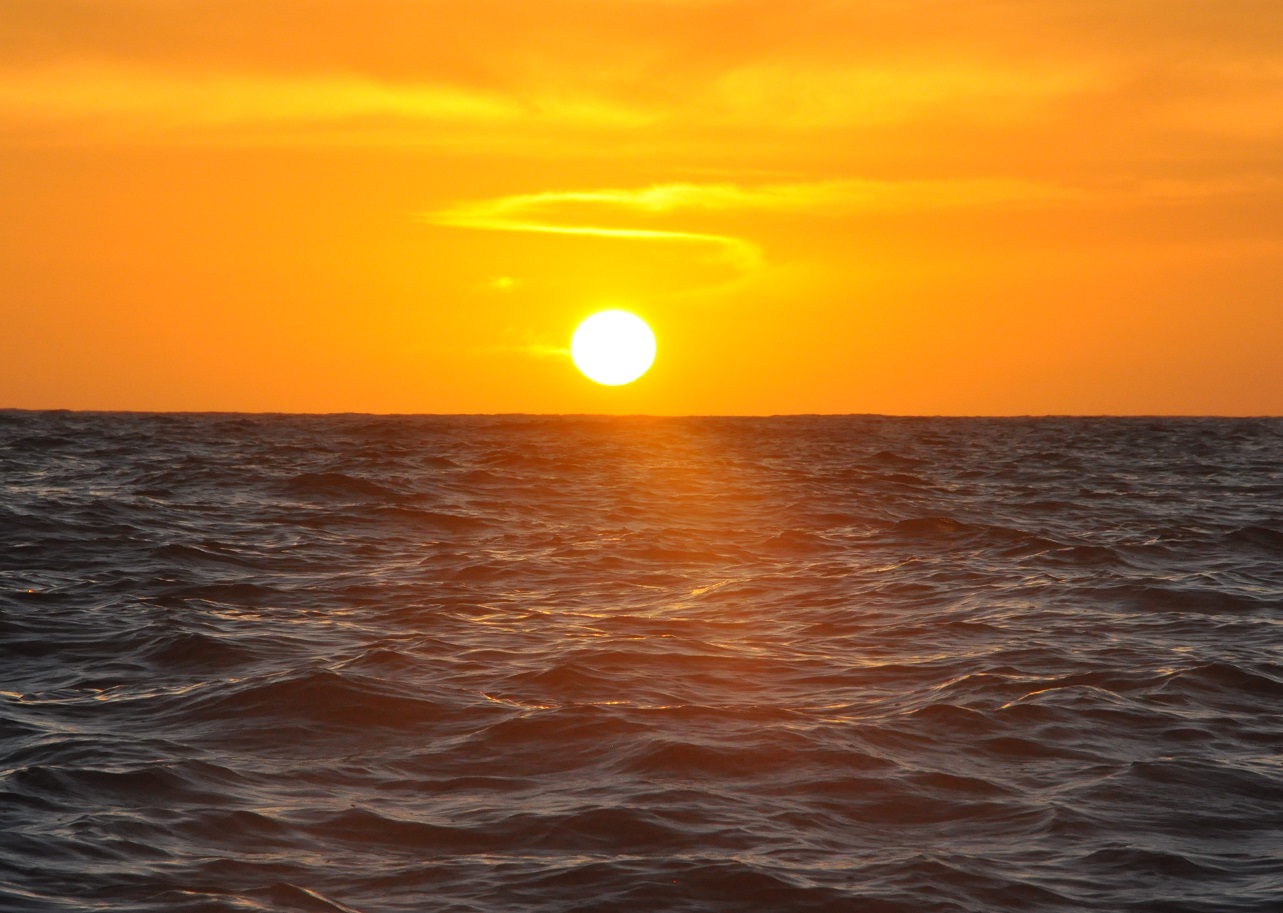
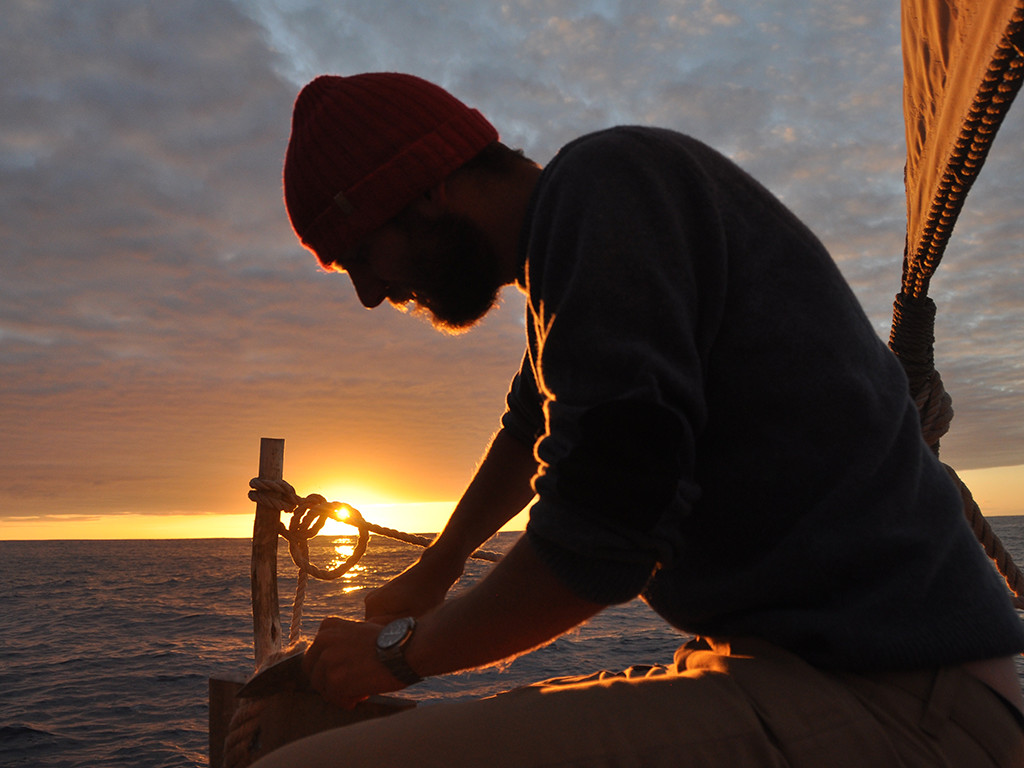
(2016-02-19) These photographs offer glimpses into the daily life on the Tupac Yapanqui raft. And non-so daily: the first picture shows Erik with the second fish caught on the this leg. In the third picture, Expedition doctor Sergey is seen with Roberto. In picture 7, Torgeir is seen analyzing the contents of the Manta trawl. Finally, Pacific sunsets never go out of style.
The sun shines on TV
(2016-02-19) Captain Signe Meling is interviewed live over a decent satellite connection in this newsclip from TV2. In her native Norwegian, with Haugesund dialect, she descibes how the rafts have worked their way southwards, how every sock is wet, and the food situation on board. While she speaks, TV viewers can watch footage from the first leg of the Kon-Tiki2 Expedition.
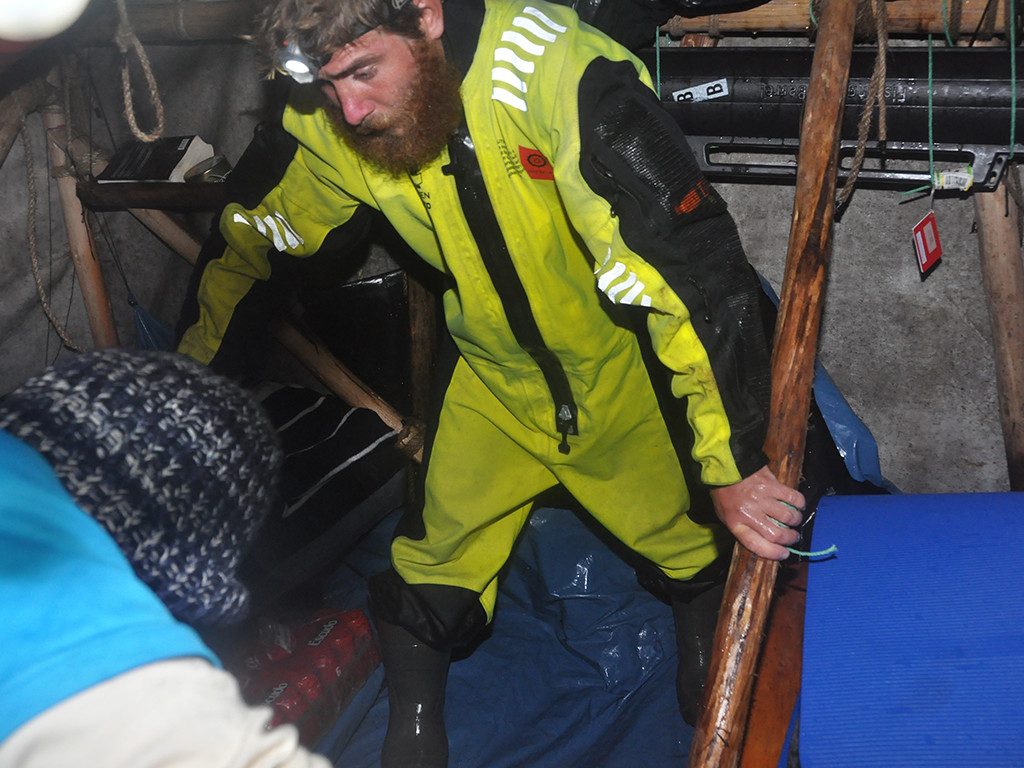
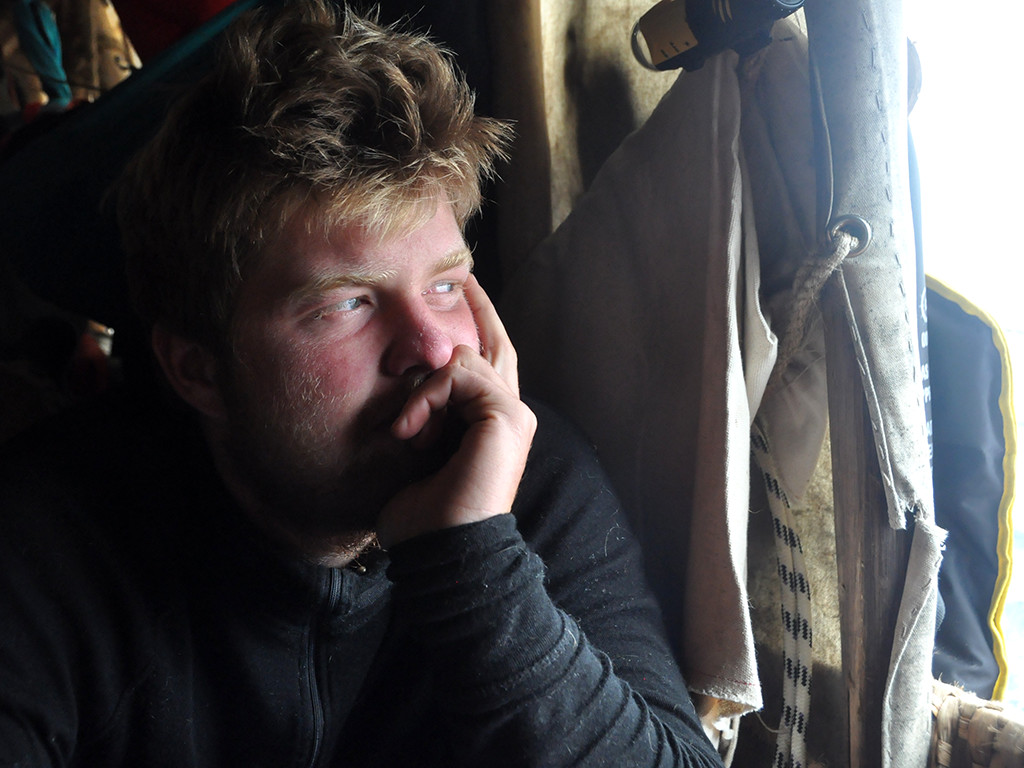
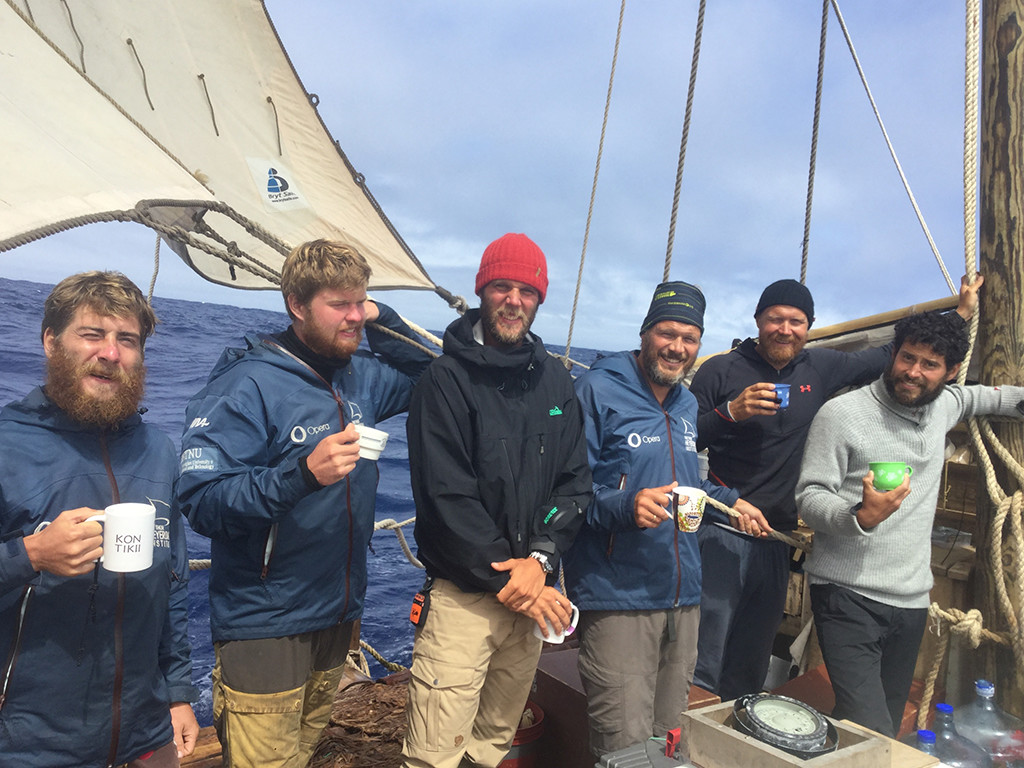
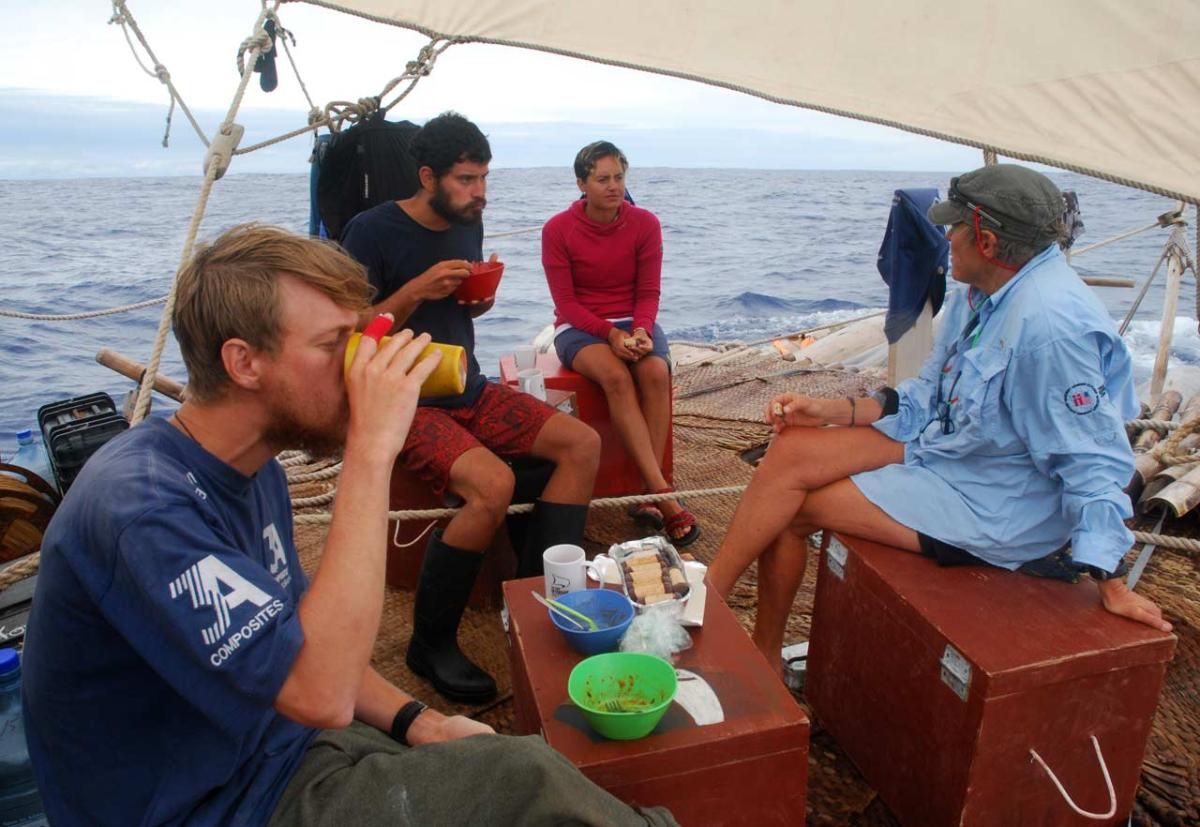
(2016-02-18) Yummy meals are served on Tupac Yapanqui. In picture 2, Erlend is serving dinner in a gale. In 3, Jimmy is woodworking in what must be our most popular watch, from 8PM until midnight. In 4, Andrey makes the guares easier to handle – using ropes. Picture 5 shows
jellyfish caught by an empty water bottle. 6 shows the view from the cabin of Tupac Yupanqui. Pedro is visiting the Tupac team and in 7 he is uploading captured data from Kongsberg echo sounders. In 8, The Rahiti Tane is photographed from Tupac. In a transfer of crew, Pedro went aboard Tupac and Sergey moves back to his fellows on Rahiti. Almost every night we have situations where "a bed disappears in
ocean" or "cascades of water are coming up between the beds". Andrey is a
true fixer of these problems, as can be seen in 10. Captain Ola Borgfjord, what are you thinking about in picture 11?
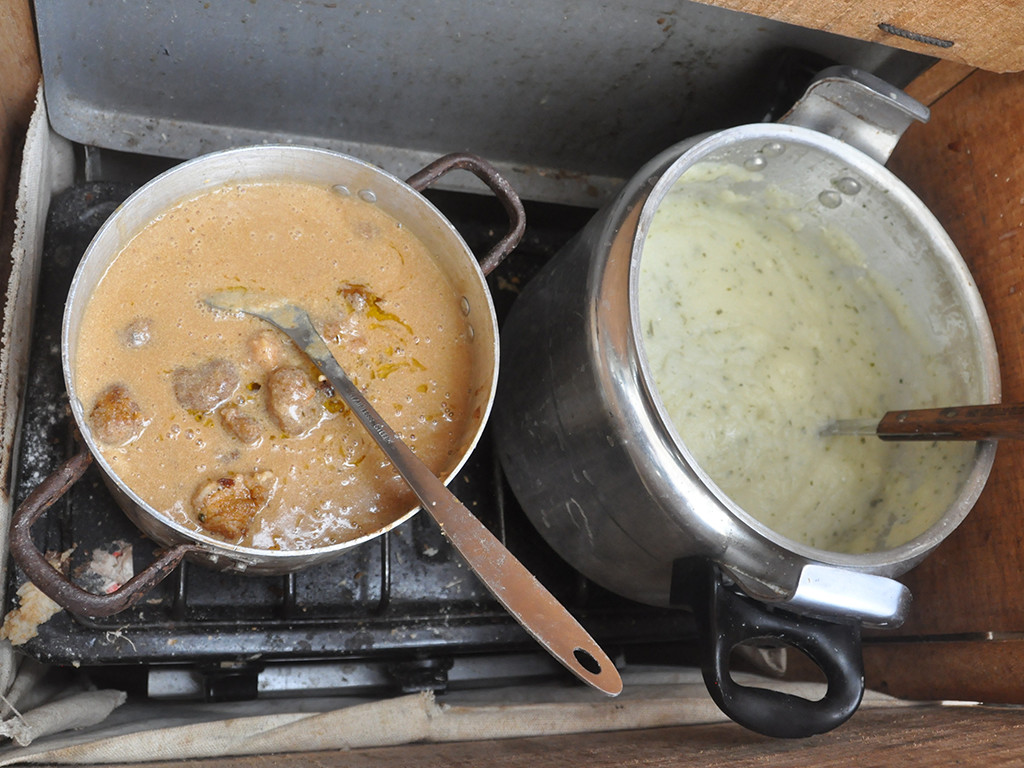
In 12, Torgeir's version of quinoa balls are cooked and will be served with brown souce and
mashed potatoes. In 13, Torgeir realizes that pairs of socks is a thing of the past.
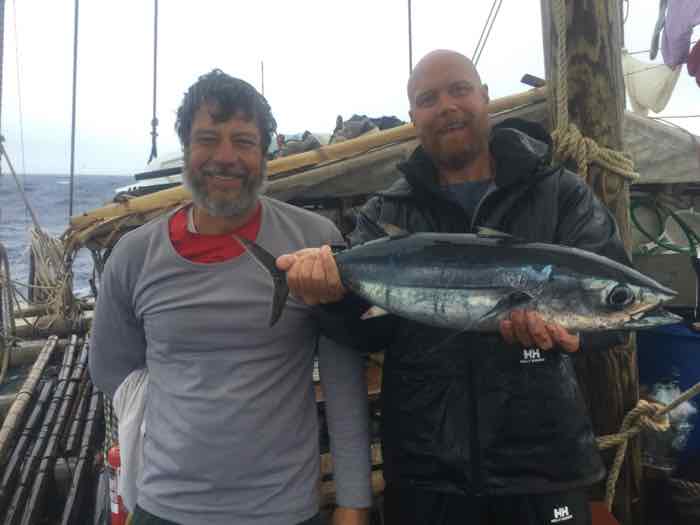
(2016-02-21) Erik who lives in the deep forests of Hedmark is the hero of the
day in the southeastern Pacific, catching a fat tuna (albacore?) for
the Tupac team and their guest Pedro. Erik was leading a meeting the
same day before this event, encouraging the team to do more fishing.
"In order to catch more fish we have to spend more time working with
the fishing gear and different types of hooks!".
(2016-02-23) Plastics in our modern societies are an almost fundamental commodity of daily life. In order to improve the quality of materials that we use – for example to pack our food – we need to understand their cycle of usage. The Tupac Yupanqui raft (TY) is following up a program of plastic collection in the ocean that tells us where, what type, and how much of some of these plastics end their cycles in a geographical location where no humans, but balsa wood raft sailors, ever visit: the middle of the south-eastern Pacific.
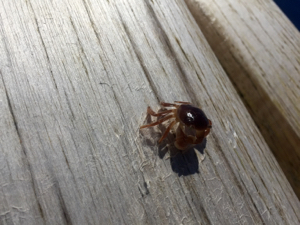
Credit for this activity is attributed to Andrey Chesnokov. Gladly, almost every other day, he stops whatever he is doing to deploy a net known as the manta trawl astern of TY. It is a "manta" because it filters particles from the sea surface in a similar way than that one the elasmobranch named after does. After two hours of trawling, Andrei retrieves the net and analyses the contents for plastics. The task is not easy and is time consuming. He finds plastics among plankton, stingy jellyfish tentacles, fish, eggs of many species and the parts of the vessel, sysal rope and balsa wood, as it disintegrates in the cruise. In this occasion, featued in the picture, an amphipod was caught among the sample contents.
Identification of the types of plastics that reach this remote locations help researchers in the fields of material technology to canalize efforts to develop better substitutes for those polymers that endure through time and do not degrade easily, and yet provide us with the daily life commodity of plastics. In this way, the kontiki2 expedition serves as an opportunity vessel and provides NIVA and NTNU with valuable samples for quality research. After the time consuming process of sorting contents out, Andrey prepares the net for the next deployment and awaits eagerly until is time for it. As the vessel approaches the continent, the task might become more and more interesting.
(2016-02-23) The biggest news of the past week is that we made it the Roaring Forties and we are finally east of Easter Island. From a week that started with a few days of no wind to constantly having wind at our backs we are a happy crew and the food is still proving to be just as good.
As at today we have two onions left, enough potatoes for 3 meals and we are starting to get into our dried and tinned products as we make our way into week 7. We had been lucky enough to not only catch a mahimahi the previous week, we also have a school of small fish that follow the raft and Mr Orlav our Russian photographer has been catching these for dinner when they are active. Signe has been a master chef again and spoilt us with lentil burgers on our sail down day and they were the best burgers we had ever eaten, couple that with some wedges and we had an amazing dinner plated on Sunday!
The Chocolate mudcake has become a staple treat and everyones eyes light up when Rasmus offers to make it for us. It just keeps getting better and better. We celebrated reaching the roaring forties and being east of easter island with falafels for dinner, and also treated oursleves to Cappucino's that Signe had brought for all of us and Norwegian Marzipan pigs from Asker. Needless to say, we were a smiling happy crew. We have also had a new crew member Erland who swapped from Tupac with Pedro for the week, he is not regretting the move having caught our best food week yet! Here is our menu:
Thursday - Mahimahi prepared 2 ways with rice, Sashimi and, Garlic and Lemon infused seared pieces
Fri - Indian Daal
Sat - Spaghetti bolognese
Sun - Lentil burgers with sides of wedges
Mon - Coconut curry beans with rice, accompanied by Russian Seared Fish
Tues - Faves aux vin a la pacifique with baked bread and mudcake
Wed - Pacific garlic and onion soup
Thurs - Falafels with rice
Fri - Potato and bean curried soup
Sat - Spaghetti bolognese
Coming to the end of Week 6, I am undertaking another stocktake of all food on board to be sure of quantities as we look ahead 5-6 weeks. Making sure that we have enough food to carry us through is important and we need to be on top of this more than ever. We have had a loss of 10kg of rice to the sea due to water inside bags and boxes, and we are now holding food in stronger bags and boxes so this doesn't happen again. Our oven is also beginning to deteriorate, so in anticipation of its complete demise we are now baking bread everyday, and saving other food for later. Signe, Rasmus and I have been taking turns on our watches to get bread baked for lunch. The smell of bread wafting through the raft in the early hours is heavenly out here. We have a few weeks left and we are keeping spirits up and bellies full as we push East to Chile!
(2016-02-24) The team on the Tupac Yupanqui balsa raft were about to take down the sail when Pedro called for attention. "Shark! No wait, it is
something else!" Erik was sitting on the roof. He took of his clothes and dived into the sea, followed by Pedro. Torgeir gave Erik a camera and you can see the stunning pictures here. Pedro writes about the fish:
The moon fish (Mola mola) is a large planktivore, one of the largest fish species known. It is regularly encountered in tropical waters and an attraction in ecotourism due to its colossal dimensions. However, the individual seen in the pictures measured around 70cm total length. Its relatively small size and high curiosity about the raft and the swimmers around it might be indicatives of a juvenile, immature, and careless about predators. Furthermore, a pelagic environment with temperate (as opposed to tropical) waters, like that TY is sailing on now, might be a safer location for a young to grow to maturity before it heads to its preferred adult habitat. Interestingly, the last 3 days, the Kongsberg echosounders had picked up the signal of "something" that has been sailing with the raft at around 50m. This "something" in the echogram matched the acoustic characteristics of a bony fish. Then, the mola mola could be that "something", feeding on the layer of plankton (also being studied with the echosounders) and sheltering itself with the raft. More sightings of this fellow could confirm that the Tupacs have a new type of follower and company.
One hour later the team experienced a peculiar event. The albatross
that has been visiting the raft every day the last week decided to
land. He (we assume it is a male) was very interested in the safety
buoy. Several times he used his beak, gently touching the yellow buoy.
This lasted until Erik decided to get closer to the giant bird by
swimming underwater. The albatross sensed something and flied up in
the air, a second before Erik popped up from the ocean.
Both animals are of the largest kind in their group. We cherished a day with giants.
(2016-02-25) You always get a little anxious and feel a bit low when the wind turns, reduces to but a mere breeze and we are forced to take the sail down. However, the sail down is a reprieve from the sailing, the wet, cold and the wind as we welcome a clear day and an opportunity to dry our wet gear. With the sail down it gives the crew a chance to relax, do some repair work and for Rasmus and Signe to get their baking on! With the slow death of our oven they took the opportunity to bake and bake and bake. Signe started early on bread rolls, which as the day progressed were becoming irresistible to a ravenous crew. As the bread roll baking came to an end, up steps Rasmus and began an epic roll out of cinnamon rolls. We have never seen so much baked goods in this raft!
The bread rolls became dinner, and served as buns for a our lentil burgers, with enough for 3 each. The cinnamon rolls following dinner were coming out of the oven warm and the cinnamon and sugar warmed your insides and you felt like a child at the bakery. We previously had all dreamed about the food comas that would be induced on return to our homes, we never thought that the same food coma could occur out here on our raft eating the same food we have been dreaming about!
Even the biggest of eaters Sergey passed on another round of cinnamon rolls, and for the last hour we have all sat around the deck like beached whales, trying to move our food babies to a more comfortable position. Rasmus was persistent though and pushed us on with 'get your Obama on 'YES WE CAN!'. But alas we couldn't finish it all, with cinnamon rolls littering the galley and more in the oven, we gave in and let our stomachs rest, with the thought that tomorrow is another day. This has been another great day in the Pacific Ocean and the Rahiti Tane crew are happier than ever.
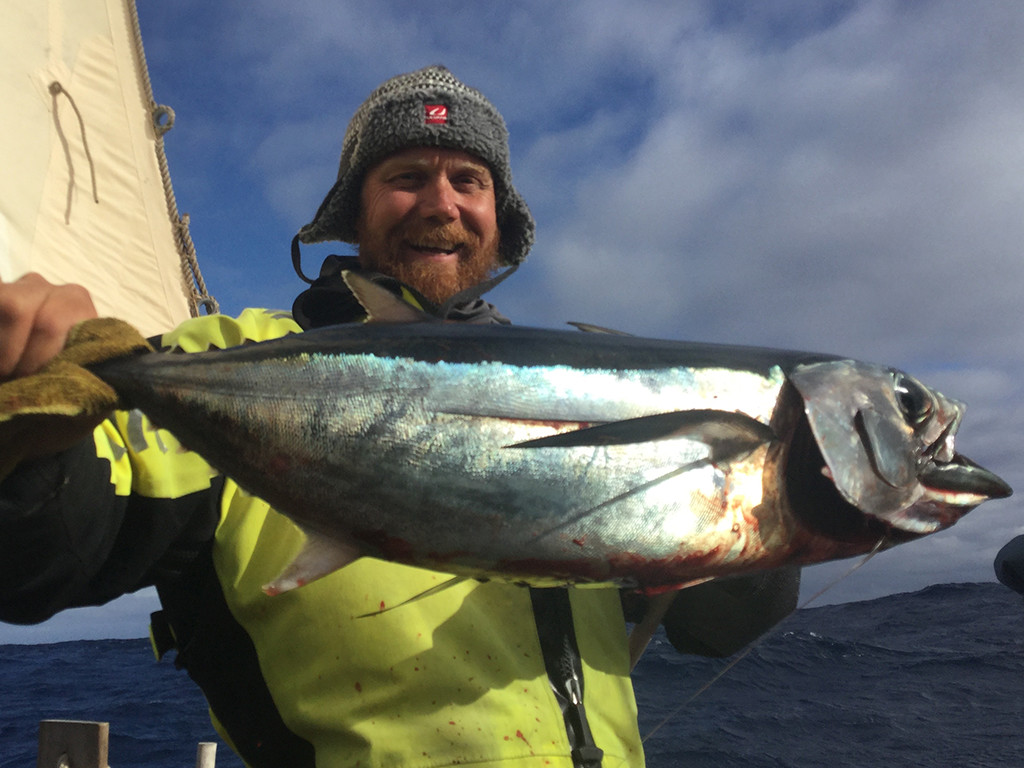
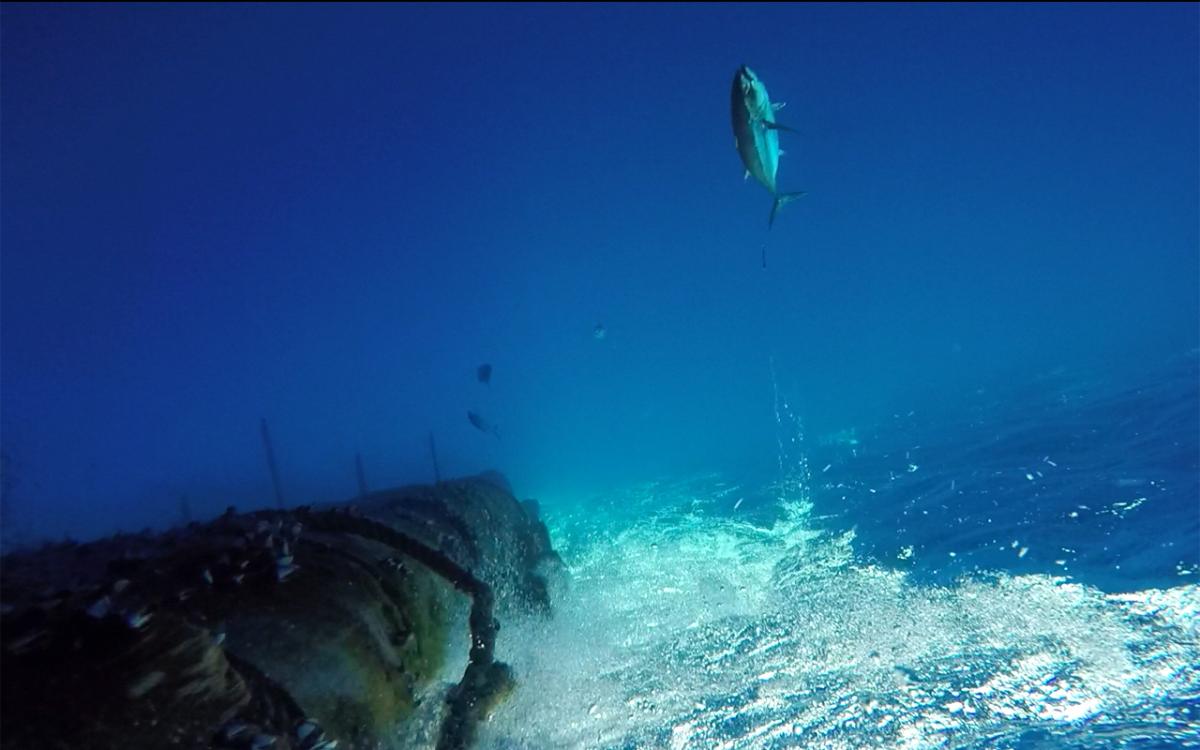
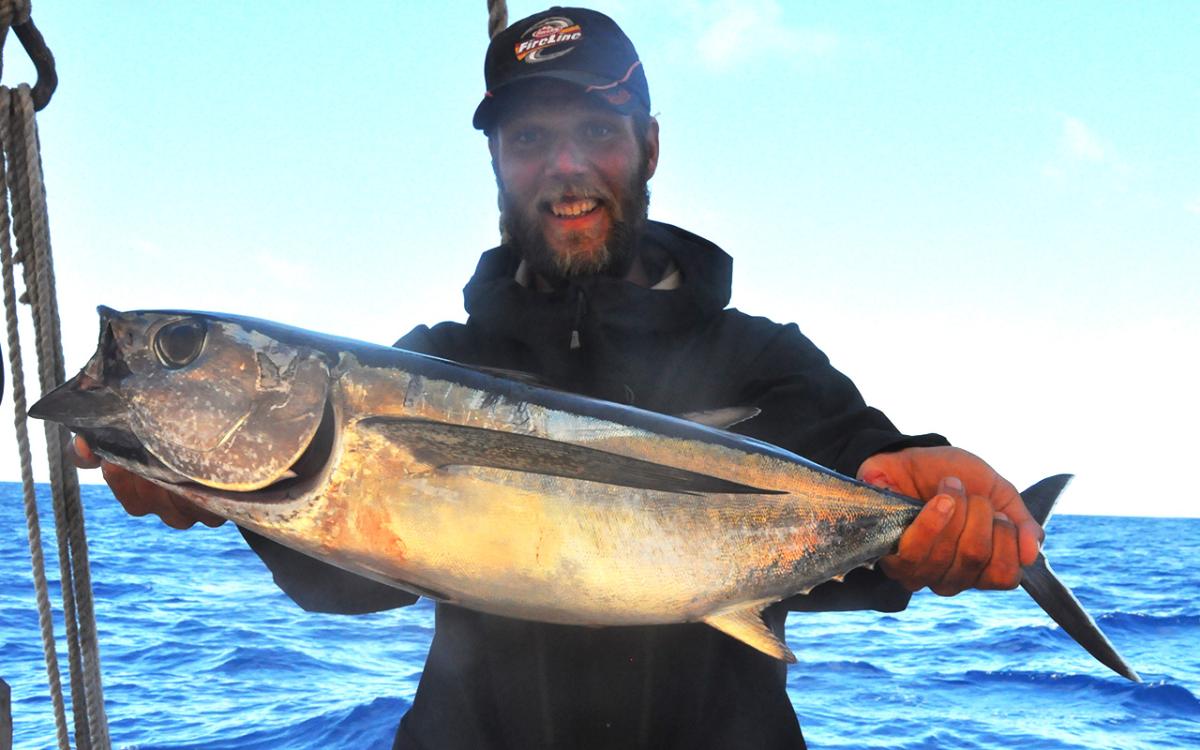
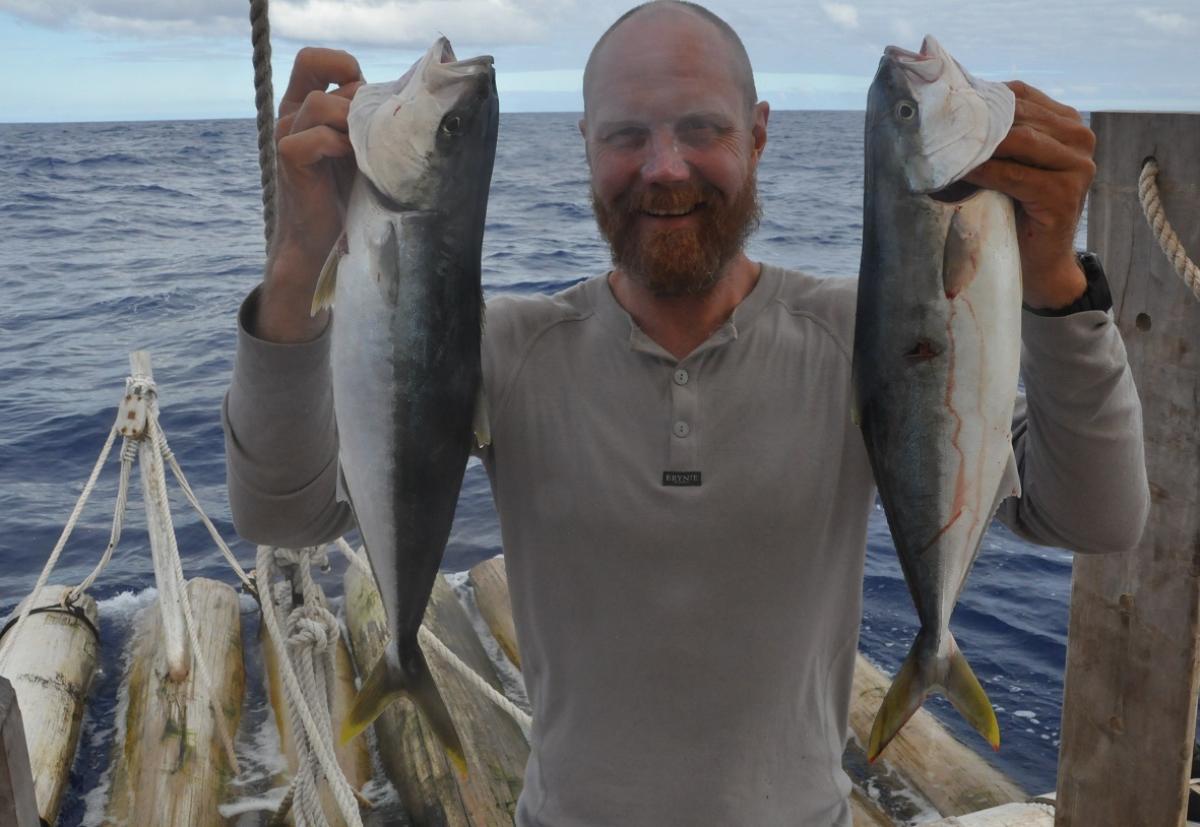
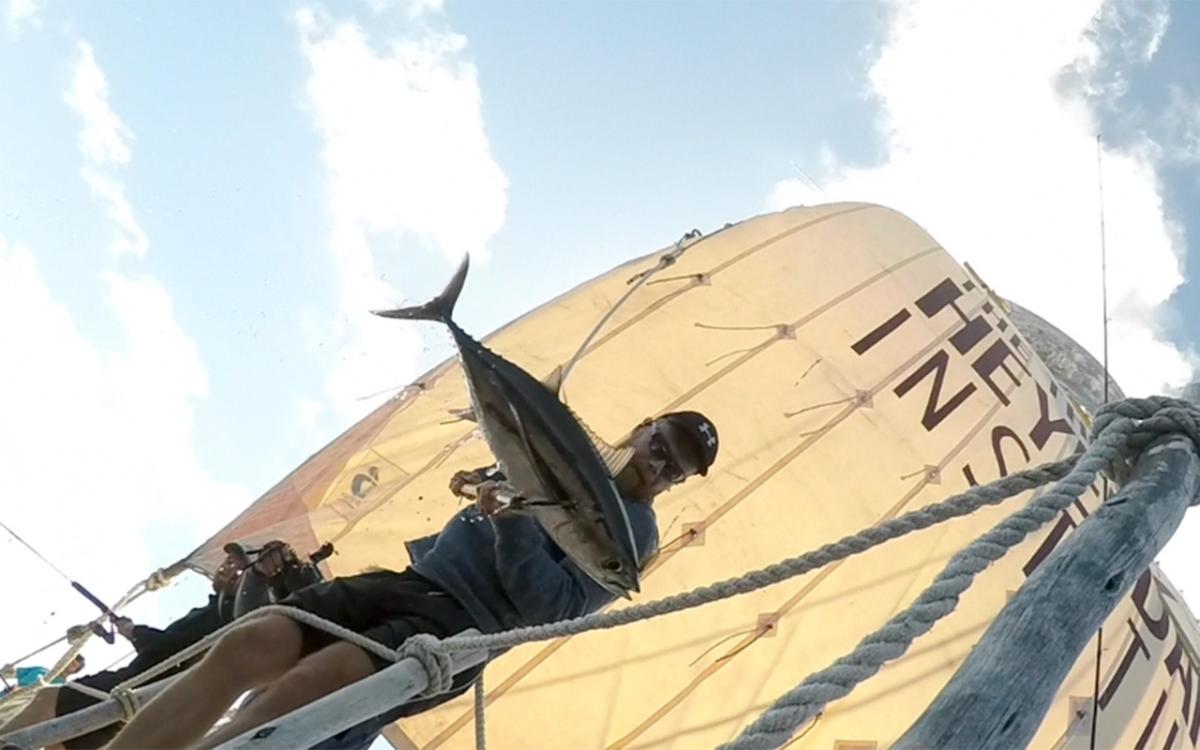
(2016-02-26) In one day, the Tupac Team got more fish than in the seven weeks sailed so far in the return voyage from Easter Island to South America. Jimmy got a tuna, and Erik and Ola supplied the diet with three more fish of another kind. The crew on Tupac has never been eating more food in one day during this voyage, and the lucky fishermen are in heaven. Jimmy got the idea of using stomach content from the tuna as bait on small Mustad hooks. Then, immediately three more fish average size 1,5kg took the bait. The underwater footage from Tupac is stunning and stills from the video are presented here.
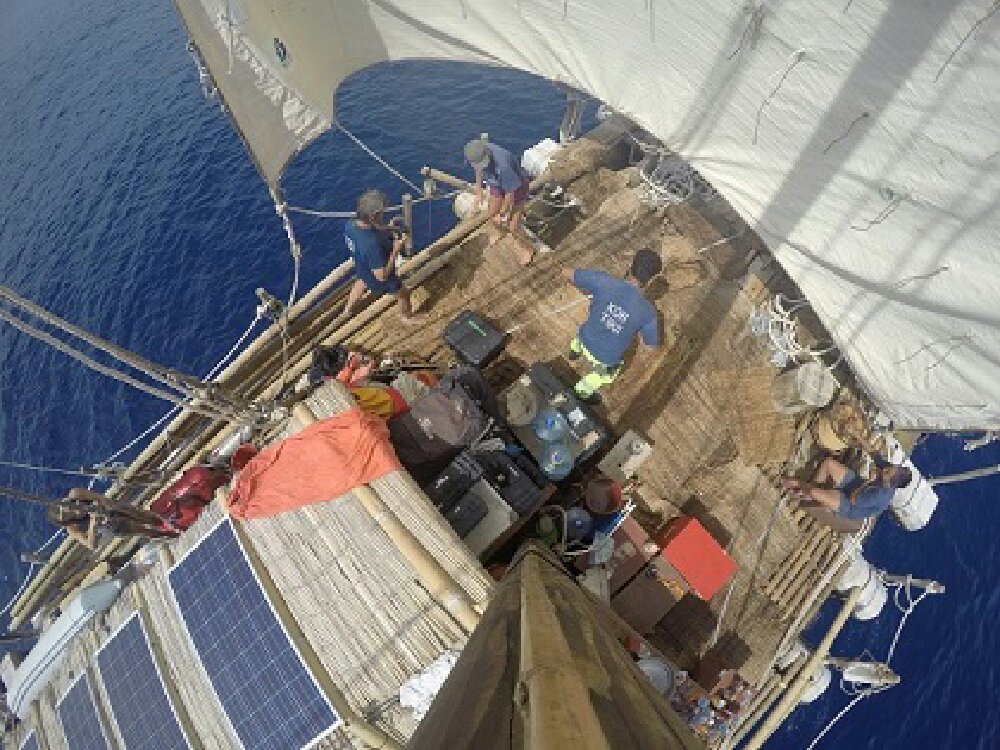
(2016-02-28) At 21:16 UTC, Tupac Yapanqui (one of the rafts in the Kon-Tiki2 Expedition) crossed into 41°S with Rahiti Tane (the other raft) following closely behind. Stable winds from northwest have enabled rapid progress in the past few days. These pictures document life on Tupac Yapanqui. In 1, the raft is seen from above. In 2, the foot of the unknown mast climber can be seen with other crew members below. In 3, the crew reefs the sail, i.e., make it smaller to allow sailing in stronger winds. 4 is a challenge to marine biologists: what kind of fish is it? In 5, Erik and Roberto show off a fresh catch – fishing has been good recently. In 6, Roberto demontrates how a mat, provided by our sponsor 3A Composites, can be turned into a Pacific fitness club on 41° south.
(2016-02-29) On a raft in the middle of the Pacific nowhere, the days can be quite the same. Even though we enjoy the trip, it is always nice to have something to look forward to the day to come. Therefore, almost every day of the week has gotten a certain culinary character aboard the Rahiti Tane. A fact that did not escape our guest from Tupac, Erlend the photographer, who after a week onboard concluded that "you guys have a lot of Days", not having the 7 weeks at sea in mind.
Early on it was decided that we would have chocolate distributed three times a week, Mondays, Wednesdays and Saturdays. This means that Lisa, who's in charge of the food, opens a chocolate bar that is divided equally among the crew, resulting in three pieces each. For those strong in the spirit, it is some times possible to save one piece for later, when the weather or the mood might demand it. There are even rumors that some crew members have managed to save all three pieces from a Monday, resulting in having up to six pieces on the Wednesday. Needless to say, the need of remarkable self-discipline makes it a rare achievement.
Since we left Easter Island on a Wednesday, the week onboard starts with Wednesday. Beside being a chocolate day, it is also the day of the week when Lisa restocks jam for the breakfast porridge, and refills our "snack packs" - small bags of nuts and raisins that keeps you going on night watches and when cooking takes more time than planned. We call it shopping day.
Thursdays became cake days quite early on. It usually means that Lisa bakes a cake with the fruits available (bananas in the beginning, now replaced by lemons), or that I bake the now famous mud-cake of Dr Wikström.
Having eaten unhealthy treats for two days in a row (unless you managed not to eat all the Wednesday chocolate, which I doubt), it is time for fruit Friday as we are having fresh fruit straight from the can. Until now we have munched sliced pineapples but rumors has it that we eventually might have to put up with peaches as we make our way through the cans. Lets hope that we are close enough to Valparaiso by that time to keep the mood good anyhow.
We all look forward to Saturdays. Not only because it is the end of the longest chocolate fasting. (Or did you actually manage to keep a piece from last Wednesday? Quite impressive indeed.) But also because Saturdays are the days when our skipper Signe shows off her skills with spaghetti bolognese. A hit already from the start, the recipe has evolved a bit during the trip. How ever we ran out of onions, chick peas and minced soy "meat" the last time, and how the future incarnations of this dish will stand in the competition remains to be seen. We all rest assured that she will pull it off. If the weather allows we might also have half a glass of red chilean wine to the Italian dish.
Sundays are the latest day to get its own speciality as the intended popcorns has only been served quite infrequently. It was not until last week that we declared Sundays to be the official liquorice day, celebrating by eating Scandinavian liquorice boats (we are always keen about the maritime atmosphere onboard). It is with happy smiles that we go to bed every Sunday night, reminding each other that "tomorrow is a chocolate day". Not that anyone ever manages to forget, but in order to make the joy last even longer. So far it is only Tuesdays that remains a "normal" week day. Lets see what we can turn it into.
However, when the wind is coming from the wrong direction we sometimes have to bring down the sail in order to minimize the setback. The same when the wind is too weak to fill the sail, and the constant rocking by the waves only turns it into a annoying flapping oversized piece of swab. Those depressing days call for something extra too keep people in a good mood. As we do not have to focus on the sail and the course, we can turn to more advanced cooking and we usually go for burgers or other dishes that take more time and attention. And maybe an extra mud-cake. When not approaching Valparaiso, we can at least surrender to some comfort eating, no matter what day of the week it is. A would-be depressing day quickly becomes a happy day when we're stuffing ourselves with cinnamon rolls and lentil burgers, cakes and extra chocolate.
(2016-02-29) After almost eight weeks at sea we are now some 950 nautical miles from Easter Island. This does not tell the whole story, for we have in fact sailed 2000 miles! This is just about the same distance as we sailed in the first leg from Peru to Easter Island. We have had wind from just about every direction and varying in strength from completely calm to a strong gale. We have sailed forwards and backwards and sideways, in circles and in figures-of-eight, mostly in the right direction but unfortunately also sometimes in the wrong direction. This is why we have sailed double the distance that now lie between us and Easter Island.
Not once during these eight weeks have I seen a weather forecast with favourable wind for more than 3 or 4 days. We can choose to complain about this but we can also choose to see the beauty of it. We cannot control the weather, we can only accept what we get and make the most out of it. A voyage like this cannot be planned to last for a certain amount of weeks for it is not up to us to decide.
To get to where we are now we had to first sail west. To sail directly towards South America from Easter Island isn't possible as a large high pressure system blocks the way - there is very little wind over a large area. When you can't go through the mountain and you can't go over it - you must go around it. West of Easter Island we found the winds that would take us south. The miles between 30 and 40 degrees south were so far the hardest to cover. A look at the pilot chart for the area tells us that although northerly winds are prevailing there is also a large percentage of southerly and south-easterly winds. This is exactly what we experienced and so we were blown back north several times. Our tactics have worked though and in total the route we have sailed is more or less exactly what we planned for.
After fighting our way south towards the 40s we are now no longer counting degrees of latitude and hugging each other for each one - we are now counting degrees of longitude (and hugging each other for each one). Within the next day we will be in the 90s, and our next big milestone is to get into the 80s.
We're enjoying a good near gale this happy Sunday as we passed the 2000-mile-mark. Rasmus made quinoa balls for dinner and now we're in our only slightly wet sleeping bags eating licorice - after all it is the official Rahiti licorice day. Lisa even issued extra chocolate for everyone. We're racing east and hoping to get into the 99th degree of western longitude before the winds turn against us again. All in all a good day to be a raft sailor.